

I don’t know anyone that reads the newspaper. In fact, I haven’t seen anyone with a paper in hand for months. This shouldn’t be new information: the decline in newspaper reading has been well documented. The truth is that most people aren’t missing newspapers. They take up space, consumers have to leave the house to go get them, and even have to pay for them. However, decline of the newspaper industry is a representation of a serious deterioration of the local news industry. More and more people, particularly younger generations, get their news from social media sites such as Twitter and Facebook, as Pew Research has shown. However, publishers on the internet have less validity and journalistic integrity. Behind the relative anonymity of the web, creators can write what they please without potential backlash from their local communities. Interconnectivity has struck a worldly blow to local and truthful news. Our eyes are directed away from our communities, and our dependence on our phones ensure that we are subjected to a slew of information that is neither journalistic nor inherently valid.
It’s an old economic trope: the big company with excess capital comes in to a local community and outcompetes the local businesses. If you’ve been to your local news website you’ll see a small, gross website that runs slowly. Without the capital and computing power cites like Facebook have, small, local websites falter and are less appealing to consumers. Economies of scale applies to the internet as well, it would seem. This has created something of an oligarchy of websites: 70% of ad revenue on the internet comes from Twitter and Facebook alone. Traffic has switched lanes from local newspaper to worldwide social media, but it is what we look at in lieu of articles written by journalists that is most disturbing.
Donald Trump’s presidential campaign has been full of gaffes and missteps. However, the one that pertains to this article is shown below:
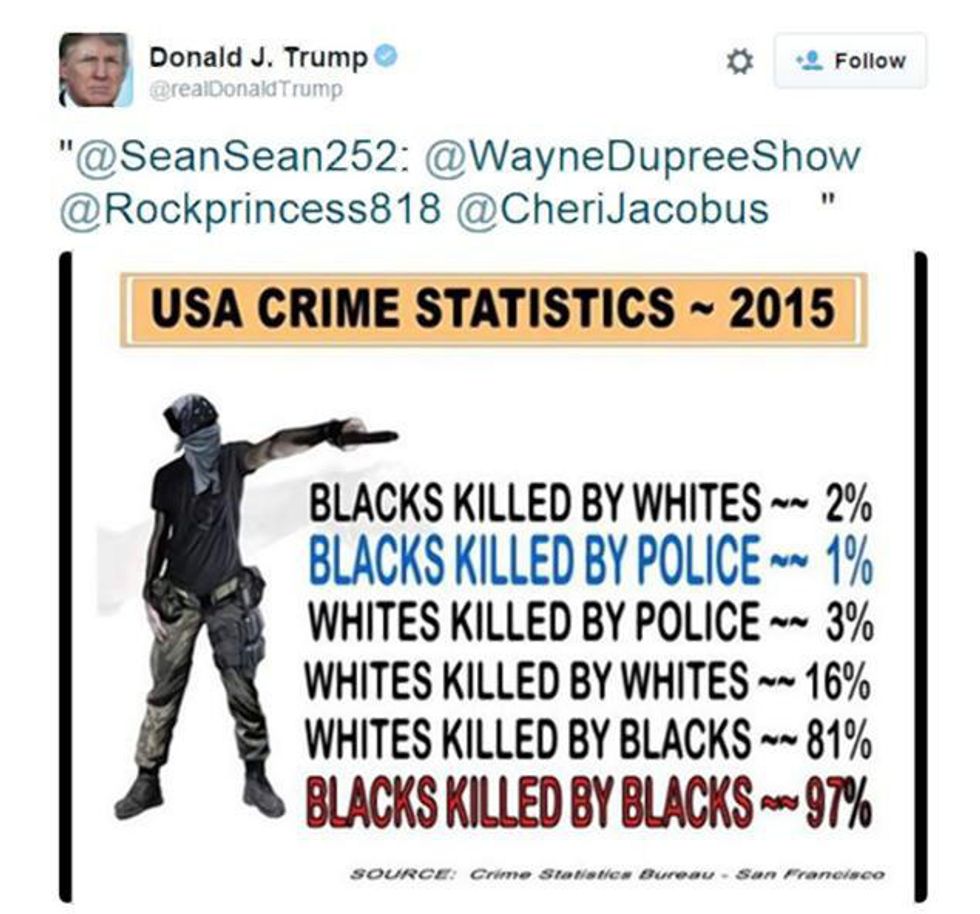
This racially charged post was soundly disproved, but it proved a point: even presidential candidates share falsified data and questionable sources. The paradigm shift from local news to ‘meme news’ isn’t a good one. There’s a comedic place for poorly edited graphics, but political memes such as these spread lies and malfeasance. Memes are not the only plaguing constituent on Facebook and Twitter. Articles, written by anyone, can gain traction and attention, but at a cost to the community. Oftentimes falling into the category of ‘clickbait,’ these writings often have little content and draw their readers in with titles that are oriented towards gathering a click rather than describing the article they represent. Take for example, the group I write for, TheOdysseyOnline.
I have written for the Odyssey for six weeks. There is an article due every Friday night and we are mandated to share it on at least two platforms when it is published. The sharing platform markets itself as a voice for millennials, but its true intentions are made clear by its marketing strategy. The Odyssey knows that clicks, not content, earn revenue, and therefore makes its purpose to garner as many clicks as possible. In my six week internship, I have never been given any guidance on how to improve my writing. The only advice I’ve been given is via e–mail, and those exclusively discuss how to make my articles receive more clicks, not become a better writer. A payment of $20 is given to the most shared article of the week. There are currently 19 writers at my university, so it’s a measly carrot and unlikely reward for many of my peers.
TheOdysseyOnline can contain some phenomenal writing. But the credit should be borne to the student, not the website. The sharing platform itself relies on economic utilization of social media to spread its splurge of click-bait listicles. The dissemination of these articles dilutes the Facebook/Twitter media stream with weak, ineffectual writing that could be far better were it from a valid news company. (The Odyssey isn’t the only one with this sharing based style). The blame does not fall upon the writer, but it is the journalistic responsibility of the employer to produce content that is meaningful, well written and important.
Market forces have driven attention away from our local communities and news providers. Our main news sources are monopolized, and our feeds are clogged with false statistics and clickbait content. It is up to us, the consumer, to give attention back to our local news stations, and support the community of journalists to whom we owe so much for years of virtuous work. Clickbait articles and memes are easy to read, but as economists say, “there is no such thing as a free lunch.” Our societal shift from local news to memes and non-challenging articles is a move that hurts our communities. It is a move that corrupts journalism. It is a move that must be stopped.

















