
David Tennant, a Scottish-born actor, is very well known for his iconic performance as the 10th incarnation of the Doctor in the hit BBC television series "Doctor Who." As of late, however, Tennant has co-starred in the Netflix Original series "Jessica Jones," based off the Marvel comics, as the villain Kilgrave. Because of this new role, "Doctor Who" fans have been comparing the hero and the villain in two major aspects: manipulation and holding hostages.
In "Doctor Who," the Doctor, who is a double-hearted alien called a Time Lord, goes throughout time and space in his ship called the TARDIS. The Doctor goes around saving the Earth as well as many other planets from impending doom, armed with his sonic screwdriver and his psychic paper that allows him to get him anywhere he needs. With the Doctor are his companions, who leave their normal lives behind to travel with and help on his quests to save and restore history as we know it.
In "Jessica Jones," Kilgrave is fully human with "special abilities." Though in the show Jessica Jones herself (played by Krysten Ritter) notes her own special abilities as being "gifted," Kilgrave is anything but. With the power to manipulate anyone by saying a simple command, he goes rampant in New York City temporarily taking over the minds of those who are close to Jessica, and those who are totally innocent bystanders. If and when Kilgrave finds someone worthless to him, he stages their murders by telling them to commit suicide. This is also something he does out of anger, considering he had his mother kill herself about three feet in front of him. He does all of this because of his love (read: obsession and fascination) for Jessica.
So, how do the two characters compare?
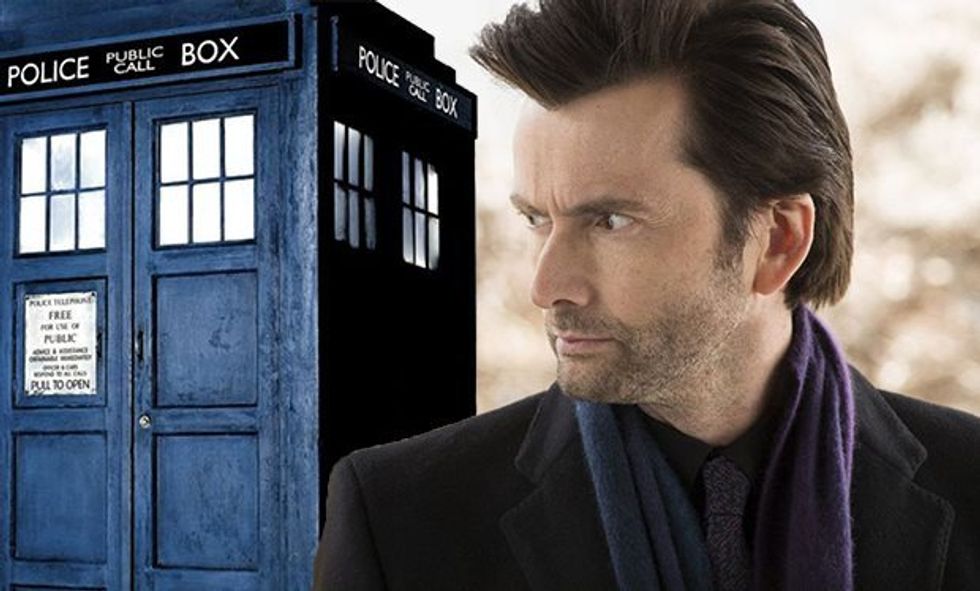
While it was noticeable that Tennant's new character again wore a suit and spoke in the same tongue, their wardrobe and appearance is something lighter that can be compared. In "Doctor Who," Tennant was recognizable by his messy hair, clean-shaven face, as well as his stylish suits, accented by his Converse sneakers. In "Jessica Jones," Tennant is again put in a suit, possibly better than the Doctor's. His hair is also slicked back, with added stubble for an edgy look. The comics depict Kilgrave as a purple man, while in the series he is a Caucasian Englishman who wears a lot of purple.


(Top: Tennant as the 10th Doctor. Botoom: Tennant as Kilgrave.)
On a darker side of things, there's the manipulation factor. While Kilgrave's manipulation is extremely obvious, the Doctor's may be overlooked. He has his psychic paper, which tricks people into thinking he's something he's not. Though he still saves the day at the end of each episode, he uses his paper as false credentials to gain information. The Doctor even goes as far as to manipulate his companions in such a way that in most cases, they have to put blind trust in him while he leaves them in dangerous, life-threatening positions.
In addition to the manipulation are the hostage situations. It's a pretty far stretch to say that the Doctor actually kept hostages. His companions were nothing more than what they were: companions. They had the option of staying or leaving whenever they pleased. In fact, there are some instances where the Doctor even attempts to push them away from him. He would taunt them, saying that he never should have brought them or that he would have been better off alone. In a later season, he even admits to one of his companions that he keeps them for his own vanity -- that he really just needs someone to show off for. These companions would then argue with him, saying that he does need them there with him. A common trait in all of his companions is that they are stubborn -- which makes it even harder for them to leave, either when they want to, or when they know they should go. That, in turn, keeps them with him because they feel care about him and feel guilty. The companions always tell him to never be alone so that he would stay grounded and wouldn't go overboard or fall into an evil way of thinking. Because of that, it isn't often that viewers see the Doctor on his own.
Kilgrave, on the other hand, already in that evil way of thinking, uses the people that Jessica Jones cares about against her. In multiple episodes she is left to decide whether she wants to do something for her own accord or help those around her. Kilgrave is always careful to have his own mentally kept hostages near him at all times to help him, entertain him, and do his dirty work.
David Tennant went from being the quirky, adventure-seeking Doctor to the dark, cunning Kilgrave. Though both characters may share similar personality traits, at the end of the day the Doctor is just what he is: the Doctor, the hero, the healer. Kilgrave, however, is the potential poster child for what a villain should be. He has a deteriorating mental state with a contorted worldview, endless plans, a twisted motive, and all the resources he needs. Tennant "made the role," as many fans say. He made the character his own while still sticking to the original character from the 1960s that is the Doctor. It was a hard break when he left the show after five years for actor Matt Smith to take his place. As Kilgrave, Tennant does an amazing job turning an extremely complex character into someone who you want to be sympathetic towards. No matter what Kilgrave does to civilians, he throws in moments of pure emotion, making it hard to hate him.