*WARNING: Season Four of "Orange is the New Black" spoilers.*
At the end of season three, "Orange is the New Black" left us feeling hopeful. As the inmates frolicked in the lake there was a sense of happiness and peace. As I binged the fourth season, that sense of hope left. The series took a hard look at the many problems facing our prison systems and the result was devastating to our emotions.
Left with the cliffhanger that was Alex's fate, we come to find out that Lolly attacks the would-be hit man, saving Alex. They plan to come back and get rid of the body, but he isn't really dead. Alex ultimately has to kill him, and then with a little help, chops him up and buries the pieces in the garden. Remember the hope you had for Crazy Eyes and her potential love interest? Well by the end of episode one, that is crushed as well. Such a polar opposite in tone from last season, in one episode the show has made it very clear things are about to get bad. The prison is basically doubling in population as a result of being owned by a private corporation. I wish I could say the many themes and issues that present themselves in this 13-episodes season were real only in the realm of television, but it simply isn't the case.
As the season progresses we see the rise of racial tensions and a white supremacist group emerges. Sophia is kept in the SHU despite her pleading, the pleading of her family, and various other inmates trying to help her. Nicky comes back from max but gets back on drugs, then gets back off. The group who hid the body in the garden grow wary of Lolly and her inability to keep the secret. Caputo gets a girlfriend who works for MCC. Healy understands Lolly and her delusions and saves her from psych. He also convinces her that the murder was a delusion. Judy king, a famous cook and TV personality, is incarcerated, but she is definitely not experiencing prison like everyone else. Aleida gets out early but realizes how hard it is to pick up the pieces of life after prison. Dogget is constantly forced to interact with her rapist, and boy does that hurt my heart.
The prison runs out of maxi pads and tampons and acts like those are luxury items. The panty business gets shut down amid racially motivated strip searches. Piper accidentally starts a white supremacy group and gets branded with a swastika, which she later turns into a window. Because honestly, who wants a swastika on their arm (besides white supremacists and nazis)?
Brooke and Poussey become a couple and we learn a lot about Poussey in the process. Taystee is Caputo's assistant and is actually quite good at it. Judy King is accused of being racist after a pretty racist puppet show she filmed in the '80s surfaces. Ultimately, they rectify this by taking a picture of Judy kissing Cindy and selling it to the paparazzi. We hear about Lolly's backstory and how her mental illness ended in her incarceration, but really she did nothing wrong. Lolly attempts to build a time machine so she can go back to when things weren't messed up. He kinda apologizes, but won't even say the word rape.
Drugs are being dealt from the salon and Daya ends up hanging out in there after her mom leaves. We find out Caputo's girlfriend has never visited a prison and only knows about them from television and movies. The guards start abusing their power and use creative punishments. One guard holds a gun to Maritza's head and makes her eat a live baby mouse. The body in the garden is found and Lolly is sent to Psych, Healy kind of loses his mind and quits his job to live in a group home of sorts. A few guards question the tactics of the others but they don't do much.
We find out how Crazy Eyes ended up in jail and it breaks my heart, she didn't even know what she was doing. The guards force Crazy Eyes and Kukudio to fight gladiator style for entertainment. The prisoners protest at the horrible treatment by the guards and Poussey, sweet Poussey, ends up dead. The body then sits on the floor for over a day while the corporation tries to find who to direct blame at so they look good. Caputo blames it on her, when it clearly wasn't her fault. The prisoners are angry and riot in response. We end with Daya holding a gun to a guards head.
Of course the events of the season aren't just a random list of events, they all contribute to the major themes and problems we see in society.
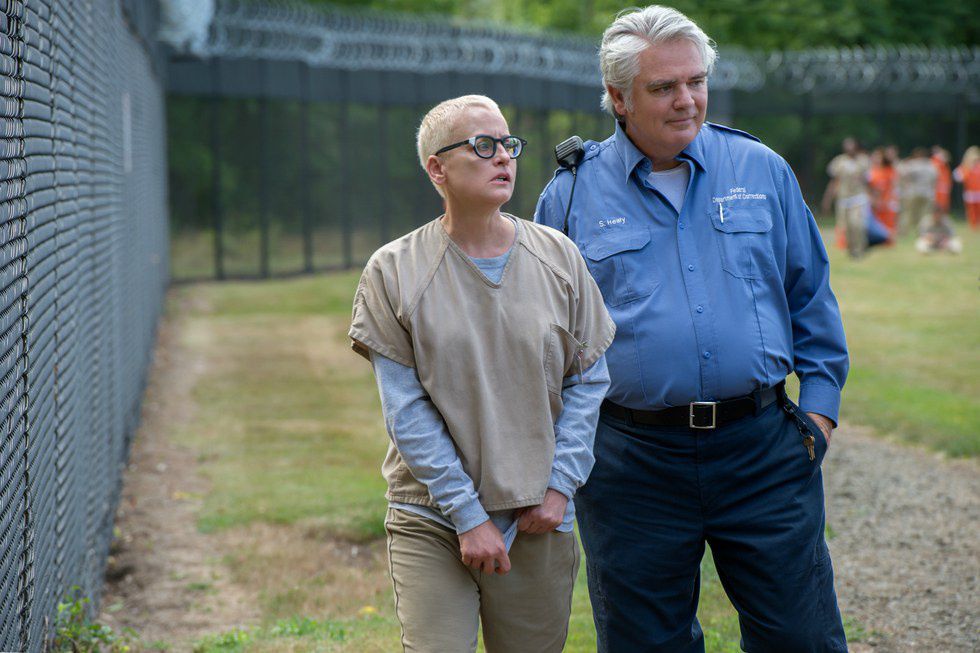
First off, mental health. The theme of those with mental illness being pushed to the fringes of society and then missing the help they need is abundant. Lolly's backstory shows how her conspiracy theories lead to her losing her job and living on the street. She sells coffee and is loved by the community, that is until a building is built in the lot where she lived. She kept away the voices, which she recognized as crazy, by shaking a stick with bells on it. When she breaks a wheel on her cart, the cops accuse her of loitering. She shakes her stick to get rid of the voices, but they believe it is a weapon and arrest her. Crazy eyes ends up incarcerated when she tries to make friends. She inadvertently kidnaps a child who falls off her fire escape when he tries to escape.
In both cases we see women betrayed by their own minds. In the case of Crazy Eyes, it is clear that she did the things she is locked up for, but it is hard to make the case that she meant for any of it to happen. She didn't realize it was a problem and only had the best of intentions. What she needed was help, not prison. For Lolly, it is hard to make the case that she really did anything wrong. Sure she does kill a man, but only to stop him killing someone else. She should never have been locked up, she should have received treatment. Locking up our mentally ill to rot away doesn't solve the problem, it isn't a substitution for treatment.
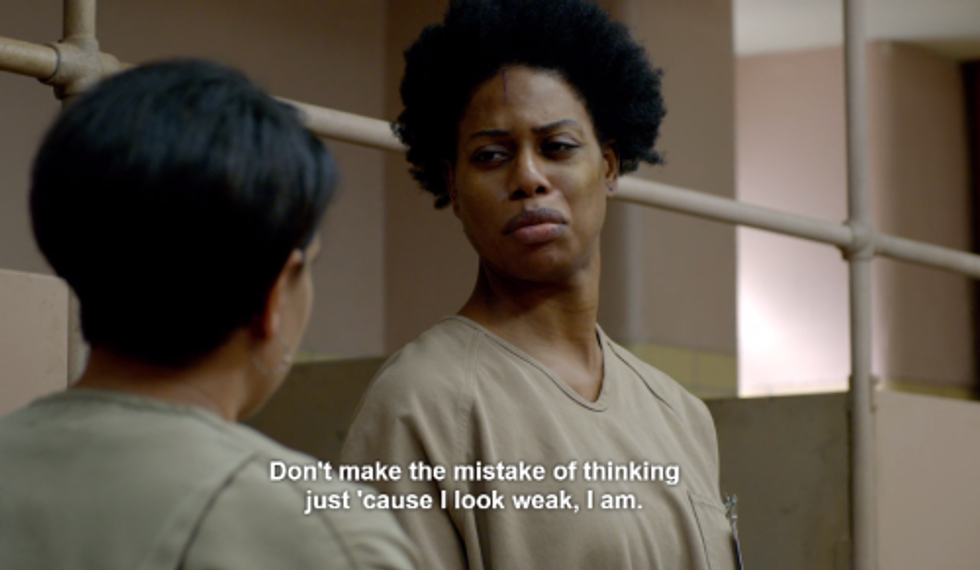
On the front of solitary confinement we have Sophia. Sophia spends most of the season in the SHU, much to the dismay of her family. They were not even notified she was in there and were denied requests for information. Sadly, this is the reality of America's Supermax prisons. Prisoners are often denied visitation and their confinement is likely not facing much oversight. Solitude shouldn't be some unregulated punishment with little oversight and no define end, but that is the reality of the situation. Seeing it in such human terms makes it hard to ignore.
"Orange is the New Black" also confronts the important and difficult topic of rape. In the last season we saw Dogget raped by a guard she considered a friend. Watching her forced to exist in such proximity to her rapist makes my heart hurt. She embodies the countless victims in the world who are unable to report their rape for whatever reason. In her situation, the power dynamic and lack of proof would not bode well for her. She eventually confronts her rapist about it. His response is the literal embodiment of rape culture. He says "But I love you. I told you that. And I said it when … When. I said it. So that makes it different." However, the show makes it very clear that him saying I love you doesn't make it different.
Through exploring the emotional trauma of this rape, they show the true reality of the situation. It isn't something to just be thrown in as a plot advancement and then forgotten, as is the case in so many other shows. The show sort of tries to hint that he has changed along side hints that Pennsatuckey may be forgiving him, but even after the apology he still has not changed. By showing her visibly uncomfortable later in the season it makes it very clear that some wounds cut deep and aren't easily forgotten. Despite Pennsatuckey's past or anything she has done, the show never indicates that she is to blame. In a culture that seems to constantly blame the victim for their rape, it is refreshing to see a show fly in the face of this notion.
The need for rehabilitation is also underscored in the fourth season. With the new influx of inmates, many are without jobs. Prison for the first three seasons was surprisingly peaceful, well at least there weren't any riots. With the combination of increased free time and twice as many prisoners, trouble seems to manifest in every episode. Not only is the lack of jobs or education/training detrimental while incarcerated, but we see the problem when Aleida faces her coming release. She has no real skills other than painting nails. Even then, it wasn't like her time in prison taught her to do nails. For many other inmates there are not job opportunities once released. Sure, some of this has to do with the fact that these people have criminal records, but a lot has to do with the fact that they have gained no skills while incarcerated. it is easy to see how someone can fall back into crime when faced with little opportunity. Aleida ends up living with the girl her now-incarcerated ex cheated on her with. We don't know what her ultimate fate will be, but given the way the season ended it doesn't look as hopeful as it should.
The crazy cliffhanger that is season four shows how easily someone can fall into bad activities. In her quest to be accepted, Daya finds herself in the midst of a drug ring. Ruiz doesn't have many qualms about violence and it rubs off on Daya. Much like how youth can be brought into gangs and end up doing things they never thought of doing, Daya finds herself holding a gun to a guards head. We don't know how this will ultimately end, but needless to say it will result in some serious punishment for her. I hope she doesn't pull that trigger, but given the people she is now with, there is no way to predict the outcome.
The mere presence and treatment of Judy King shows the inequitable treatment of people in our justice system. People don't receive the same punishments based on factors like race or socio-economic status. While everyone else is overcrowded in doorless bunks, King lives in a spacious room with one other roommate. Her every desire is accommodated while others can't get basic necessities. She is a symbol, but an important one.
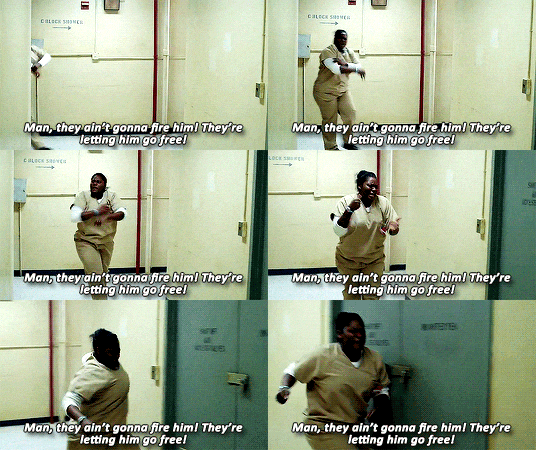
Poussey's death was one of the hardest to bear parts of the season. Seeing a lovable and genuinely kind character killed in such a horrible way was a hard pill to swallow. What was even worse though was how long she was left on the ground after her death. I think it goes to show the dangers of prioritizing profits over people. MCC cares far more about their own PR than the person who died. They show their lack of caring about employees as well as the seek to pin it on CO Bayley. Honestly, their entire takeover was a hot mess, but the treatment of Poussey really just took the cake in terms of horrendous.
As if right out of the Stanford Prison Experiment, the guards begin to abuse their power in this season. Whether using humiliating punishments, preventing prisoners from exercising basic human rights, using guns to force them to do things, or forcing gladiator style fights, the guards were out of hand. Even those who saw problems in this system either did not step up to stop it or were shut down when they did. It highlights an underlying problem we see in situations with an imbalance of power. That power is exploited to hurt and keep down others.
Season four of "Orange is the New Black" may not have been as lighthearted and hopeful as season three, but the themes needed to be addressed. Although my heart hurts at the events that transpired, it is important to evaluate these important issues.