

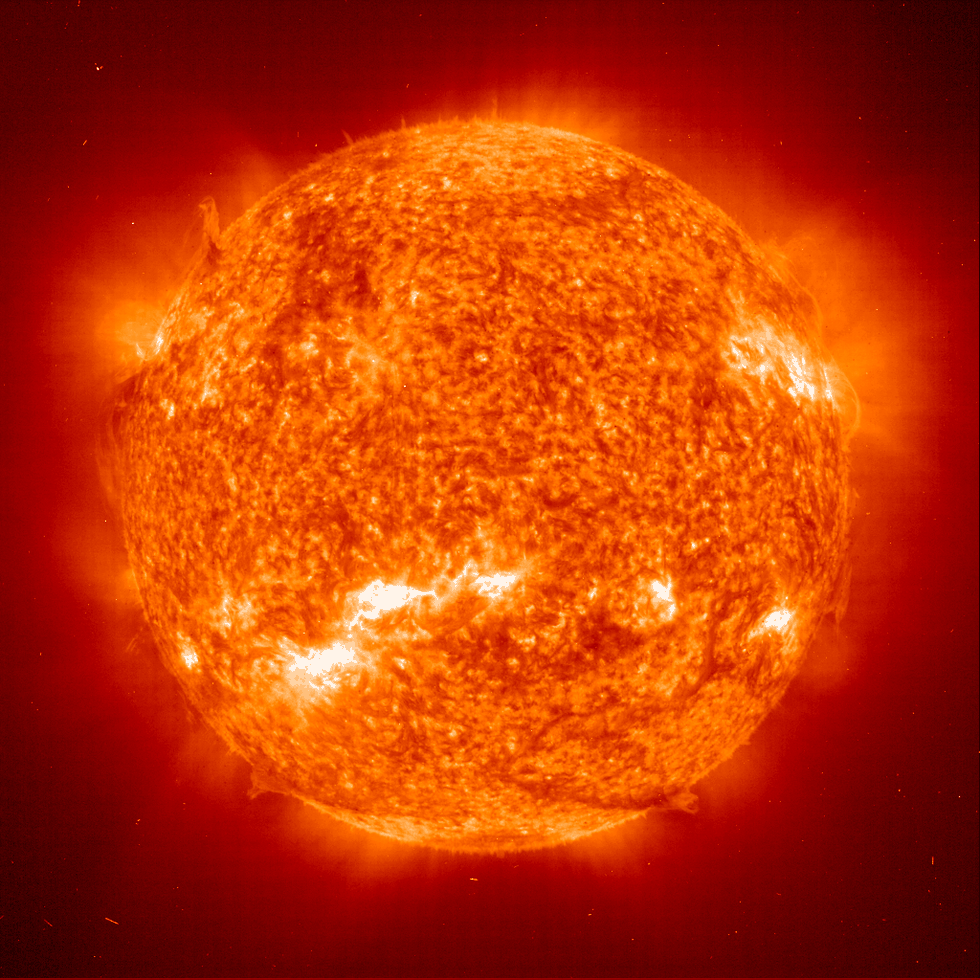
The stage of the night sky invites Earth to a very familiar scene of darkness, punctuated with little bright dots called stars. Our galaxy, the Milky Way, has more than one hundred billion of them, and each of these balls of plasma is a sophisticated wonder of nature. Some stars are yellow like the Sun, red and a bit cooler, or blue and extremely hot. Some stars are huge, encompassing nearly the orbit of Saturn, but some are very small, barely much larger than Jupiter. Many of them even have planetary systems around them, but what exactly is a star? How do they form? And what do they do throughout their lifetimes? In the first part of our close look at stars, we’ll explore how stars form from giant gas clouds and how they live and evolve through their lifetimes.
Gaseous Collapse
No, I'm not talking about what I experience after I go to Taco Bell. Let's get serious. Galaxies have very unique shapes and structures. Spiral galaxies like the Milky Way have very defined spiral regions that are composed of molecular gases and interstellar dust, the perfect ingredients in the perfect place for stars to form. Over millions of years, giant, local clusters of molecular hydrogen, a few other elements, and dust start to shrink, a consequence of gravity's ability to overcome the pressure forces of the gas. This process converts gravitational potential energy into kinetic energy and slowly heats up the material. This continues until the collection of material gets significantly smaller, but also hot enough to start emitting radiation, when it enters the protostar phase (also known as a pre-main sequence star a little later on).
A protostar is huge compared to the star it will later become, but much cooler. As the protostar shrinks and continues to heat up, its core becomes hot enough to produce its own energy in order to halt its collapse, and now we're really cookin'.
Ignition
With all of these different names being thrown around (protostar, pre-main sequence star), we have to draw the line somewhere. A "star" is truly born when hydrogen fusion starts in its core; after the core conditions have become so hot and so dense that not even electromagnetism can keep atoms apart.
Hydrogen is the lightest and most abundant element in the universe and makes up nearly 90 percent of the composition of all stars. Ionized hydrogen, its most abundant (if not only) form inside a star, is just a simple proton. The core of a star has an unfathomably great number of hydrogen ions colliding at tremendous speeds, and by virtue of their kinetic energy and with a little help from quantum mechanics, billions of these two-hydrogen collisions (per second, of course) produce a single helium ion. Helium is a bit lighter than two hydrogen nuclei, so the leftover mass is given off as energy (think E=mc2
) in the form of a gamma ray.As a cool side-note: It takes roughly 100,000 years for a photon that was created at the core of the Sun to reach the surface, and then just 8.3 minutes to get to Earth! The photon sheds off energy while it undergoes what astrophysicists call the "random walk," a zig-zagging path through numerous absorptions and re-emissions, and breaks the solar surface as a visible photon.
These gamma rays push back mechanically against all of the surrounding material and establish a balance between gravity (acting inwards), and energy production (acting outwards), called hydrostatic equilibrium, the first stable state for a star. This point marks the beginning of a star's Main Sequence lifetime, which can last a very, very long time.
In Their Prime
The Main Sequence is the period of time in which a star only fuses hydrogen into helium, and no other fusion reactions occur. Our Sun is about 4.6 billion years old, and has about 5.4 billion to go in its Main Sequence lifetime, but there are stars that will live much longer, and also those that will spend very little time on the Main Sequence. Giant stars, above 10 times the mass of the Sun, may only spend a few million years on the main sequence, but dwarf stars with masses around 10 percent of the Sun may spend nearly 10 trillion years on the Main Sequence! These dwarf stars aren't very big and they aren't especially bright, but they will outlive humanity's likely lifetime a billion times over. But for average stars like the Sun and giant stars like Mu Cephei and VY Canis Majoris, the Main Sequence days don't last forever.
Eventually all stars run out of hydrogen in their cores, and have to resort to new means of energy generation to stay alive. Stars will burn through helium, carbon, and even Iron in an effort to stay stable, but as we'll find out in the second part of this series, gravity always wins.