My first word as a baby was “daddy,” and because of the drastic changes in the meaning of this word, it makes me cringe to admit that.
The word "daddy" is derived from “dad” meaning one’s father. “Dad” transitioned into “daddy” by adding the suffix “y,” and thus caused a plethora of new definitions, mainly sexual. “Daddy” came into the English vocabulary in 1523, at the beginning of the modern English time period. The exact origin of the word “daddy” is unknown, though, but specifically, it is claimed that the origin of the word may have come from baby talk. The forms “dada” and “tata,” meaning “father,” originated from childish speech. So maybe children are the geniuses behind the invention of the word “daddy,” which is a scary thought if you ask me.
All throughout the 19th century, the term “daddy” was used in the same context, referring to one as 'father.' In 1912, “daddy” was primarily used among the African American population in reference to a woman’s male lover, usually as a form of address. This is where we start to see the change in meaning happen with the term “daddy,” in which it becomes more sexualized. For instance, someone might say, “here comes my daddy” when referring to their husband; however weird that may be to us, it was a common term dating back to the early 1900s.
Extenuating the sexual connotations of “daddy” comes another definition from the 1930s, and this one was a surprise, to say the least. According to the Oxford English Dictionary, “daddy” was considered prison slang for a man who took an active or dominant role in a homosexual relationship, especially one that provided physical protection to a typically younger and more vulnerable inmate. It is plausible that one inmate would refer to his dominant counterpart as “daddy,” and he would act as the younger, more vulnerable one's protector.
Taking a break from the sexual connotations, “daddy” can also be used as a term of measurement, such as the best, worst, largest, oldest, or of the most importance in a situation. This term dates back to the mid 1900s and is a pretty standard definition, even though we may not hear it being spoken in daily conversation. “That St. Bernard puppy is the daddy of all puppies” could be used as an example, meaning that a certain St. Bernard puppy is the best of all the puppies in the litter (but I am not so sure "puppies" and "daddies" should go together in the same sentence). So, if you ever want to put a lot of emphasis on one singular object, make sure to call it the “daddy” of all [insert odd class of objects here] so people can truly understand just how important your topic is. Give it a try. I dare you.
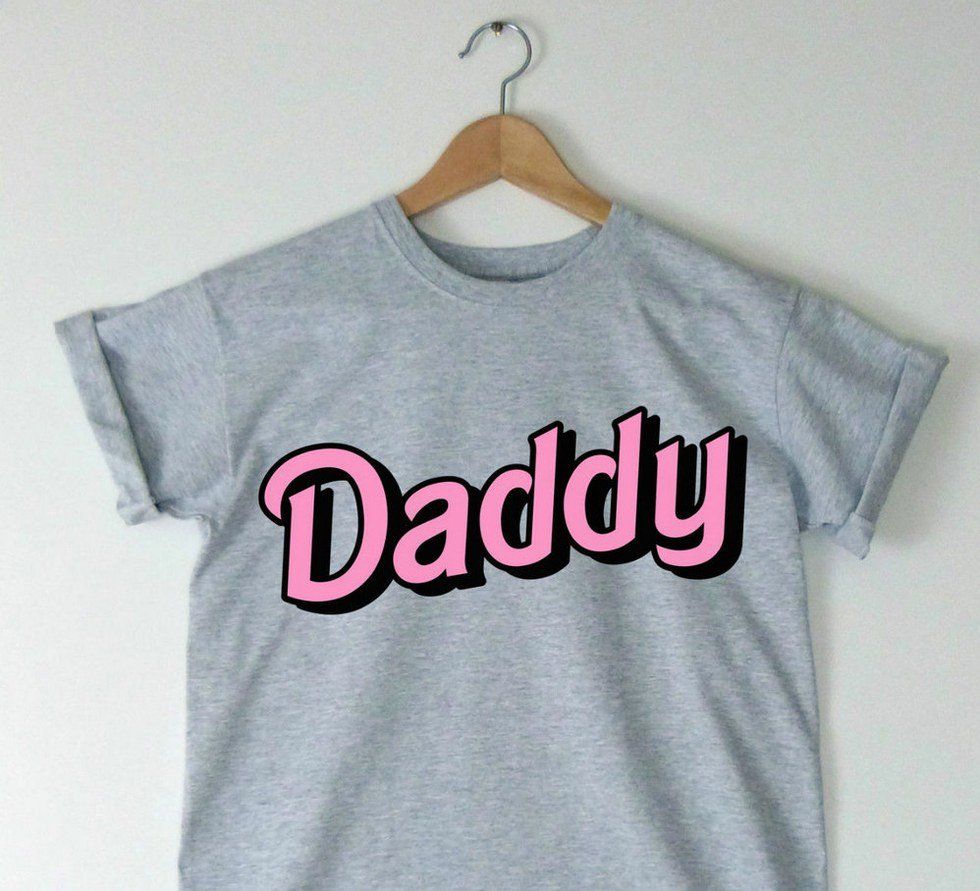
Fast forward to the 21st century, where millennials now control the basic vocabulary that we as humans use to communicate with others. “Daddy,” to millennials, is a term for a girl's boyfriend or husband who takes care of her, looks out for her -- it's basically a term of endearment that should be used for a man during sexual encounters. There are times when I will hear someone refer to their husband, boyfriend, or fiancé as "daddy," obviously blind to the negative connotation (or maybe not), and I can't help but cringe. Leave it to us fragile, emotional millennials to take the word “daddy,” meaning one's father, and turn it into something sexual. I mean, come on, guys. There's even apparel you can buy that says "daddy" on it. What have we done?
To this day, I have no idea why the term “daddy” appeals to those who use it, but be forewarned: The excessive use of “daddy” in its arbitrary sexual context may be the reason the word becomes a part of casual conversation. To anyone who uses this word in its sexual context, please spare me and everyone else that awful cringing feeling we innately get once we hear this word. It is not fun, and it is most definitely not “what the cool kids do.” So please stop sexualizing childhood. It's weird... And sad.