The amount of Americans moving and traveling abroad continues to increase each year. With the increasing numbers, it's a surprise how few are aware of culture shock.
The first time Justin Damask arrived in a foreign country he was completely surprised. "I was stunned," Damask says, "Buildings I encountered in Rome were up to 2,000 years old. Walking through them showed the contribution of hundreds of generations, resulting in a collage of the human history shared by all those in the Western world." This was one of the many ways that Damask experienced culture shock.
Culture shock is the feeling of disorientation in a unfamiliar cultural environment. That's the basic definition, but it's so much more. Not only does it affect a person's emotional state, but also their physical state. It can involve a range of different emotions and feelings for each individual, and physical symptoms that greatly affect how one normally functions. It can be something as simple as being in awe at how old everything is in Europe compared to the United States, to something bigger such as not being able to sleep and eating meals at abnormal times.
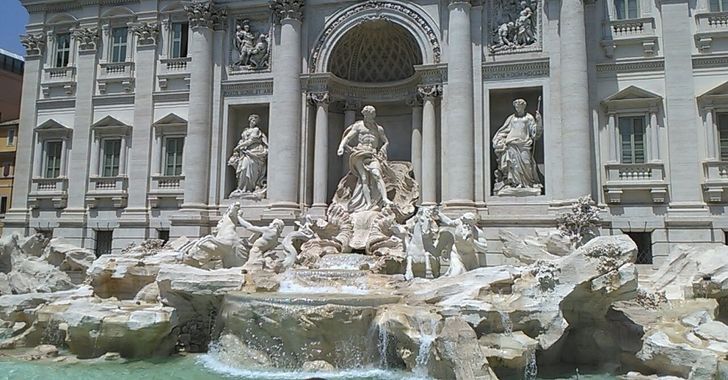 Trevi Fountain, Rome, Italy by Elle Johnson
Justin Damask, 22, is a college student at the University of Dallas. This past summer he went on a trip with some friends to Italy. It was his first time ever being out of the country, and, like many people, he wasn't prepared for the cultural shock.
It was previously mentioned that Damask was astonished by the old buildings, but he also experienced another much more common form of culture shock. He couldn't understand the Italian language. "It was frustrating not being able to communicate with the people I met," Damask said. He continued to say that his frustration led him to want to be able to speak many languages, starting with mastering his Spanish.
While ancient buildings and unknown languages are some things that shocked Justin Damask during his trip to Italy, when Jeffrey Corron arrived in the United States for the first time, he was shocked by something completely different.
Jeffrey Corron, 21, is studying at the University of South Carolina and he first moved to the United States at the beginning of high school. He had lived in Yokohama, Japan, the second largest city in the country, until he moved to Greenville, South Carolina, which is a much more suburban area compared to Yokohama. The first noticeable difference for him was that he needed a car to get around Greenville. This was the hardest part, what Corron called a cultural shock, especially since he could not drive when he first arrived in the United States. In Yokohama everything was very close together. Corron could reach grocery stores, the bank, drug stores, almost anything just by walking less the ten minutes from his house. He even said, "The beach was a 45 minute train ride away, and to go to the movies I literally had to go across the street." That was not the case in Greenville. "Somewhere like Greenville the movies is probably like a 20 minute car ride, and the beach is like a four hour car ride," Corron said.
Another shock for Corron was the racial diversity in the United States. "The U.S. is a melting pot compared to Japan where everyone is mostly Japanese," Corron said. He continued to say that there is some racial diversity in Japan, but not nearly as much as there is in the United States. This is also something that Damask noticed while he was in Italy. Most Italians were Caucasian Italians. There is some racial diversity, just like in Japan, but again not nearly as much as there is in the United States.