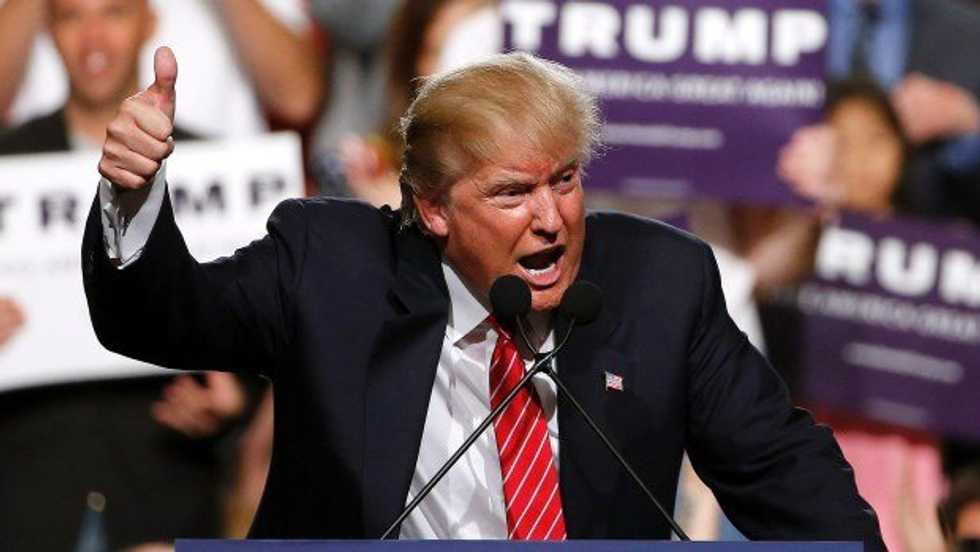
“‘This Will Be The End Of Trump’s Campaign,’ Says Increasingly Nervous Man For Seventh Time This Year” read the headline of an article posted on The Onion earlier this month. Satire though it was, like all good satire it was based on a contemporary reality: the sudden rise and apparent invulnerability of Donald Trump’s campaign are perplexing to political analysts of various affiliations and degrees of inclusion in the world of American politics. While this might be an excusable reaction from independent bloggers and Facebook commenters to the insurgent Republican’s watertight candidacy in light of repeated examples of his self-assured bigotry, it is somewhat disingenuous when it comes from the Republican establishment itself.
This is, after all, the same establishment that for decades has traded on the material and societal insecurities of the white, male, Evangelical working class by portraying itself as the defender of traditional American values. From the thinly-veiled racism of the Southern Strategy to the slightly-less-thinly-veiled racism, sexism and xenophobia of today’s political discourse, the GOP’s approach to electoral politics was and remains the encouraging of their favored demographic to come out to the polls as an act of patriotic defense against the evils of progressivism, secularism and multiculturalism. And while it’s true that no previous Republican candidate or politician from recent memory has been as brazenly vitriolic as Trump, the nationalism, xenophobia, toxic masculinity and overt racism that he’s demonstrated throughout his campaign are popular with the Republican right precisely because they’ve been primed to hate all of the things Trump rails against — it’s just that the people who did the priming had political sensibilities which prompted them to weave their reactionary ideology into appeals to revisionist history, patriotism, free market economics, American exceptionalism, and so on.
And so when Trump says that a majority of Mexican immigrants are rapists and murderers or that mosques should be closed and Muslims barred from entering country, or makes a sexist or ableist joke at a rally, or is unable to differentiate between his proposed policies towards Muslims and those of Nazi Germany towards Jews when asked to do so by a journalist, why should we be surprised that he gains followers from among those on the right who feel disenfranchised and disillusioned by both the Obama administration and their own moderate Republican representatives? These are people who for years have been told by talk radio, Tea Party politicians and some cable news outlets that their livelihoods, lifestyles and very lives were being jeopardized by immigrants, Islamic terrorists, LGBTQ-identifying people, socialists, or whomever the scapegoat of the week happened to be. Condemnations from the rest of the media and society are viewed by Trump supporters as accolades, since they’re largely the same criticisms that’ve been hurled at the supporters themselves for years due to their holding what they’ve been taught to view as common sense and good, old fashioned American ideals. By all accounts Trump is deploying the same approach that’s become expected of the GOP, but is doing so without pretense or the veneer of respectability that had thus far hidden its ugliness from superficial examination.
There’s a word for this brand of shallow, divisive rhetoric, utilized by charismatic public figures to galvanize masses of alienated people against their fellow citizens along socially convenient lines in a grotesque parody of populism: demagoguery. Demagogues are nothing new, and have been the bane of democratic societies from Classical Antiquity to the present day due to their virtual usurpation of the electoral system as they manipulate the materially and ideologically vulnerable to act against their interests and against their nature with promises of law, order and national restoration. And while their supporters eventually suffer for their abandonment of civil society in favor of a familiar, empowering political barbarism, they only do so after tremendous damage has been done not only to the state’s political institutions and legitimacy, but also to those marginalized people whose persecution fueled the demagogue’s initial rise.
When fascism spread throughout Europe in the early 20th century, it often co-opted both conservative mainstays like religious institutions, the patriarchy, and nationalistic sentiment and thitherto leftist tropes like populism, mass action, and grassroots organizing. To quote Sinclair Lewis’ play, “It Can’t Happen Here,” “the worst Fascists were they who disowned the word ‘Fascism’ and preached enslavement to capitalism under the style of Constitutional and Traditional Native [read: W.A.S.P., not indigenous] American Liberty.” The campaign of Donald Trump bears all the hallmarks of a fascist movement: it is exclusionary, supports established hierarchies, is uneasily comfortable with violence (both at the policy level and in a more immediate sense, as when he intimated approval of the supporters who beat up a protestor at one of his rallies), and is bombastic in its blithe jingoism … all while continuing to endorse democracy and actively appeal to “the people”. And though his rivals in the upcoming GOP primaries, particularly former Florida governor Jeb Bush, are starting to more consistently denounce his greater excesses, they—and the rest of their party’s leadership and auxiliaries in the media—ultimately cannot critique Trump without necessarily critiquing their own stewardship of the Republican Party as well. As to do so would have them ridiculed out of office in our current political climate, however, this is unlikely to happen, and the seeds of fascism will continue to be quietly sown in America for leaders like Trump to reap.