
You may have clicked on the link to this article wondering to yourself, what is cultural appropriation? If you did, thank you for reading. The world needs more people like you who are willing to educate themselves on things that matter (because maybe I’m biased, but as pressing as Kylie Jenner’s latest cosmetic surgery must be, there are more important things to address first). Because cultural appropriation is not a term often used in casual conversation, it is commonly misunderstood by many who use it. So first, let’s start with the definition. Cultural appropriation is defined as “the adoption of elements of one culture by members of a different cultural group, especially if the adoption is of elements of a non-dominant culture by members of the dominant culture.” Basically, when someone adopts aspects of a culture that is not their own, that is cultural appropriation.
So. What’s the big deal about cultural appropriation?
I’m glad you asked.
The reason cultural appropriation is an issue is because it signifies an imbalance of power that still lies between minority cultures and today’s dominant cultures. It perpetuates centuries of oppression and racism, dis-empowers individuals that are already marginalized, and promotes cultural stereotypes.
For example, let’s say it’s Halloween. You’re more than psyched about your kick ass costume, because this year, you’re dressed as a geisha. You’ve covered your face with white powder, dabbed red lipstick on your lips and thrown chopsticks into your hair. Perfect, right? Until someone accuses you of being a cultural appropriator. To this accusation, you take immediate offense. You had no malicious intentions when picking out your costume, so how can this affect people negatively? You’re certainly not racist!
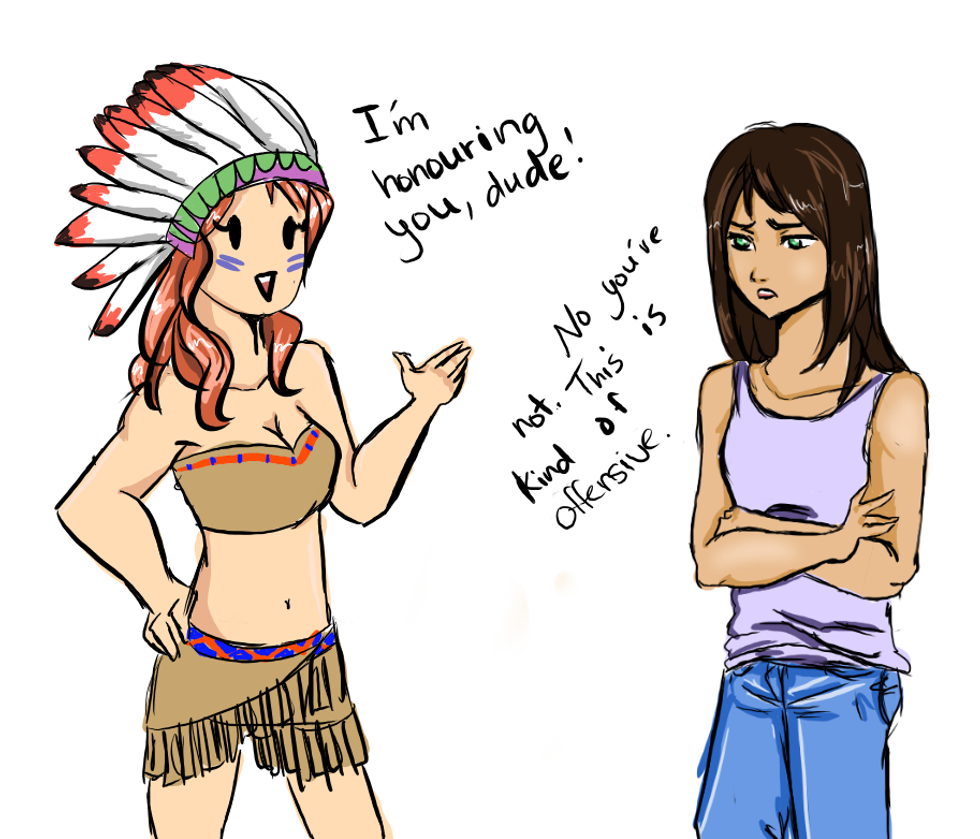
Racialicious writer Tamara Winfrey Harris notes, “A Japanese teen wearing a t-shirt emblazoned with the logo of a big American company is not the same as Madonna sporting a bindi as part of her latest reinvention. The difference is history and power. Colonization has made Western Anglo culture supreme–powerful and coveted. It is understood in its diversity and nuance as other cultures can only hope to be.”
Cultural appropriation is referring to a specific power dynamic in which individuals from a dominant culture claim ownership of elements from a culture of people who have faced systematic oppression by that dominant group.
There is no doubt that this is a complicated issue. But as we are a progressive society moving towards times of acceptance and growth, we must take our actions into account and behave in ways that eliminate oppression rather than perpetuate it.
Luckily, this does not mean there is no middle ground. A happy medium has been coined with the name cultural exchange. Cultural exchange is less of, “Here, take some of my culture while I help myself to yours,” and more of creating a mutual exchange between the two parties.
A lot of what it really comes down to is privilege. I am a white, cisgender woman. I know that in today’s society this makes me incredibly privileged (not that women don’t face discrimination as well, but that’s a whooooole other story). The fact that I can put on a bindi and a sari, wear it to a party to feel “ethnic” and “exotic” and then return back to my everyday life and be taken seriously is a sign of my privilege. There’s no denying it’s tricky, but we must work to find the line between appropriation and appreciation. I can appreciate Indian culture, try on their clothes, and enjoy their food. But if I don’t take it seriously and treat it with the same respect I treat my own culture, my actions become demeaning and offensive. As a member of a dominant culture in my country, I must recognize that satisfying my personal need for self-expression by using another culture’s symbols is an abuse of my privilege.
To put it simply, marginalized cultures are not to be treated as costumes. They are not to be ridiculed or devalued for our own personal pleasure. It is a simple matter of respect.

Labeling someone’s behavior as cultural appropriation is not necessarily labeling that specific person as evil or insensitive. Nor does it mean that cultural exchange is impossible. There are certainly ways to partake in one another’s cultures without causing harm. In order for this to happen, as I mentioned before, there must be an element of mutual respect and understanding from both parties. There needs to be a principle of equality. It is our responsibility to not just notice but listen to members of marginalized cultures. We must become informed of the ways in which their cultures have been appropriated (and exploited) in order to act in a way that demonstrates our appreciation of them.
I know this is a lot to swallow, especially if this is your first time even reading the words “cultural appropriation.” But I don’t want you to leave this article wondering, “What have I gotten myself into?” Because although there are lots of technical components, the primary step towards ending cultural appropriation is to educate ourselves. It starts with you. It starts with creating awareness and sensitivity among your friends, your family, your neighbor with the mariachi costume that he faithfully pulls out every Cinco de Mayo. It means engaging in continual conversation about topics that may be foreign to you. The more we take the time to appreciate and understand one another, the closer we are to becoming a nation that can thrive without oppression.

















