


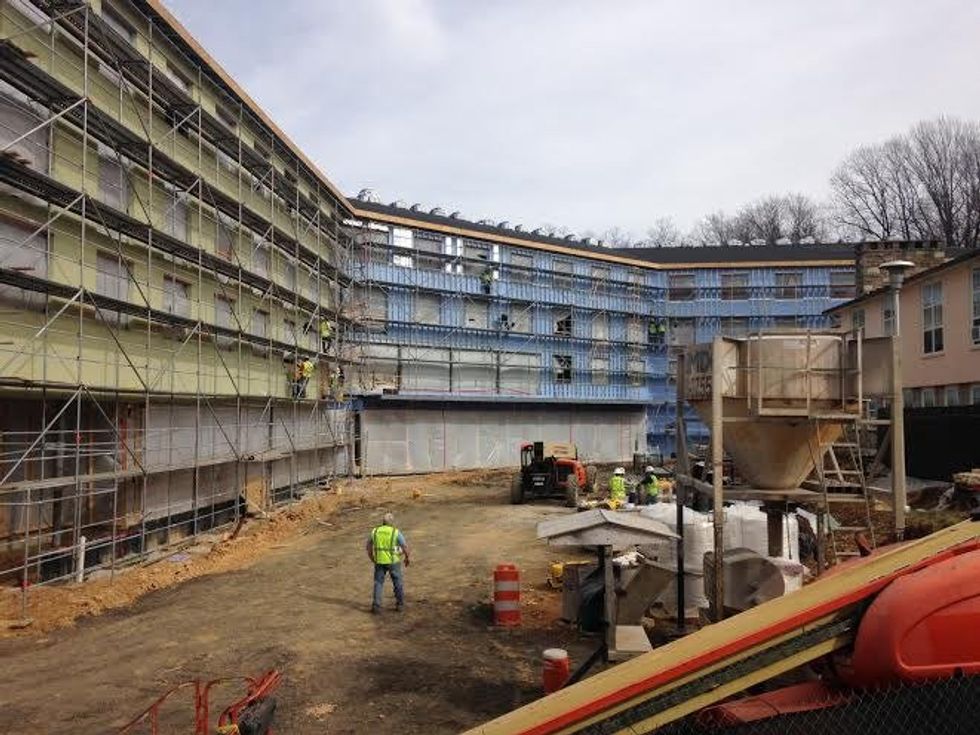
Goucher’s campus is transforming rapidly. Construction on a new freshman residence hall began in May of 2015 and will be completed by August of this summer. The building will house 185 beds and two apartments for faculty and staff. Unlike most dorms on campus, this residence hall will have a common room, kitchen, and study on every floor. As expected, the rooms are mostly doubles. This new residence hall is the first of three buildings that will soon be the new First Year Village. Its budget is $17.2 million.
While students attend classes, construction personnel work 40 to 50 hours a week, even coming in Saturdays to ensure the job gets done. The work is constant; construction continues through snow, rain and sun thanks to a dedicated team of laborers, foreman and engineers. Foreman Terrance McLane recalls a time when the site was covered in 29 inches of snow. The roof had not yet been constructed, and workers had to shovel snow from the top floor before they could continue to build.
The new building is constructed to withstand various types of severe weather. The foundation is built on a three-inch concrete deck, with a system of steel columns known as Hambro bars. Two vapor barriers of foam and plywood reinforce the building’s exterior. This unique covering provides protection from both the cold and heat.
The new residence hall will be rated LEED Silver, by the Leadership in Energy and Environmental Design. Out of 4 possible designations, LEED Silver is third from the top, after Gold and Platinum. Goucher College’s Project Manager Linda Barone explains the rating, writing, “Some of the environmental features include higher efficiency heating and air conditioning, low flow showers, sinks and toilets, locally sourced building materials and finishes . . . [and] energy efficient lighting.”
Constructing new buildings is a growing trend at public and private colleges across the country. While students’ enrollment and donations remain stagnant, colleges and universities are expanding their campuses at a dramatic rate. According to Moody's, “from 2000 to 2011 . . . the amount of cash, pledged gifts and investments that colleges maintain declined more than 40 percent.” Compared with colleges across the country, Goucher is heavily reliant on donations, receiving about 45 percent of its funds from alumni. Because of its Northeastern location, Goucher may find it difficult to increase enrollment even with new buildings. Andrew Martin of the New York Times reports that, “enrollment is flat or declining at many institutions, particularly in the Northeast and Midwest.”
With fewer funds and more expenses, colleges take on greater debt, which is eventually paid for by raising students’ tuition. Mount St. Mary's University, a small private college only an hour away from Goucher, had amassed $63 million in debt by 2012, the same year they started constructing a gift shop. School tuition is clearly affected by the university or college’s construction projects. Many college rating websites describe Mount St. Mary’s tuition as costly, with startclass.com calling it, “extremely expensive.” In 2011, Drexel University unveiled an integrated science building that contained the largest bio-wall in North American. Now $467 million in debt, Drexel’s net price of attendance is among the highest in the nation.
It is unclear why so many schools choose to spend money on construction. Perhaps school administrators think that if they build new dorms, students will automatically fill them. New buildings can give the impression of success and improvement which might attract students. Construction is particularly attractive to college presidents, as it feeds egos and secures legacy.
Many students and parents question whether money spent on construction could be put to better use elsewhere. Sarah Strohmeyer, whose son attends Bryn Mawr, comments, “Keep the carpet worn. Delay painting ... invest in the faculty, the library, labs and financial aid.”
This reporter was unable to discover whether Goucher College took loans to pay for construction. Increased tuition costs are due to a variety of reasons, and may not be related to construction. This article examines the trend of college construction across the country and how it may relate to Goucher.














