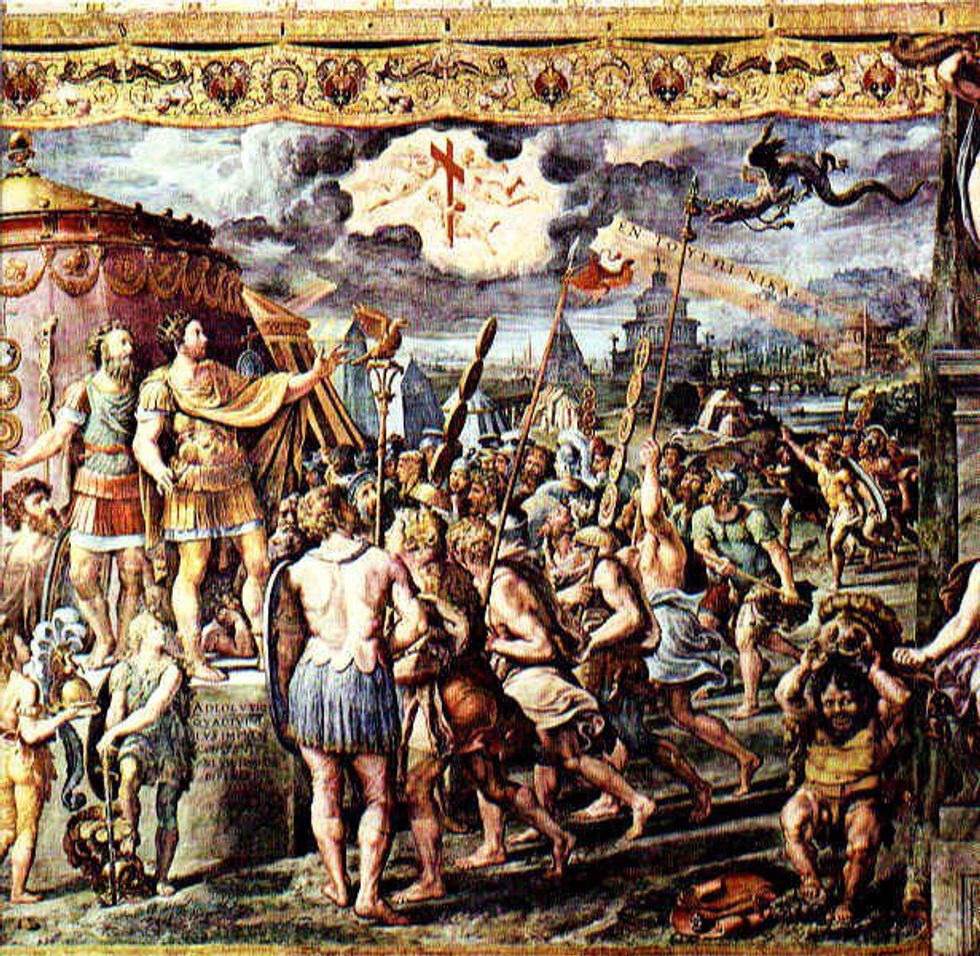
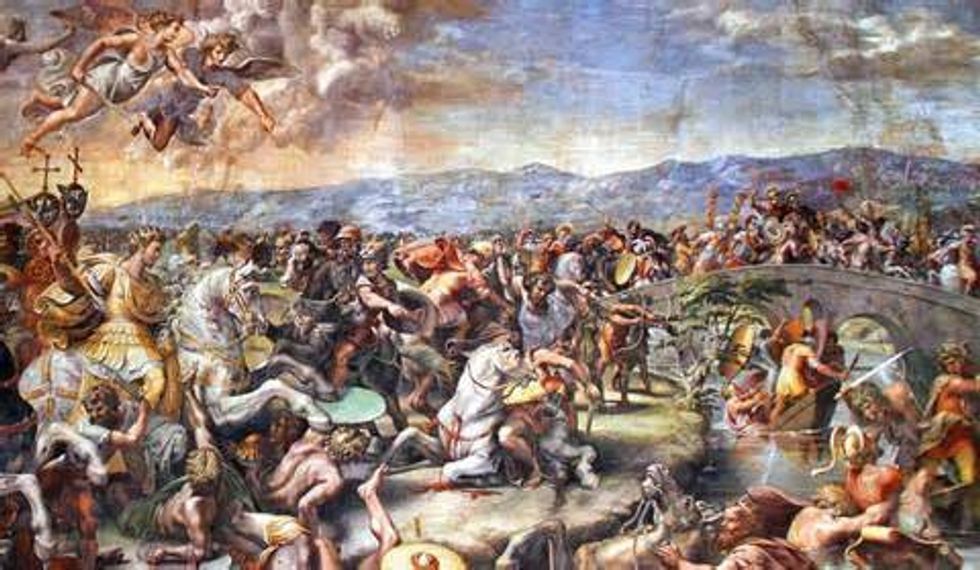
What Christian has never heard of Constantine's vision? I think just about every Christian has heard at least one version of the story within their lifetime. Nonetheless, the story begins at the battle of Milvian Bridge where two young men fight on an open field to reclaim the title of Emperor; a story as old as time. Constantine, before the battle, has a vision according to Eusebius who is Constantine's bibliographer, in which the story goes: In the heat of marching Constantine looks up to the sky and beholds the Chi-Ro (the original Christian cross) and hears a voice that states from this sign you shall conquer. So naturally, Constantine bears his men's shields and banners with the iconic symbol.
Or so the story goes, however in Eusebius' first account of the battle states that Constantine's own faith was enough to substantiate the victory, and yet in the later rendition Eusebius states the vision. It is Lactantius who writes the story first. I cannot express the difficulty of this predicament.
History shows us that Constantine was neither a believer nor a follower of Christ at the time of the battle.
That aside, Constantine wins the battle and among the thousands that are dead, his men discover Maxentius' body, having drowned, and now brought back to shore just to be beheaded by Constantine for good measure. Maxentius' head was then sent to Carthage as a deterrent of further aggression and rebellion, giving Constantine full control of the Western Empire.
The problem with this widely accepted story of the battle of Milvian bridge as having divine interference and, essentially, god given victory is that it is completely made up! Yes, I said this story, that Raphael creates on a massively beautiful fresco within the Vatican, is entirely a myth.
The story wasn't released to the public nor to his two bibliographers, Eusebius and Lactantius, until the council of Nicaea in 325 CE. Now let's look at Constantine's arch in Palatine Hill, Rome; the arch was constructed 3 years after the battle in 315 CE, which shows the shields of his men bearing the Chi-Ro. However, this is not true; nowhere on that arch is the Chi-Ro or any other form of cross for that matter. For such a vision to have changed the aptitude of the battle and Roman history, surely the man responsible would have depicted the reasoning for the victory, right?
It turns out the story is perhaps one of the best pieces of propaganda that has survived the ages. It is a great story, though, and I like the painting.