Video games are typically defined as a relaxation hobby. After a long day, one can boot up their gaming platform of choice and lose themselves in a virtual world. But other games take a different approach. Some games seek to make you panic, to stress. And one recent game has brilliantly captured the harrowing rollercoaster that is stress, and how to overcome it.
"Darkest Dungeon" was released last month, putting players in charge of an estate that has been taken over cosmic horrors. From there, it is a "Dungeons and Dragons" style game, sending teams of adventurers to fighting off monsters. But the core gameplay is built around stress: each character has a stress meter which rises as they see more and more nightmare-inducing monsters.
I’m not going to embellish or hyperbolize my stress, but needless to say, I deal with stress (like every human being on the planet). Sometimes I deal with stress worse than I should, and sometimes better. Darkest Dungeon is the first game that I’ve found that conceptualizes stress in a real, easy to understand way, but more importantly, it gives motivation to overcome it.
For starters, the idea of stress as a statistic feels oddly fitting. In the game, little incidents occur that either raise a lower stress, such as becoming stressed from a lack of light, or losing stress after killing a monster. In real life, stress is a constant presence in daily life, and isolated moments can stress you out or lift some of your mental burdens.
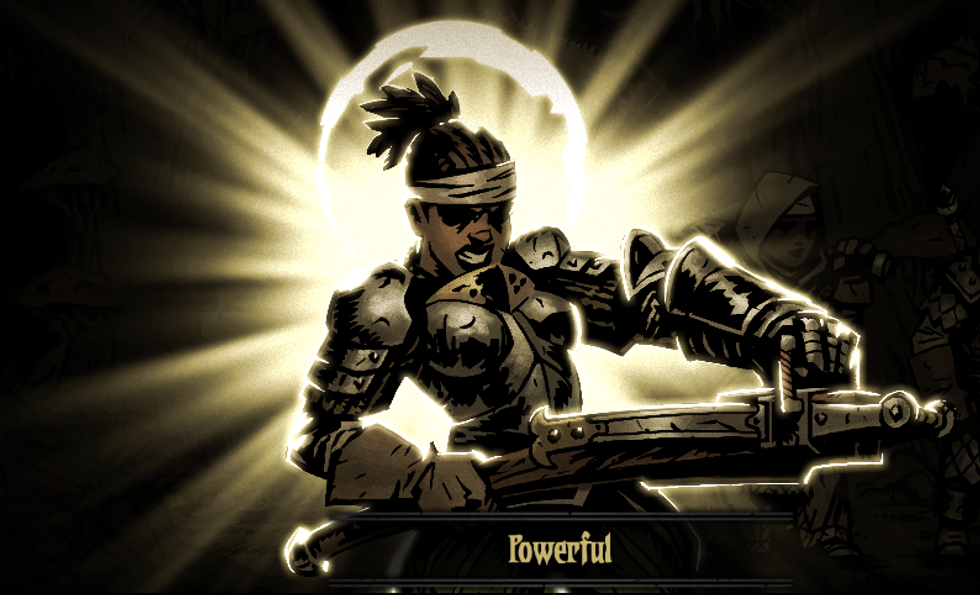
In-game, once a character’s stress level reaches 100, their “resolve” is tested, resulting in either becoming overwhelmed and “afflicted” or overcoming and "virtuous." In real life, this is called “The breaking point." The game also understands stress isn’t an emotion on its own, it’s a circumstance that causes emotions. For example, afflicted heroes can become paranoid, selfish or hopeless while virtuous heroes become powerful, stalwart or focused. It's genius, helping define “stress” as more than a vague term for apprehension.
But above all, the game gives the motivation to defeat stress. Here are two stories from the game that help explain it perfectly: halfway through a dungeon, my healer is in a selfish state. When their turn came, he decided to pass on his turn without my input. The next turn, my bounty hunter was killed because of his low health. One character’s stress cost another their life.
On the other side of the spectrum, I found myself once cornered, an entire team on the brink of death. My archer’s stress had finally reached the critical point. But instead of becoming afflicted, she became powerful. Within a turn, the battle had turned on its head, as every shot was a one hit kill. She had aggressively ripped victory from failure’s jaw.
Stress is unavoidable. Even with the best-laid plans, things fall apart to the roll of the dice. From there, there are two options: allow it to take over, hurting you and those around you, or overcome it, proving your resolve. People have talked extensively about Pixar Studios' "Inside Out" being used to teach children about how emotions work, and I feel like "Darkest Dungeon" could be used for an older demographic. It presents stress as a quantifiable entity, something that is perfectly natural and that even the best heroes face. But more importantly, it knows stress is beatable. It’s just another trial to overcome because there is no greater reward than fighting your way through the Darkest Dungeon, victorious.