

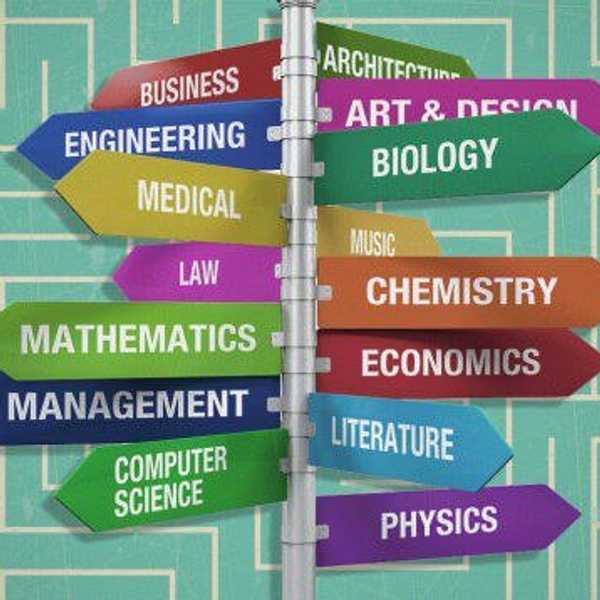

There is no doubt that saving time and making money have become central in this fast-paced, business-oriented world we reside in. Consequently, it should come as no surprise that higher education has become more about “getting a decent job” and less about “discovering the self.” From middle-class parents to various political leaders, the “helpful” advice given to college students is identical, monotonous and can be summed up in two simple words: Be practical. However, this emphasis on pursuing wealth may be promoting apathy and passivity in both students and professors. When education’s main concern becomes the commercialization of one's skills and knowledge, it becomes detrimental.
Higher education institutions are transformed into business enterprises by stressing the importance of financial success. William Deresiewicz, a former Yale professor, claims that the moral and cognitive purposes of college are now disregarded, setting its economic purposes as the top priority. Even more disconcerting is how this is not only accepted, but actually promoted by authoritative people that many look up to. As an example, Deresiewicz cites Governor Rick Scott of Florida as one who “has singled out anthropology majors as something his state does not need more of.” Unfortunately, this does nothing to quash the stigma towards majors (e.g., humanities, physical sciences, social sciences) that don't rake in the big bucks. This dismal attitude is malignant in the sense that it not only belittles the fields mentioned, but it also deems those who study them as incapable of contributing anything of high value.
This marketization of academic institutions not only leads to staggeringly expensive tuition fees, but most distressingly also devalues both teaching and learning. Gaye Tuchman, a sociology professor at the University of Connecticut, enumerates its domino effect: educational institutions imitate corporations, professors behave like “ambitious entrepreneurs (many of whom are often oblivious to the undergraduates populating their classrooms, lecture halls and labs),” and students “act like consumers intent on receiving elaborate and ever-expanding services.” When education becomes largely understood in terms of monetary values, correspondingly it becomes largely treated of monetary importance only.
In support of this, various research and statistics demonstrate the adverse effects upon students, professors, and the academic institutions overall. A simple observation in the case of students is that learning has become secondary. This is a bold statement that nonetheless resonates with what many others believe to be true. People go to college with the main goal of joining the workforce, and learning just so happens to be part of it. As Deresiewicz points out, “Learning for its own sake, curiosity for its own sake, and ideas for their own sake” are no longer deemed rational.
Constantly, students are being nagged to choose a career in health, engineering or technology by their parents. It has become commonplace (and for some, even normalized) to pressure students with regards to which career path they should take. Understandably, because parents would like their children to have stability in life, they tend to push them towards the most profitable majors. “We only want what's best for you,” they would say. But in doing so, these parents may be ignoring some crucial factors: Does the student enjoy that subject? Is the student good at that subject? If not, then the parents may unintentionally be setting them up for failure—or in the very least, for a boatload of stress. For instance, not everyone who signs up for engineering is equipped with the skills it requires. Studying for it will be made much more strenuous for those who lack interest in that field.
Another flaw in pursuing higher education simply to climb up the social ladder is how it does not necessarily ensure success in the future. Peter Cappelli, a professor at The Wharton School, explains that because the job market is unpredictable, specializing in “what's hot today” may not yield our expected pay off in the future. Cappelli talks of the IT boom to bust in the 1990s-2001, which perfectly illustrates how unforeseeable changes can occur within a short amount of time. Clearly no one wants things to end up this way. No parent would want to be put in a situation in which the paternalistic “We're only looking out for you” statement then becomes “Sorry, kid.” But the reality is that this does happen, and contrary to what some parents may believe, this isn't that unusual and nobody's kid is guaranteed to be the exception.
Furthermore, Cappelli reminds us that students are forced to choose a path at age 17, “before they know much of anything about their interests and abilities.” The weight of deciding what college to attend to and what academic subject to major in is placed upon the shoulders of teenagers. Thus, teenagers who are uncertain of what they want to make of themselves are nevertheless subjected into one. Instead of being exposed to a wide array of knowledge they can choose from later on, they are to sign themselves up for a narrow route immediately. By the time they realize that it may not be for them, they have already spent tens of thousands worth of undergraduate fees. To make matters worse, Cappelli states that specialized “skills don't transfer easily anyplace else,” thus making it hard to adjust if suddenly that field stop hiring. So in the end, what's left is a miserable college graduate with bills to pay.
Without question, professors have a lot of impact on their students. Thus, it makes sense to examine what sort of changes have effected them amidst the modernization of higher education. Lately, the emphasis on professors has been on research rather than on teaching for them to get tenured. When teaching is no longer the central goal of professors—albeit it’s their employers that encourage them to do so—it’s bad news for students and professors alike. It's important to remember that apart from instilling knowledge, professors also play a major role in molding their students' character. They have the responsibility to spark intellectual debates, to nurture curiosity, to inspire passion, and to constantly challenge accepted ideas among their students. These duties, however, are taken off the pedestal by the commercialization of education.
Certainly, pragmatism is and will continue to be part of the U.S. heritage. Always, we ask, what is its practical use? Yet the pursuit of passion—or truth in the field of physical sciences, for that matter—is valuable in itself. This is exactly why we have a general education curriculum, so as to instill in students skills in other things outside of their profession. On top of that, students are not merely consumers—they are only to the extent that what they should demand and what they should be supplied is good quality education. Students are not merely products either that the colleges sell off to the labor market. They are more than that, and colleges and professors should be among the first to treat them as such. As banal as it sounds, don't we also want to find meaning in our lives? When education is treated as a means to make money, it fails to suggest any long-term goals other than to just make money, and then make more money later on.
Ultimately, finding a middle ground between the traditional and economic values of higher education should be the goal. Learning something simply because it is practical should not be the be-all end-all, although we also must be careful not to resort to an ideology. It is a complex and difficult process as these values prove to be conflicting at times, requiring students to constantly make compromises—and sometimes, even sacrifices. But because what led us in this situation is a result of our own choices, certainly its resolution also lies in our hands. The upcoming elections gives us the opportunity to attain a high-quality, low–or no-cost mass public higher education. If that doesn’t seem feasible, we can take advantage of technology by utilizing it to provide mass online open courses. Said best by Ronald Barnett, a professor at the Institute of Education, the goal of higher education should not be an either-or but a unity of the two: a “philosophical university that also embraces large concerns and large future-oriented possibilities.” Students must be given the opportunity to choose the career they want without signing themselves up for financial ruin.

















