

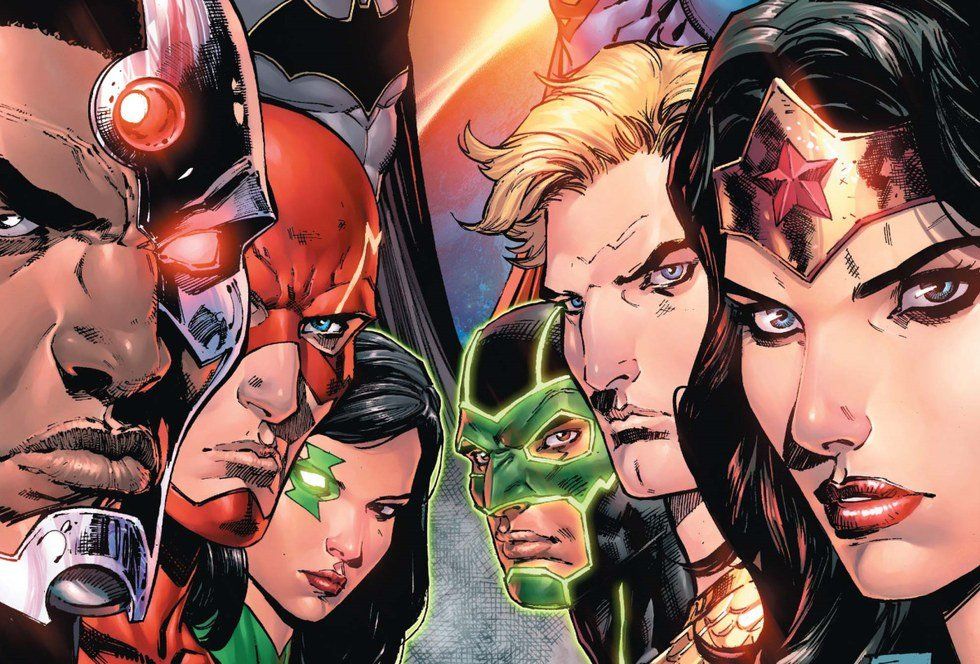
I will be reviewing the newest volume of the Justice League that launched after DC Comics’ Rebirth initiative. This will encompass issues #1-11 and account for the three story arcs (spoilers) that have taken place thus far: The Extinction Machines, State of Fear, and Outbreak. The book has been written and is still being written by comic book writer Bryan Hitch, with several artists alternating to do the interior art as this book is being released bimonthly.
I want to be upfront in saying that Bryan Hitch is an excellent writer. His work on JLA (Justice League of America), which is different from Justice League- the title being reviewed, has been fantastic and has actually been released at the same time he was writing Justice League. That’s how I can validate that his work on Justice League is absolutely abysmal and I expected so much more from him. I can say with confidence that I enjoyed the art and although alternating artists is not something I’m particularly fond of, I enjoy all their pencils and inks. The plots and writing, however, are quite awful and I think they should be used as an example of how not to write a comic book series.
Let’s begin with the opening story arc, The Extinction Machines. Bryan Hitch clearly wanted to start the series with a bang, but falls remarkably short by the end of the plot. It begins quickly and we discover that there are these giant entities known as The Kindred come to destroy the earth in order to save it, so they say. They seem to be stealing the powers of the Justice League that they claim belonged to them and were stolen. The Justice League succeeds of course by the end, but everything in between was catastrophically written and difficult to understand. I didn’t understand much the first issue and took it as a method of setting up what was coming next; the same happened in the second issue; and the third and so on all the way until the story arc finished. The problem is that nothing was explained and every member of the league is doing their own thing. The Flash is busy evacuating people most of the time, Cyborg is just processing confusing codes, and Aquaman was busy listening to mysterious crystals that apparently only he can understand and are telling him exactly what to do in order to save the earth. As a matter a fact there is a panel with Aquaman actually mentioning that he was actually mentioning how crazy it was and saying how this is actually somewhat normal in his life compared to other events. We never heard about these crystals ever again and they are the exemplar of what a deus ex machina is.
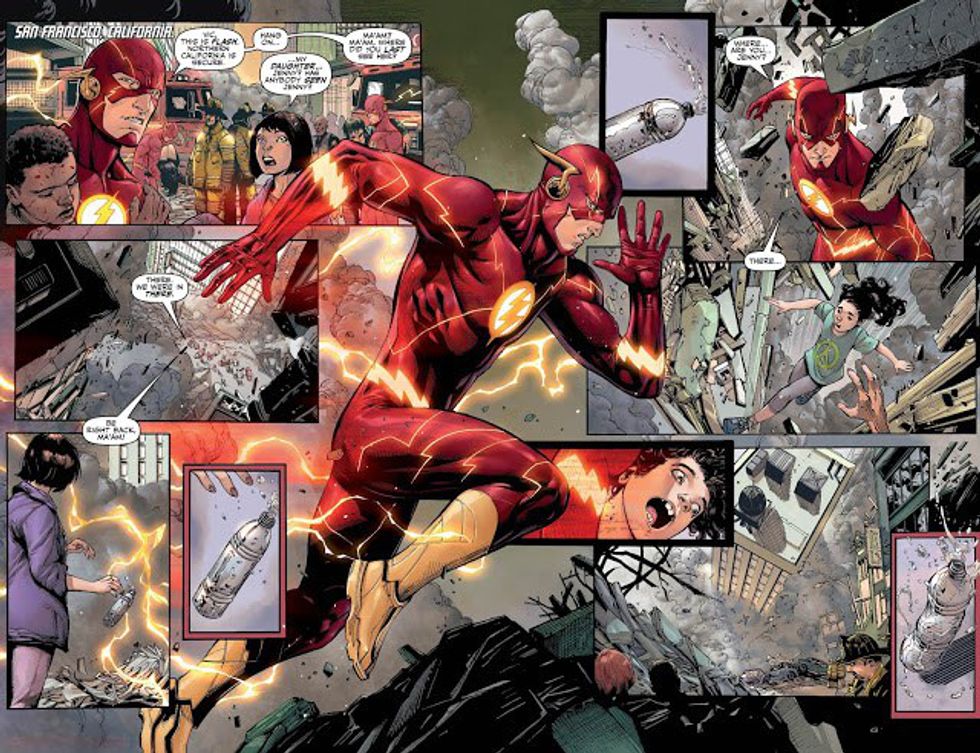
That’s only scratching the surface of the story arc’s issues. There are moments where the league tries to attack in a manner that would keep people safe, but in actuality they were falling hundreds of feet from the sky with no mention of them being saved, yet there was an explicit statement saying there was only 1 fatality. There were also a couple of plot twists at the end of the issues, such as Cyborg’s resemblance on this alien machine species, but it was never delved into and was just another method of defeating The Kindred without any understanding of why and how. As a matter a fact, I am still wondering what The Kindred actually are. Although I was not the biggest fan of the story arc, the amount of blanks that were left behind deserved some attention and so much more could have been built from the foundations of this story. Overall, it was a congregation of good but very poorly executed ideas.
State of Fear was the second story arc in the series, and only expanded 2 issues. It was a very grounded story, as it should be considering the magnitude of the The Extinction Machines, but again it makes you ask, “so what?” It begins by the league fighting off this ominous dark entity that make everyone paralyzed from their greatest fears. The green lanterns, who are fueled by courage and will power were able to overcome the experience and lead the league to victory. Afterwards, the two issues go into the lives of each of the heroes who all have things to attend to and do so in groups of two conveniently. As the issues progress, it seems that the entity they fought let on an after effect, and the heroes fears overwhelm them into thinking and doing wrong deeds. It allowed us to see that behind those costumes and uniforms, they were people like us and vulnerable. It went out of its way to show how the world would be if we took initiative through fear rather than compassion and logic. It correlates with many of the issues we are facing today, which is why have an appreciation for the story arc, however, by the time I finished it, I expected more. What happened to that entity that caused this? What was it? I have absolutely no idea and it was used solely as a way of getting the story’s themes and messages across rather than taking into consideration all aspects of the plot. For that reason it was interesting, but far from good.
Outbreak, the most recent story arc, was almost as bad as the first. It revolved around the aftermath of The Kindred and the family that suffered that one fatality, that of the family’s mother. As a result the father begins to use his hacker skills to create a program that would allow him to take money from the richest in the world and redistribute it to those that were affected by The Kindred. His young daughter is also apparently a genius hacker and used the program to create an A.I. known as Genie on their Ipad to sell to a company and help her family make money. Unfortunately the child son of the family begins playing games on it and since Genie can access any system in the world, it gives the Justice League trouble in understanding why they are being attacked. Simply put, a child’s imagination came true and caused the league trouble. Part of the game is later revealed to be a bounty where villains are rewarded a fortune for defeating the league. A swarm of the league’s old villains appears to challenge them as they try and isolate Genie for the safety of everyone.
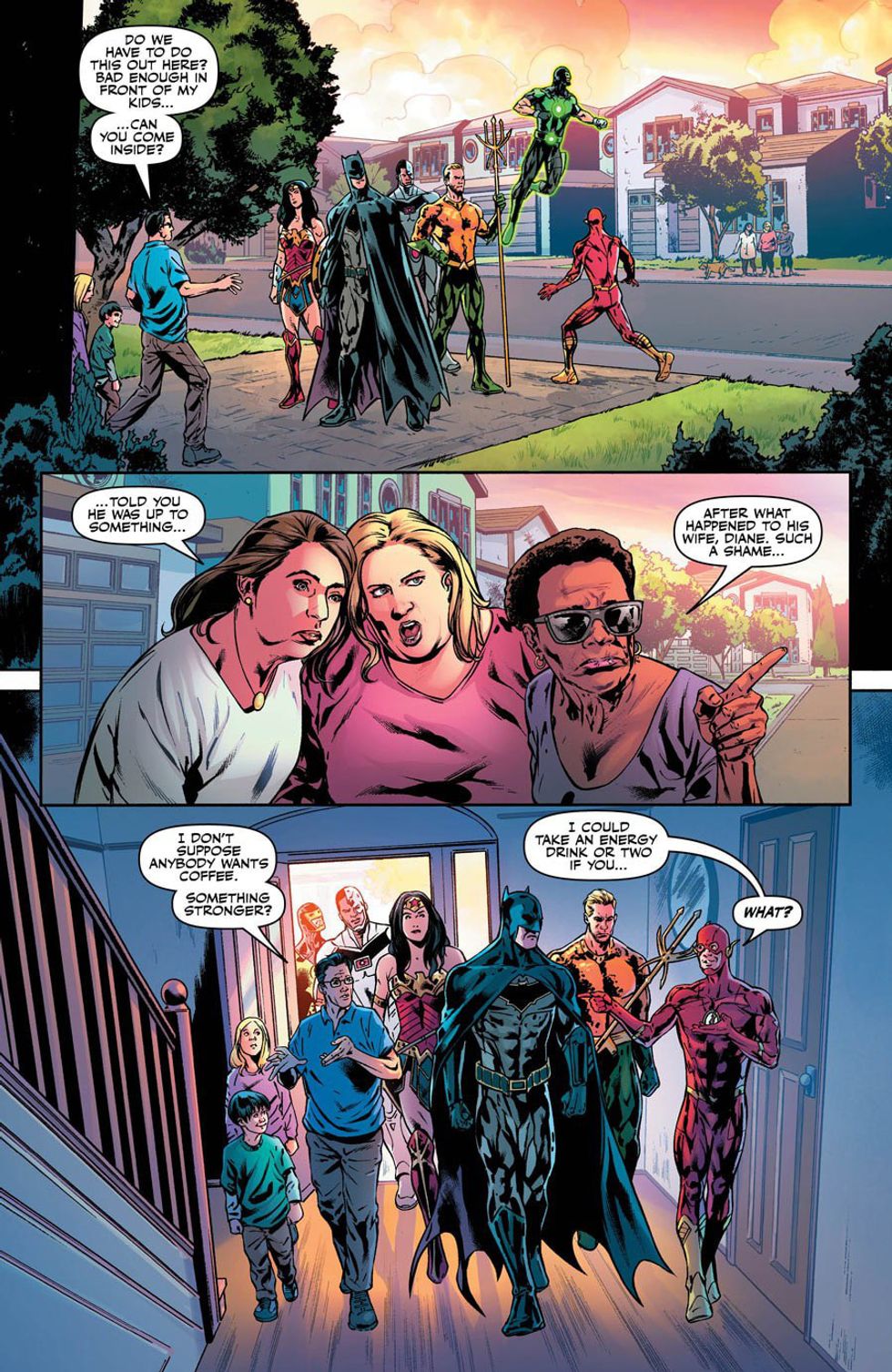
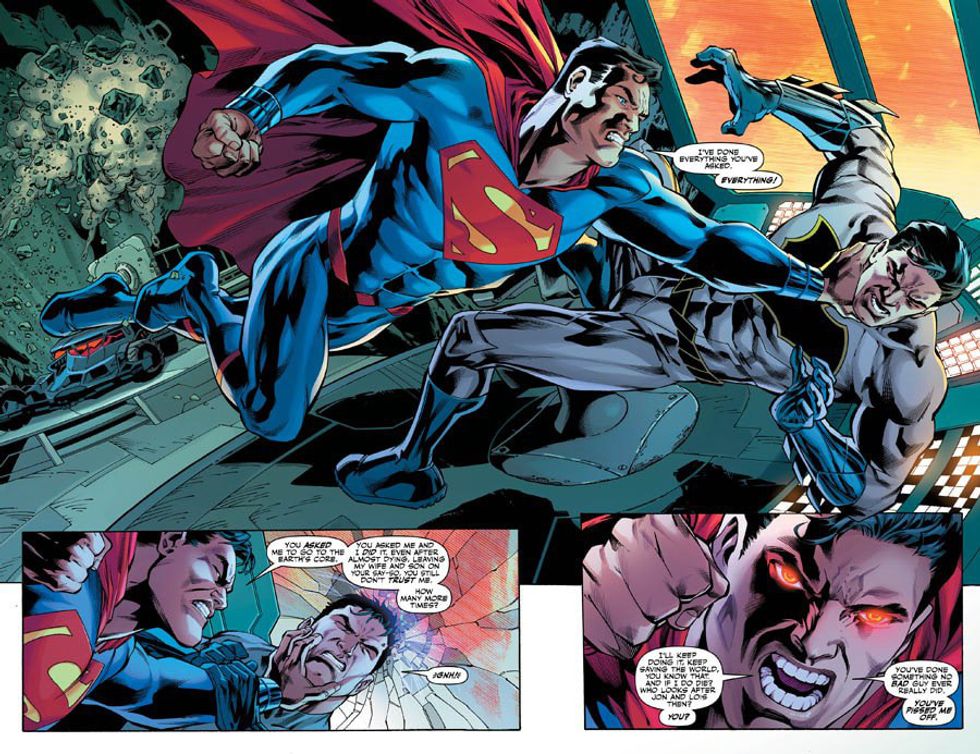
The problem with this arc is that it felt like an advertisement for kids. It was like the justice league was featured in a child’s TV show, and what worse is that villains appeared for the bounty that don’t even have an interest in money, but were there for plot purposes. Not only that, but their constant referencing to the tablet as an Ipad made it sound like they were publicizing it for Apple. Superman was not in the plot, which usually I don’t mind, but it was clearly because he could have defeated most of the villains that appeared in one fell swoop and one line was dedicated to explaining that, which happened to be Genie’s fault as well. Adding onto that, there was no character development, no forward advancement of the series’ overall plot, or any other advancement of interest. It was a stand-alone story and it was so mediocre that it was upsetting. This is the Justice League, what fans expect blockbuster action and epic storytelling with good characterization and character progression regardless of the fact there are many protagonists. This sounded like a filler story that my little cousin proposed.
Every writer has a different approach to storytelling. Some use dialogue more than others, and others use short and satisfying stories while others embark on adventures that take years to complete. I am really open to all kinds of writing and styles; it keeps reading interesting. However, from a superstar writer who I know could write infinitely better than what I’ve been reading, Justice League has been incredibly disappointing and I don’t recommend that anybody support at its current state. Unless Hitch decides to step up his game or a new writer comes along, avoid this comic series at all costs and check out almost anything else.














