When I was in grade school, and even high school, my friends and I would laugh and make jokes all the live long day. At the time, we thought our jokes and rips on each other--which consisted mainly of fat, racist, and homophobic jokes, you know, the classics--were harmless and all in good fun. It's not like we were really trying to insult each other. After all, we were all mostly fat ourselves, we knew none of us were gay (and really wouldn't care if one of us were), and I was half black and therefore gave us all permission to use the n-word willy nilly. They were only jokes!
I'm sure there are plenty of you that know exactly what I'm talking about. Maybe some of you are in complete shock that some kids in 6th grade would talk like that. Well, that's what urban youth raised by TV and the online forums will get you, at least in my case. At the time, our perspective was small. We were five kids just having a good time. How other people may feel about the words and jokes we said were not on our radar. It didn't need to be.
Ten years later, my perspective is much broader. I'm a senior in college. I meet and interact with people from different corners of the world who live different lifestyles and practice different cultures every day. My perspective is now this: I am a member of a giant space rock coexisting with other space rock members, on which we basically all want to just be happy for the 80 or so years we exist. We have way more in common than different.
I mention all this because lately there has been a huge resistance toward the perceived "political correctness" of comedy. Let me start by saying that I've come to loathe the term "political correctness." It's the latest new buzzword thrown around like crazy, typically by individuals who don't like that people get "offended" when they "just make a joke." These jokes, from what I have personally experienced at least, are typically the same dumb, tired punchlines that rely on stereotypes and misinformation to get a laugh. Women are bad drivers, blondes are dumb, black people are thieves, Jews are cheap. I've heard them all before. Everyone has. You can probably even guess the demographic that typically tells these kind of jokes.
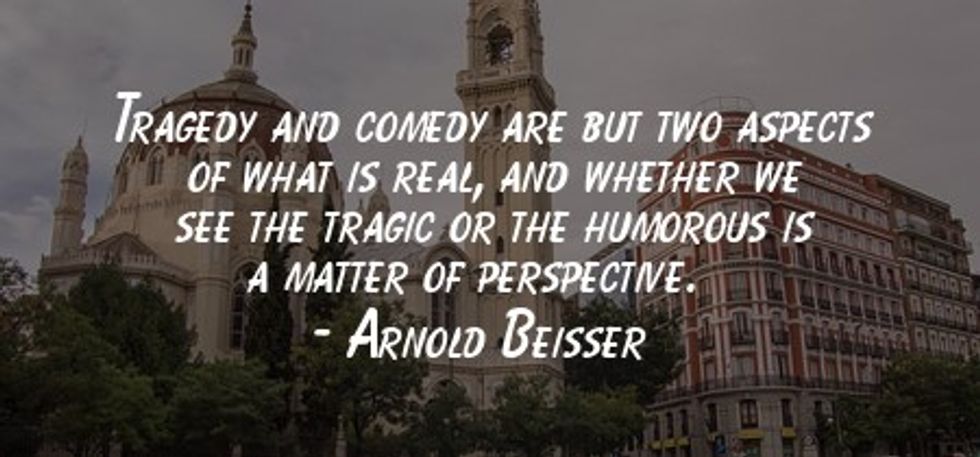
It's our own perspective, our life story. It's how and why we are who we are that dictate what we find funny. Comedy, according to author John Vorhaus, is defined as a marriage of truth and pain --in every punchline is a layer of truth that makes it recognizable as an aspect of life, combined with a sting of pain that makes it immediately relatable to the audience. We get the joke because it's true, and we laugh because it hurts. Because we are all subject to bias caused by whatever zeitgeist got to us first in our formative years, we may perceive what is true differently than someone else. What is true for the guy in Iowa may not be true for the girl in California.
This is why what is funny for some can range from just plain not funny to outright offensive to another: our perspective dictates what truth in a joke we perceive and what kind of pain is experienced. You may think that joke about a black guy stealing a TV from your house in the middle of the night is hilarious and will be a big hit, but it's probably not so funny to the white looking dude with the black mom who, as a kid, was stopped all the time by strangers while walking with her, thinking his nanny may have kidnapped him or something. This is why some people may have a hard time taking a joke, because what you consider "just a joke" is a harsh reality for others. For the joker, the truth is that black people steal things, the pain is that black people steal MY things. For my mom and I, the truth is that prejudiced individuals think black people are all thieves. The pain is that because of this, it's totally acceptable to poke fun over black people being wrongly suspected of, persecuted over, and assumed to be thieves. It's just not true, but it's true enough for the joker.
The real kicker about perspective is that it only really changes when you're young and impressionable, not barring crazy, life-changing events that shift people's entire world upside-down (but these aren't particularly common). Thanks to the internet, my generation has a greater potential to be connected and integrated into a worldwide community right from the get-go, unlike our parents who are still trying to figure out how to share that great Minions meme to their sister on Facebook. We share everything--maybe even too much, at times-- and through this sharing, we get an unfiltered account of individuals who experience and suffer because of racism, sexism, mental health issues, sexual abuse, you name it. We can learn that not only do these issues exist but they are exceedingly common. When you realize just how many of your friends and loved ones suffer through these afflictions and call it their daily life, you just don't get a chuckle out of those jokes anymore.
I'm not telling you to change your perspective if you happen to enjoy blue jokes such as these, but what I will say is that you should realize that people don't get offended for nothing. It strikes a real, actual nerve that goes beyond the reaches of a joke. They don't have to "toughen up." They're already tough enough to call you out on your lame jokes. One of the most important rules in comedy is to know your audience. If you're going to continue with that kind of humor, which you have every right to, then you're probably better off sticking to telling them to people who have rigid perspectives identical to yours; they are the ones who will probably get the biggest kick out of them. Otherwise, you may just find yourself being the only one enjoying them out of a group of friends no longer enjoying you. After all, what's the fun in comedy if we're not all having a good time?