
Alice Goffman is a brave, compassionate, and inspiring sociologist. I first heard about her father, Erving Goffman, in an Intro to Sociology class where I then read his book The Presentation of Every Day Self. He worked in micro-sociology, a branch that focuses more at an individual level rather than a structural level. His research, however, isn't what we're here to talk about (not today, anyway).
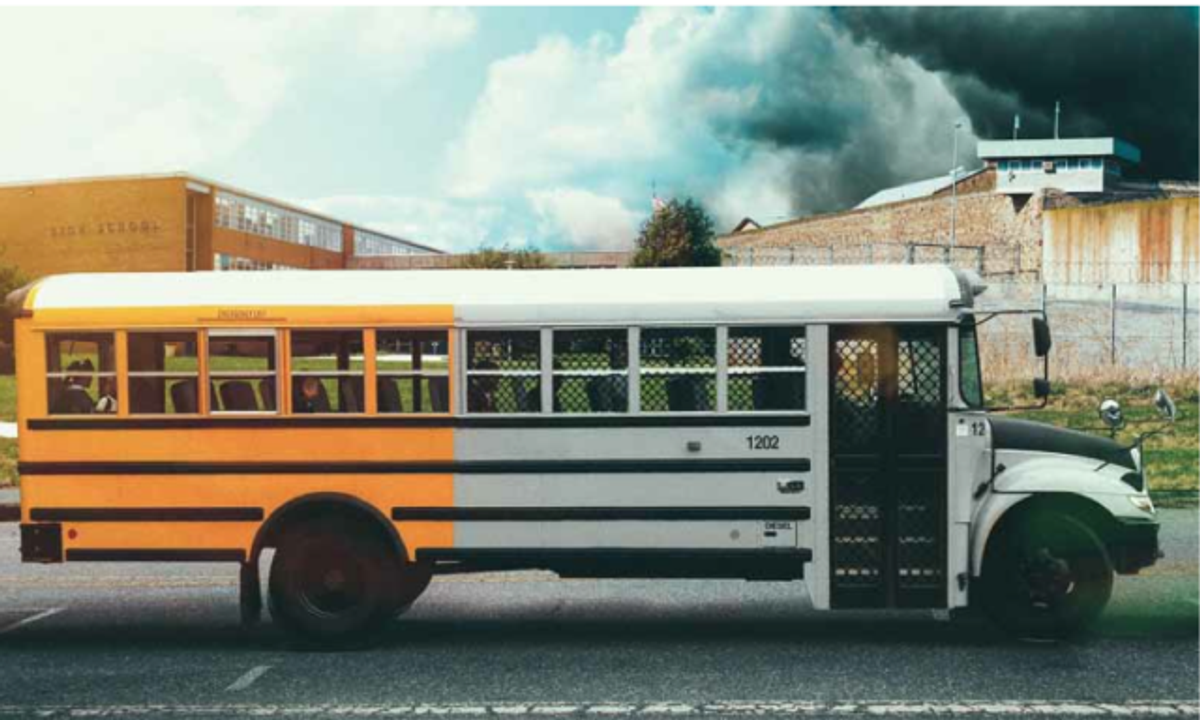
I watched a TED Talk recently given by Alice Goffman (watch it here) that covered a concept similar to the school-to-prison pipeline. If you don't know, the "school-to-prison pipeline refers to policies and practices that push our nation's schoolchildren, especially our most at-risk children, out of classrooms and into the juvenile and criminal justice systems".
Basically, Goffman discusses the two juxtaposing institutions that a student-aged individual can enter into. The first institution is expensive (on average, individuals have $20,000 in debt), it gives the individual a sense of pride, greater knowledge, and a better chance in the labor market. If you didn't guess it, the first institution is college. The second institution - prison - provides far less opportunities than college. Prison is also expensive - in New Jersey, prisons cost roughly $40,000 a year to maintain - but it is a mark that will be permanently branded on an individual's life.
The incarceration rate has gone up 700 percent in the last 40 years. There are about 716 people per 100,000 going to prison, most of which are poor African American and Latino youths. Most of these kids are worried not about their grades, but about whether or not they will be stopped and searched on the streets. In 2013, stop-and-frisk was still a majorly controversial issue due to racial profiling.
While studying at the University of Pennsylvania, Goffman decided to place herself in the community surround Penn, a historically African American community. In the first 18 months, Goffman saw police contact every day and 14 times there were violent incidents after apprehending a suspect. This sort of activity is a common and for most of us, unheard of.
In a class I took recently, we learned about a concept called "the zone of transition". Social disorganization theorists found that criminal neighborhoods were inherently criminal. In these neighborhoods, there's no sense of community, no power, and even a cultural adaptation to poverty. While this may seem a little whacky, it's not all wrong. Areas that were redlined beginning around the 1940's continue to be rundown or impoverished areas.
You might find yourself asking, "Well, don't these kids deserve to be in prison? Aren't they doing things that constitute jail time?" Like Alice Goffman, my answer to that question is no. If the kids that grew up in low income, high crime neighborhoods had grown up in neighborhoods with privilege, they would have lived different lives. Privileged kids aren't stopped and searched for drugs, their frat parties aren't raided. If they were, do you think we wouldn't find drugs? Do you think there wouldn't be illegal activity?
Goffman references two things that I think are very important. The first is "The New Jim Crow", a provocative book highlighting the racial disparities in incarceration rates. The second important reference, was a speech given by President Obama at an NAACP conference, a speech in which he said, "By just about every measure, the life chances for black and Hispanic youth still lag far behind those of their white peers". All around our country, people like Michelle Alexander, Alice Goffman, and President Obama are working very hard to bring to light the severe injustice youths are facing.
So, why are we not offering support? Goffman's call to action at the end of this TED Talk in incredibly moving. In my area alone, groups like the Boys and Girl Club of Northeast Florida, City Streets 2 Student Athletes, and the Sulzbacher Center are looking to help those that are disadvantaged. But the real solution, according to Alice Goffman? Let's bring some justice to the criminal justice system.

















