


While at work the other day, I mentioned being tired to my boss. He gave me a scrutinizing look and replied with, “Tired? You’re too young to know what ‘tired’ means.”
This was not the first time I’ve been told this. It makes me wonder if adults (or anyone who isn’t in college, for that matter) realize just how hectic and stressful our schedules can be. I'm getting the feeling this is how they see it:
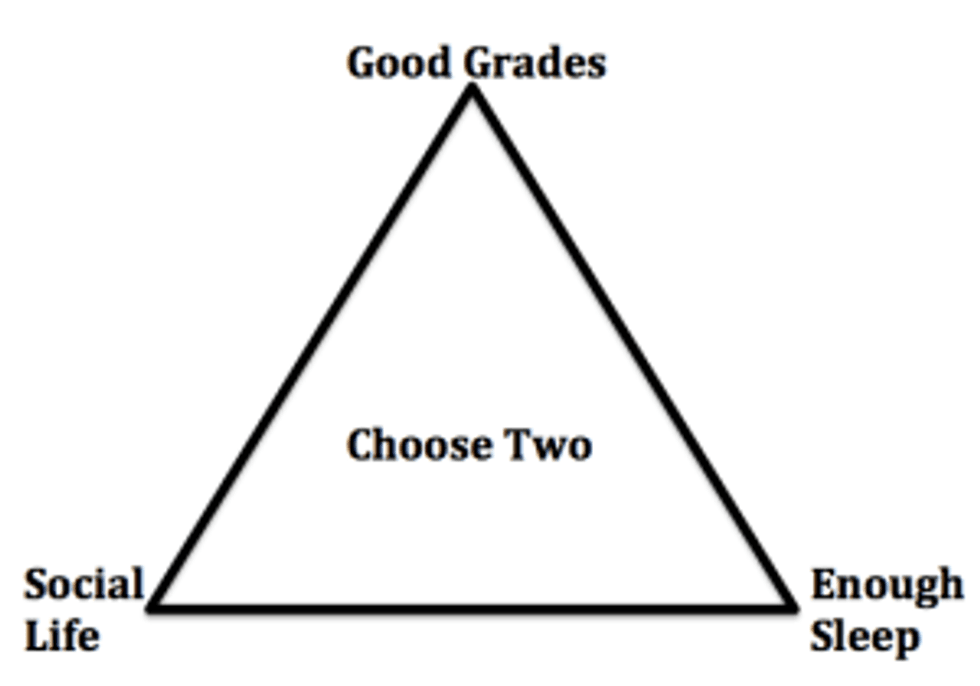
Yes, many of them went to college themselves, but there’s a big difference. College didn’t used to be emphasized as much as it is now. College attendance after high school did not used to be an absolute like it is for many students today. It just was not something that every young adult did. Over the years, a greater emphasis has been placed on college and more resources have become available to make attendance more attainable. It’s now very difficult to find a sustaining job without a college degree, which has lead to a rise in the amount of students that attend college. According to the National Center for Education Statistics, the enrollment of full-time college students increased by 28% between 2002 and 2012 alone. With more and more students graduating with college degrees, job fields that once were guaranteed have become competitive. There are more and more applicants in job fields that are not growing, which means that current college students have to do whatever they can to make their resumes stick out from the others.
What does this mean? We have to balance resume builders (volunteer hours, internships, clubs, leadership roles, student government, sororities or fraternities, etc.) on top of classes, homework, and, for many students, jobs. In addition to this, we also still have families, friends, and significant others to make time for. This is a more accurate description of a college student's schedule:
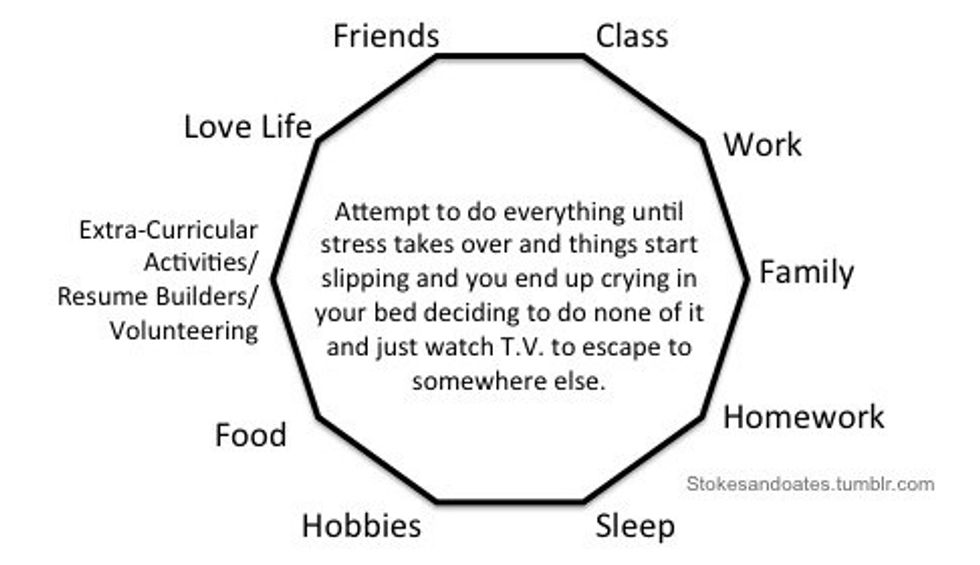
A full-time college student takes between thirteen and eighteen credit hours per semester (between four and six classes.) The general rule of thumb for college students is to spend two to three hours of their time outside of class on homework and studying for every hour they spend in class. (This is a real statistic; on the syllabus one of my professors gave me, he wrote that he expected us to devote two hours outside of class to readings that we would later use in class.) Assuming that a student takes the average of five classes, that’s between thirty to hours of studying and homework outside of class. So, fifteen hours of actual class-time, plus thirty hours of studying equals around forty-five hours total. This is the equivalent of a full-time job.
On top of their main full-time job (school), many students have part-time jobs. You can then add an average of around twenty hours, more or less, bringing our total to sixty-five hours. On top of this, students have extra-curricular activities, internships, and volunteer hours. According to a survey by the Bureau of Labor Statistics, college students spend an average of around three hours per week-day engaging in sports or other activities; that’s twenty hours a week. This brings our total to eighty-five hours. The same survey showed that students sleep around eight hours every night, adding another fifty-six hours per week. Our total then jumps to one hundred and forty-one hours.
Given that there are one hundred and sixty-eight hours in a week, college students now have about twenty-seven hours left. Divide this remaining time between family, friends, significant others, religious services, personal hygiene routines, eating, fitness, and the other small things we didn’t cover, and the week is over. The remaining hours are filled, maybe even over-filled.
So, yes, I think it’s safe to say that college students have a reason to be tired. Our schedules are crazy, hectic, and stressful.
*The information in this article was provided by the following sources: nces.edu.gov, collegeparents.org, and bls.gov.