

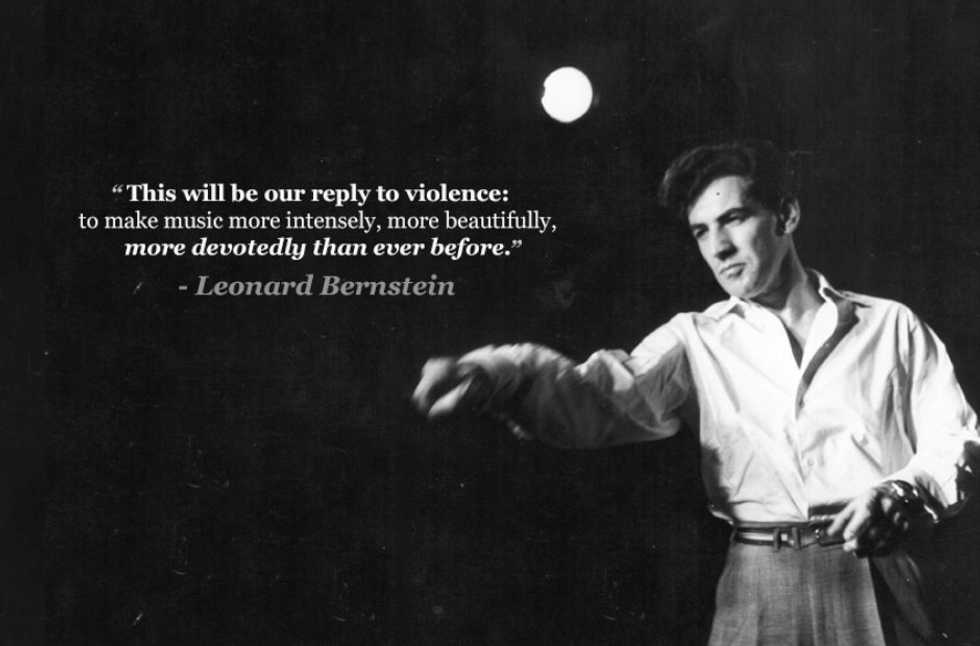
“This will be our reply to violence: to make music more intensely, more beautifully, more devotedly than ever before.” — Leonard Bernstein
These are the words of former New York Philharmonic conductor, Leonard Bernstein, after the assassination of President Kennedy on Nov. 22, 1963, according to his website. His words may be dated; however, his message is timeless.
On March 22, 2016 just before 8 a.m. in Brussels, Belguim, two explosions shook the world. One explosion killed 10 people in the departure hall at Brussels Airport, and an hour later another explosion at Maelbeek subway station in central Brussels killed 20 people. More than 230 people were injured, according to the New York Times.
We know now that ISIS has taken responsibility for these attacks, according to Fox News. However, this is not even a lead as it seems ISIS takes responsibility for almost everything bad happening in the world today.
So how does classical music fit into all of this? Let’s look back on some of classical music’s responses to violence in the past.
Riots in Ukraine: January 2014
Markiyan Matsekh, pianist, decided the best way to convey a message of protest was through his art, according to BBC News. He played classical piano in front of police lines during the riots. His piano was painted in the colors of the Ukrainian flag.
This event became part of the Warm Ocean Strategy, a movement that gained momentum in Ukraine during this time. It aimed to protest in a peaceful manner during political unrest.
Baltimore Riots: April 2015
Baltimore Symphony Orchestra held a free concert near the riot’s location after the Baltimore riots about a year ago. Their music was received by dozens, according to The Associated Press, and the symphony tried to restore a sort of normalcy to the city through their music.
Classical Music in Brussels: February 2015
The Piece, “In Memory of Khojaly Victims,” was performed at the Royal Conservatory of Brussels during the 23rd anniversary of the Khojaly massacre in 1992, according to the Brussels Times. During this tragedy, 613 civilians were killed and 487 were injured in Azerbaijan.
Composer of the piece, Romain Zante, believes in the strong power of classical music.
Zante explained, "We believe that music is a universal language which can be an important means to reunite our world.”
In the wake of these attacks in Brussels, we need classical music now more than ever. The power of this language can unite everyone and give us the power as a nation to heal.