
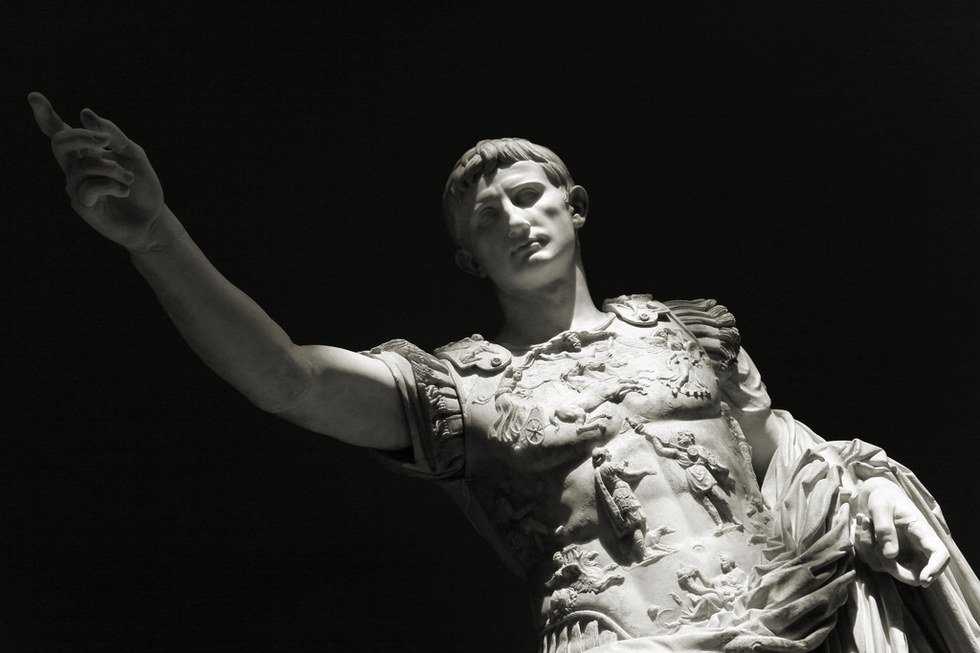

Augustus of Prima Porta, White Marble, 1st cent. AD
Today, politicians think carefully about how they would like to be photographed and presented in the media. Propaganda is by no means simple commercial advertising; it is political and spiritual. While commercial advertising seeks momentary effects, political propaganda aims to win a worldwide quota of supporters. In the past, history shows numerous accounts where propagandists gave up their lives for a leader or movement.
When political propaganda comes to mind most imagine flyers or advertisements in the media. However, some of the most beautiful sculptures and paintings in the world historically contain political subject matter, address public concern, or awaken viewer sensitivity. Just as present bombardment of election campaign efforts seen today, ancient imagery can provide an abundance of knowledge on political figures. The Prima Porta Augustus, exemplifies the ideas and influence comprised in political propaganda.
Ancient Rome teemed with art that was closely intertwined with politics and propaganda. The first emperor of the Roman Empire Augustus, aware of the effects in political art, utilized art to communicate his ideologies. One of the most famous sculptures of the emperor is the Augustus of Prima Porta done by an unknown artist in 20 B.C. At first glance, the marble sculpture appears to be nothing more than a portrait of Augustus as a general or an orator.
With a closer look, the portrait contains ulterior motives communicating ideas of authority. The sculpture depicts Augustus as a military leader who strongly supports Rome’s religion. After gaining power from the civil war, Augustus realized how quickly one could gain and lose control over an empire.
Prepared to use any tool to maintain his empirical status, Augustus used religion to secure his position and protect his political agendas. However, using religion as a commonality for the Roman citizens was not enough. Augustus desired to be seen as a supreme spiritual leader by all of the Romans.

Doryphoros of Polykleitos, white marble, Roman copy
In the Prima Porta, Augustus is a free standing sculpture, standing in a relaxed contrapposto pose. Garbed in regalia, Augustus stretches his hand to address troops and assert his dominance a strategic leader and military conqueror. With further examination, the Prima Porta bears a strong resemblance to Polykleitos’ Doryphoros, a classical Greek statue from the fifth century.
Both sculptures have a similar contrapposto pose and idealized physical characteristics. Doryphoros and Augustus are sculpted as the epitome of perfection: young and flawless. The similarities between the two figures is nothing new. Roman artists often modeled their own artistic works from their classical Greek predecessors. The significance of Augustus’s depiction is that he bears the body type of a young and powerful Greek athlete when in actuality, Augustus was middle-aged man when the sculpture was commissioned.
_detail_01_by_shakko.jpg)
Another important symbol of the Prima Porta is the cupid and dolphin located by Augustus’ right calf. Cupid, the son of Venus, and the dolphin may refer to Venus’ birth from the sea. The association Cupid and the dolphin hold with Venus imply Augustus is a descendant of the gods. Augustus’ connection can be made through Julius Caesar, his adopted father, who claimed to be a descendant of Venus.

Augustus of Prima Porta, detail, white marble, 1st cent. AD
The final symbol in the portrait is the cuirass or breastplate Augustus wears. Adorned with figures, the cuirass provides additional propagandist messages. Although there is much debate over the exact role the figures play, there is again an overarching message of Augustus’ greatness.
Depicted as a military victor and the provider for the Pax Romana, a duration of peace in the Empire, Augustus is placed by the gods. At the center of the breastplate are two figures: a Roman and a Parthian. To the left, the Parthian enemy forms military standards referencing Augustus’ international diplomatic victory in 20 B.C.E. when military standards were returned to Rome.
Apollo and Diana, are depicted demonstrating Augustus’s support for traditional Roman religion. In the bottom of the composition Tellus, the earth goddess, holds a cornucopia and cradles two babies. Tellus is another symbol of the fertility and plenty the Pax Romana brought. The Augustus of Prima Porta does not stand as just a portrait of an emperor, but rather, as an announcer of Augustus as a great victor connected to tradition, gods and the bringer of Rome’s Pax Romana.
When the word propaganda is presented, one may have a very distinct image in mind. Generally posters containing a modern aesthetic of black lines, bold colors and a short but message is stock standard for political art.
The use of imagery to convey a persuasive message is not only apparent today, but also in many forms of artistic portraits of powerful leaders. These portraits were created as catalysts for a leader’s beliefs and ideas. Often political images contain a high visual and emotion component for the viewer.
The impact of these depictions are so great that the benefits gained from sender to the receiver are substantial. When a figure or idea is a constant presence in an individual’s life, that concept or figure becomes an ingrained and “natural” part of a person’s daily life. Although the portrait of Augustus, is highly artistic with an undeniable amount of skill and visual beauty they were created to spread critical messages that even the illiterate could understand.
Touched by influential images every day, individuals are surrounded and defined by the messages fashioned to sway their personal perceptions.

















