


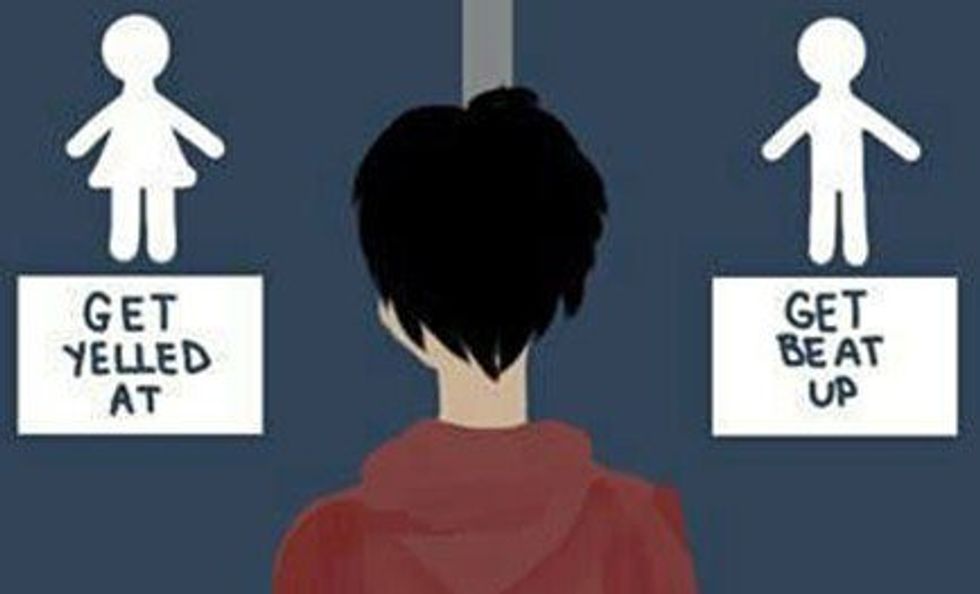
In recent years, people who identify as transgender have been given the recognition and acknowledgement that they have fought so long and hard for. New light has been shed on the transgender lifestyle thanks, in part, to social media and news outlets. Information about what it means to be transgender and how to appropriately address a transgender individual has spread across the internet like wildfire, fueled by the curiosity of people who want to become more knowledgeable on the subject, but the focus on transgender people has also been met with fierce backlash, particularly by individuals who identify as cisgender. And most notably, that backlash has involved access to public restrooms.
Before delving into the raging war on bathrooms, it's important to know exactly what transgender and cisgender mean. According to Merriam-Webster, the word transgender is an adjective that means "of, relating to, or being a person... who identifies with or expresses a gender identity that differs from the one which corresponds to the person's sex." In short, a transgender individual is a biological male or female who self-identifies as the opposite sex. An example of a transgender person would be an individual such as Caitlyn Jenner (formerly known as Bruce). Simple enough, right? Now, on to the definition of cisgender. Merriam-Webster also defines cisgender as an adjective meaning "of, relating to, or being a person whose gender identity corresponds to the sex the person had or was identified as having at birth." This means that a cisgender person is a biological male or female and self-identifies as such. An example of a cisgender individual would be someone like me who was born a female and continues to identify as female. Got it? Good. Let's move on.
The big bathroom debate concerning transgender people has most recently been ignited by Target's stand for inclusivity, which states the following: "In our stores, we demonstrate our commitment to an inclusive experience in many ways. Most relevant for the conversations currently underway, we welcome transgender team members and guests to use the restroom or fitting room facility that corresponds with their gender identity." This seems like a fair statement, right? Equality for everyone, allowing every customer and employee the same opportunities, but for some, this policy crosses a line—a line that they have drawn out of fear and a lack of information.
Let's discuss why the negative feedback that this restroom rumble has received is not only wrong but unprecedented. First of all, nowhere in Target's stand can a statement be found denying a cisgender individual his or her ability to use the facilities that match their gender identity—absolutely nowhere. Cisgender people aren't even mentioned, and for one good reason: it's not about them. It's not about me or you or any other cisgender person we may know. It's about transgender people finally feeling comfortable in the body they're in. As a cisgender person, would you feel comfortable being forced to use a restroom designated for the opposite sex? Would your child or your friends or family? Would you feel safe entering a public restroom of the opposite sex only to be met with revulsion and even deadly threats? Absolutely not, so why should a transgender man be forced to use the women's restroom simply because his appearance and anatomy may not match his gender identity?
The argument against allowing transgender people to use facilities that correspond with their gender identity seems to be twofold: less-confrontational critics suggest the alternative of transgender bathrooms and more radical dissenters claim that allowing a transgender individual to use the public restroom matching their gender identity poses a threat to cisgender people. However, there are flaws that can be found in each of these points. The creation of transgender restrooms is especially problematic in that transgender is not a blanket term. As with cisgender, there are male and female transgender people, and by forcing all of them to use one specific facility simply because they are categorized under the transgender umbrella, an even larger issue of discrimination and misinformation is born. The same could be said if all cisgender people were forced to use the same restroom. Furthermore, a so-called "transgender" bathroom already exists. Many people know it as a unisex bathroom, and at some point in their lives, they've used one. But unisex bathrooms are few and far between, which is why accommodations are being made for transgender people in existing facilities because it's the fair, just, and right action to be taken.
On the other hand, the more aggressive response to allowing restroom freedom to transgender people is blatantly disrespectful and insulting. Transgender people live in perpetual fear of using public restrooms because they're terrified for their own safety. As a cisgender woman myself, I can only imagine the pain associated with that type of fear, especially in such a private and vulnerable space. When a transgender person sets foot in a public restroom, they have the same intentions as you and I: relieve themselves, wash their hands (hopefully, as everyone should), and be on their way. It's that simple. No transgender individual plans to barge into a bathroom to do harm to you or anyone you know, and to even insinuate that that is a possibility is absolutely absurd.
By penning this article, I mean to make one very important point as clear as I can: transgender people are just that: people, and they deserve to be treated as such. They deserve the same privileges, rights, and opportunities as you and I, as cisgender people. We are all human, and no individual, gender identity aside, should live in fear of performing a necessary bodily function, especially in the privacy of a restroom. We all gotta go at some point, people. It's no secret. For many, using a public restroom is humiliating and petrifying in and of itself, so why make that experience even more debilitating? Everyone, transgender and cisgender people alike, should be allowed to use a public restroom and feel safe and comfortable while doing so, but that can only be achieved by making the choice to squash the stigma and choose acceptance instead.

















