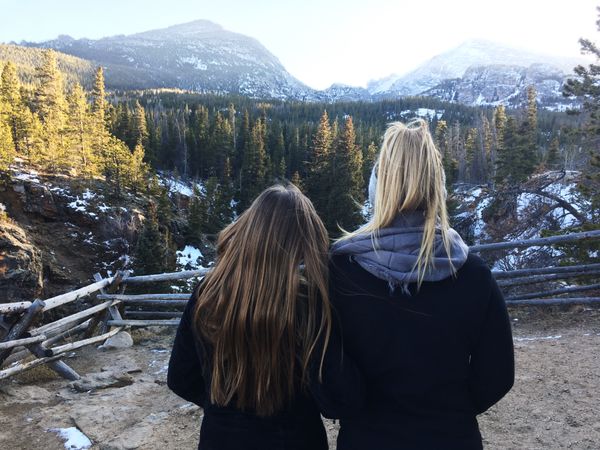

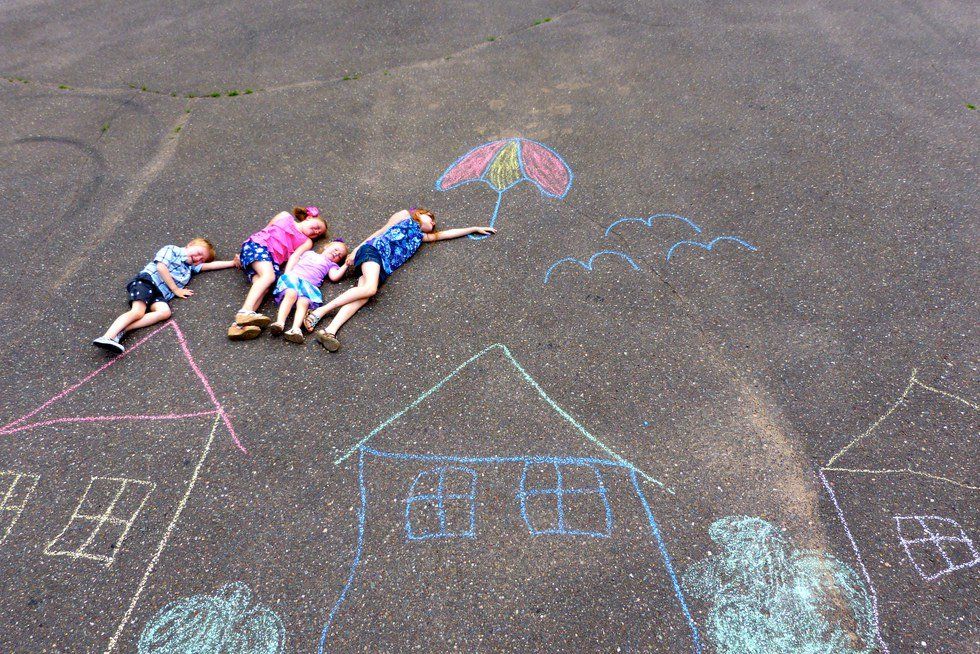
I hated the way the chalk felt on my hands, but it was worth it. Our little city required labor, the discomfort of chalky fingers, and a vision. Each day after school we raced up the street to the cul-de-sac to build a city of our own invention. School days were short, and daylight was in our favor. The limitations were simple: Be home by dinner and “play nice.” So when the bus rolled up at the bottom of Fieldstone Court, a crew of light-up sneakers stumbled up the hill. We panted and moaned, but nothing would stop us from reaching the summit. This was our Everest. This was my neighborhood.
Time changed the rules. The same round-up of kids stand taller in the shadow of the stop sign, but no one dares to exchange looks. The suspended silence is snapped as Bus 99 rounds the corner.
For a neighborhood of kids that grew up so close, we could not have grown farther apart. No one acknowledges each other in the high school hallways. My generation- supposedly the most connected generation- is actually the most disconnected. We hide behind the homogeneous and anonymous. Social media has created a comfort zone where we don’t have to step out of our shells. We don’t even have to step out of our bedrooms. Yet nothing can replace the human community that exists in our own backyards; the kids who watched me fall off of my first bike. We weren’t afraid to fail in front of each other then, why are we now so paralyzed?
Growing up in my neighborhood was important to me. As an only child, I had to earn companionship. Trips to visit extended family required car rides to Virginia or a red-eye to Germany, so I was the only kid at the dinner table. Whereas I learned how to hold my own in adult conversations, I needed to learn the social rules of my peers. To help me along, my parents chose a classic suburban neighborhood as our home. However, even the best-planned foundation for community can crumble.
The cracks started in elementary school with the inevitable gender-divide. Suddenly, everything had a gender: colors, clothing, even toys. When the neighborhood started to split girls-and-boys, I followed. Then in middle school came the more devastating divide. As if it wasn’t hard enough to determine what you were good at or what you liked, now your preferences came with social consequences. I found myself on the losing end of this deal. I didn’t like sports but musical theater. That alone put me on the outside, looking in. Finally, I entered the “eat or be eaten” world of high school where you are put into a box without the wiggle room needed by a real person. Once you stake your territory, you’re in, and I found my community as a theater kid. I played my role accordingly: extroverted, passionate and creative, but also keenly observant and empathetic. When you’re an only child and other kids call you bossy, you take it to heart. I moved in the opposite direction, becoming more sensitive to others and aware of my surroundings. The world around me- my neighborhood, my community, had changed.
Maybe had our parents organized block parties to mend the cracks in their early stages, the divides would not have become so great. Maybe had we not been so privileged we would have appreciated the personal connections more than the connections from our iPhones. Maybe it was inevitable, and the answer is not in preventative measures but in recognizing what pulled us apart. This loss of community, disconnection from real people, is endemic of my generation. We must look beyond our iPhones to find a solution. As a generation, we must climb this societal Everest and return to the connections that were once shared at the cul-de-sac. Perhaps, there, we can find common ground.