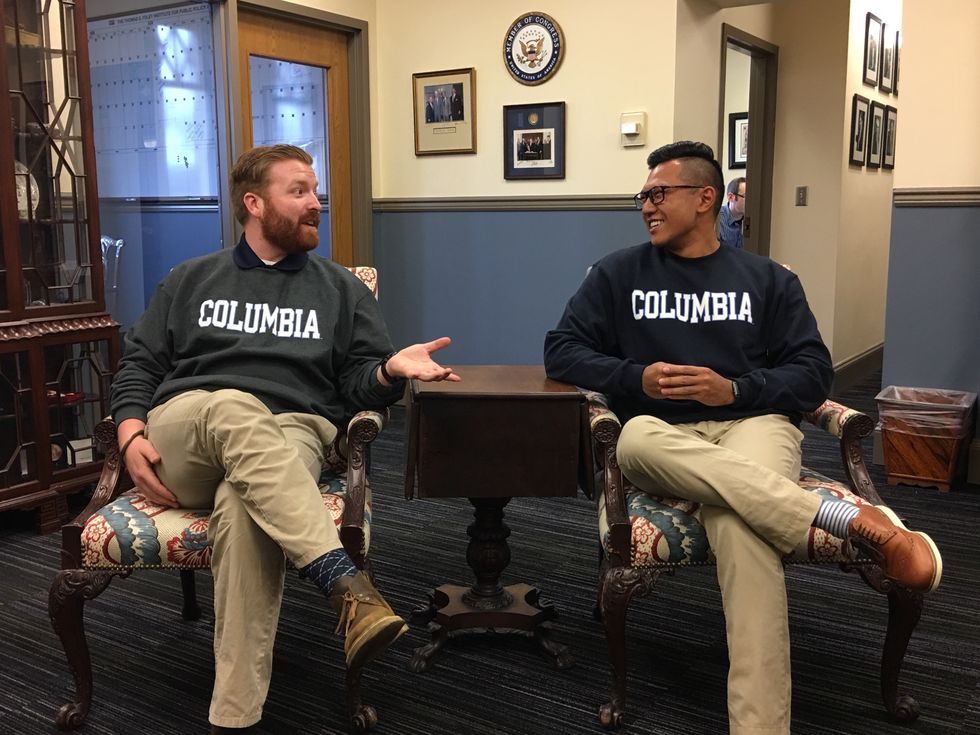
In any other circumstance, we would never have met. The path created for both of us to end up at Washington State University, in the midst of preparing for graduation, is one of wonder and inspiration. While the Charoonsophonsaks and the Schillings have diverse histories of their arrival to the United States, they share the same doctrine of the search for success and the opportunity to create legacy. Our ancestors were drawn by the “American Dream.” However, our generation, Millennials, are locked in an internal battle for a similar dream, one that, for many, seems to be out of grasp and out of sight. The “American Dream” of old is no longer viable or attractive to our Millennial generation. Hard work and determination; the idea of singular home ownership; a job to support a family; a secure middle-class life are all aspects of the American Dream that our parent’s generation sought. We don’t disagree with those aspects of the dream, but we see the need for revision; to create a revival in the “American Dream” and present a Millennial one.
The dream that we envision focuses on wonder, perseverance, connectedness, and social civility, a dream that gives our generation the audacity to sculpt a vision for the future overflowing with hope and faith.
The Charoonsophonsaks hail from Thailand, having had educational opportunities throughout their life. However, they envisioned a new beginning in the United States for themselves and their future family. Soon, in hopes of pursuing the “American Dream” of new beginnings and amazing opportunities in America, they audaciously leapt across the Pacific and settled to raise a family. America has been called a great many names: melting pot, salad bowl, soup of diversity. Succinctly, and for Millennials, we believe in integration. We seek integration of our work and social lives, family, and friends, national and international relations. Unlike the Charoonsophonsaks, the Schillings traveled from Germany entering the United States from the eastern shore, across the Atlantic hundreds of years before the Charoonsophonsaks. Although their journies differed from ocean to ocean, they pursued the same “American Dream,” one that would lead to success for them, and their descendants.
Yet there has been a major change in the landscape and understanding of what the American Dream is. Many journalists and articles have been questioning whether or not millennials have given up on the “American Dream” itself. Personally, we think that this is partially true, but not entirely. You see, millennials have just given up on the old notion of the “American Dream” and instead, we have created a new dream: the “Millennial American Dream.” The Millennial American Dream begins with a sense of wonder, a need for inspiration, for achievement. Motivation directs millennials to achieve more and do more, if our work or standing is void of wonder, we begin to lose interest and seek other opportunities. For us, that means working on a project that secures equal opportunity for all to succeed, or providing a new technology that solves an inefficiency. The Millennial American Dream is one where wonder provides the structure for success.
Our generation requires a growing connection to our fellow person, be it someone across the country, ocean, or sky. We understand that our actions at home have an equal reaction abroad, be it in a village or city across the continents. In short, the Millennial American Dream seeks to impress upon the world a growing legacy of interdependence and interconnectedness, that an individual’s success or failure, means success or failure to all. However, Millennials seek success in a much different fashion than previous generations. Millennials crave challenges, we want success to mean and matter more to us than just a paycheck or line on a resume. Largely this is due to the fact that Millennials, as a whole, strive to interest themselves in a myriad of fields and to become proficient in a wide range of tool sets. Naturally, we work to develop ourselves into global citizens fascinated by the newest technologies and a growing sense of interconnectedness.
Millennials are often misconstrued and over analyzed. “American Dreams” of old do not fit the mold necessary for our generation to find success. Indeed, our Millennial American Dream is a revival of the classic American doctrines that make this country great: life, liberty, the pursuit of happiness, equality, opportunity, individualism, and exceptionalism. Our social development, civic engagement, inspiration, sense of wonder, perseverance for success, and connectedness, while communal, allow significantly for independent changes and interests. The Millennial American Dream must be defined in order for a collective sense of mission. Once we are able to do that, there is no telling how our generation can change the world.
Just as the Charoonsophonsaks and the Schillings left their respective lands in search of a greater union, Millennials must too seek out, with this dogma in mind, fresh opportunities, and possibilities. Our ancestors took their own leaps of faith in order to provide their descendants with their own hope and faith. The Charoonsophonsak will continue on after graduating as a business analyst at Accenture in Seattle. The Schilling heads east to begin graduate school at Columbia University to study international history. With the Millennial American Dream in mind, the stage is set to persevere and strive to better ourselves, our communities, and our future. Ancestors of old sought success and security. Millennials must, with wonder, perseverance, connectedness, and social civility, light the way for the generations to come filled with hope and faith.