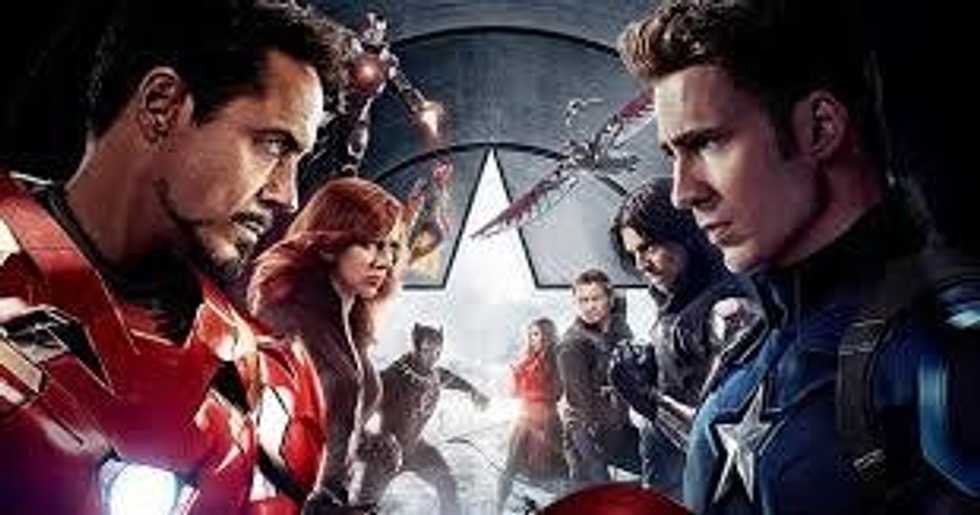
On May 6, American theaters opened with a fantastic new movie, "Captain America: Civil War." As I, and many others, flocked into the theaters after our last finals that day, our hearts were already fluttering with an intense excitement about the the events to come. The trailer alone had made me super anxious, especially with that heart wrenching scene where a heart broken Tony Stark says that he was Steve's friend, too, not just Bucky Barnes' (a.k.a. the Winter Soldier).
Well, the movie did not disappoint. It wasn't as action-packed as some of the other movies, but the action that was in it was awesome. It introduced some fabulous new super heroes to the Avengers team and Cap's team. I could write all day about the movie, and how amazing it was, and how I went to see it in theaters twice opening weekend. However, those things are only the tip of the iceberg. Sure, I walked away thinking about the plot, the new characters, and some of the other typical things you think about walking away from a Marvel movie. However, it wasn't until later that I began wondering if maybe the movie was more than just a movie. Maybe the movie we all waited anxiously to see had some deeper symbolism. Maybe "Captain America: Civil War" is really more like "Captain America: Civil Commentary."
Let me explain. If you have seen the movie, you know that Bucky Barnes really isn't the reason Iron Man and Captain America are disputing. The trailer made it seem like that was the reason, but in reality they were arguing over the "Sokovia Accords." The United Nations wrote up a manual of sorts that constrained the Avengers to their decisions. The Avengers group could only act in response to a calamity when the Council gave them the go ahead. This manual was named the Sokovia Accords because of the city's destruction during the fight between Ultron and the Avengers ("Avengers: Age of Ultron").
When the time came to sign the accords, Steve Rogers, Clint Barton (Hawkeye), and a couple others refused to sign. They didn't like the idea of being controlled by an outside council that had no experience in the things that they had been a part of, and felt like they alone held all of the knowledge and skills to control their actions. Tony Stark, Natasha Romanov (Black Widow), and the rest felt that the Avengers actions should be controlled by an outside council, so they signed the accords.
The role the UN plays in all of this is interesting to me. Should the UN have the power to control the Avengers' actions? Is the supposed safety of the world worth giving up the right to act as the Avengers see fit to defend themselves and to better the world? I started thinking that maybe Captain America and others represent those in our world who feel that America should be able to act according to what we feel necessary to defend ourselves and our allies. America has taken many actions in recent years in the name of defending liberty and helping people groups around the world. A lot of Americans fear the threat of UN control, claiming that we will lose our sovereignty. In the movie example, they would be like Cap's team.
Others (in America and abroad) feel that our actions need to be reigned in by a higher force for the protection of other nation's safety and sovereignty. In the example of the movie, they would be like Tony Stark's team.
I'm not saying that this was the writer's intention, but I do think its interesting the way it worked out. This is not one of those issues that's going to solve itself (very few issues do), and I offer you no opinions of my own. My goal here is to only make you think, and to bring to your attention that Hollywood incorporates things like this into their media.