


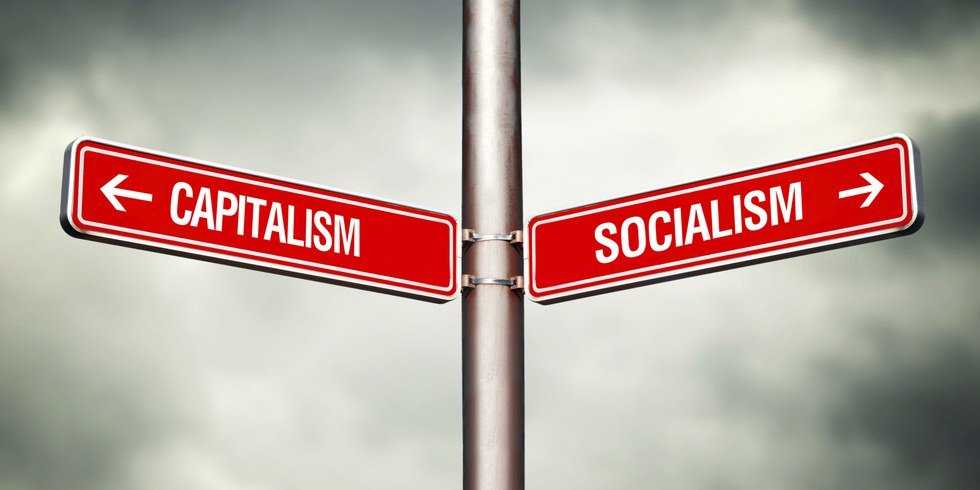
I’m not going to sit here and pretend I’m “fair and balanced” like some media outlets may try and have you believe. I have an opinion, and I’m not going to hide behind discrete agenda pushing to try and prove why I’m right. I’m going to keep my opinion until someone sways it otherwise. Capitalism is great. Socialism is horrible.
Now that we’ve got that out of the way, let’s be a bit more intellectual.
The dictionary definition of Capitalism is an economic and political system in which a country's trade and industry are controlled by private owners for profit, rather than by the state. Socialism, a political and economic theory of social organization that advocates that the means of production, distribution, and exchange should be owned or regulated by the community as a whole. Now, at face value they don’t seem all too different. But in practice, they couldn’t be less alike.
In order to objectively analyze each system fairly; in order to come to a valid conclusion, we must first try and view them without our pre-drawn conclusions. Try to detach yourself from individual experiences you may have had with each, and decide which is more practical. Imagine you are one of the founding fathers/mothers of a brand new country, and you are trying to decide which of the two would be most effective in keeping your economic, and overall ship afloat.
In socialism, the means of production lie in the hands of the people as a whole. Everyone works for the betterment of the community. It is dependent on altruism being a primary characteristic of human nature. In true Marxist Socialism, there is no need for money, because there doesn’t need to be a means for exchange. Everyone works for the betterment of each other, discounting individual ambition. Marx thought this would allow people to only do what they absolutely love as a career.
Now right away, I find a major flaw in this philosophy. Do we honestly think our society would be run as smoothly as possible if everyone was simply doing what they loved? It may sound harsh, but it’s not true nor will it ever be. What if everybody had a love for basketball, and virtually nobody had a love for farming? This doesn’t seem farfetched; basketball is fun, farming is brutally hard work. How effective would this be in feeding our population if we had an unlimited amount of basketball players, and pretty much no one growing our crops?
Capitalism’s solution for this glaring practicality hole is simple. Money. We need money to survive, so as long as there is a societal need somewhere in the market, someone will be willing to pay for it. The incentive of working for money fills most if not all societal aspects necessary for keeping the machine running smoothly.
Karl Marx and Socialism’s pragmatic solution for this conundrum is a more radical, and far more dangerous one. One that contradicts the very core of its moral philosophy. Communism. You still have no need for money, but means of production are handed over to a small central planning system. If you can’t count on everyone to have an interest in every aspect of society in a balanced way, might as well hand that responsibility off to a group of a few people to delegate people’s work for you. Right? Wrong.
More often than not, that central planning system is the state, and you just gave them all the power. As we’ve seen in case study after case study of communism, tyrannical regimes will inevitably rise once they are given unlimited power. From Stalin to Mao to Castro, it never ends well. Often in genocide.
Okay, so what if socialism kept its means for exchange. It kept money, and just evenly distributed it amongst the people. Democratic socialism as it’s often referred to as.
Democratic socialism is arguably theft, but since we are simply arguing practicality and not morality here, let’s take a closer look.
This too has its issues (sorry Bernie supporters). It is unpractical, but let me explain why from a psychological perspective. Imagine you are a scientist, and I work at a car wash. You and your team, through years of hard work and grueling days in the lab, miraculously discover a cure for cancer. I, on the other hand, work part time scrubbing Honda’s down with soap. Who contributed more to society? Well, the obvious answer would be you, but it doesn’t matter because at the end of the year, we both receive a check for $30,000. Okay fine.
Now let’s think ahead to next year. You just put in all that hard work with your unique talent and work ethic, yet you received the same compensation as someone who so obviously didn’t. Are you now going to be motivated to cure more diseases and advance society even further? Or are you going to take it easy because you can and everyone gets the same check at the end? I think that answer is obvious as well.
Let’s look at it as if we were both in the same field. Now we are both wheat farmers. Throughout the year, you produce 10 thousand tons of wheat, and I produce 25 thousand tons. At the end of the year, we both get a check for $30,000. Now whether jealousy is a factor or not, I will see that all I have to do to get my $30,000 check is produce 10 thousand tons of wheat. Farmers who produce more will start producing less and less until nobody in our society is producing wheat anymore.
No one does anything to progress society, and at the end of the year, all our checks go down to $25,000. This will continue to happen until no one is trying to move the species forward, everyone is just striving to survive, and relying on the government.
In my opinion, Capitalism’s argument is a sounder one. The incentive for money produces competition, therefore higher quality products. If all you have to do to make more money than your neighbor is make a product more people want to buy, you are going to improve your own product. How do you think you got the iPhone or the computer you are reading this article on? People trying to give you better stuff so they can make more money. Simple.
Now capitalism is obviously more effective in advancing the species, as even Karl Marx admitted, but a problem that often arises in capitalism is those who are left hanging at the bottom.
Ah, you thought I wouldn’t address it did you? Guess again.
The reason so many people at the bottom of capitalistic systems stay there is because they aren’t in fact in capitalistic systems at all. Like we have in America its crony capitalism, or corporatism, that paves the way for such top heaviness. How do we get to corporatism? Government regulation.
One of the reasons wages are so low and job creation is so difficult is because we have a minimum wage floor. That’s right, if you get rid of the minimum wage, wages will go up all on their own. All minimum wages do is make it so big corporations are the only ones who can afford to pay their workers. Small businesses will inevitably fail because they simply can’t afford to stay in business. People get discouraged at how hard it is to start a new business, stop starting them, and the big guys get to keep winning.
When there is no minimum wage, employers and employees enter mutual contracts that allow small businesses to eventually succeed, and competition wins out.
But how do more small businesses = higher wages for workers? Supply and demand that’s how. The reason wages are naturally low at this point is because work isn’t very valuable. There are far more workers than there are jobs available, so people will work for less. However, when you create more businesses, therefore more job opportunities, the workers become more and more valuable. Companies will then be bidding against each other for even low-skilled workers, and it’s a win-win.
My solution: cut the government’s ties from the private sector, and let the competitive nature of pure capitalism do its thing.
If we just look at case studies, my point isn't exactly hard to prove. True poverty doesn't exist in the united States. If you look at someone below the poverty line in this country, with food, shelter, and internet access, versus someone in poverty in Venezuela or Southeast Asia who will in all likelihood starve to death in the near future, the difference is a daunting one.
The main knock against capitalism is usually income inequality, but I’ll take a system of unequal success (USA) over a system of shared misery (Greece, Venezuela, Spain, etc.) any day.

















