
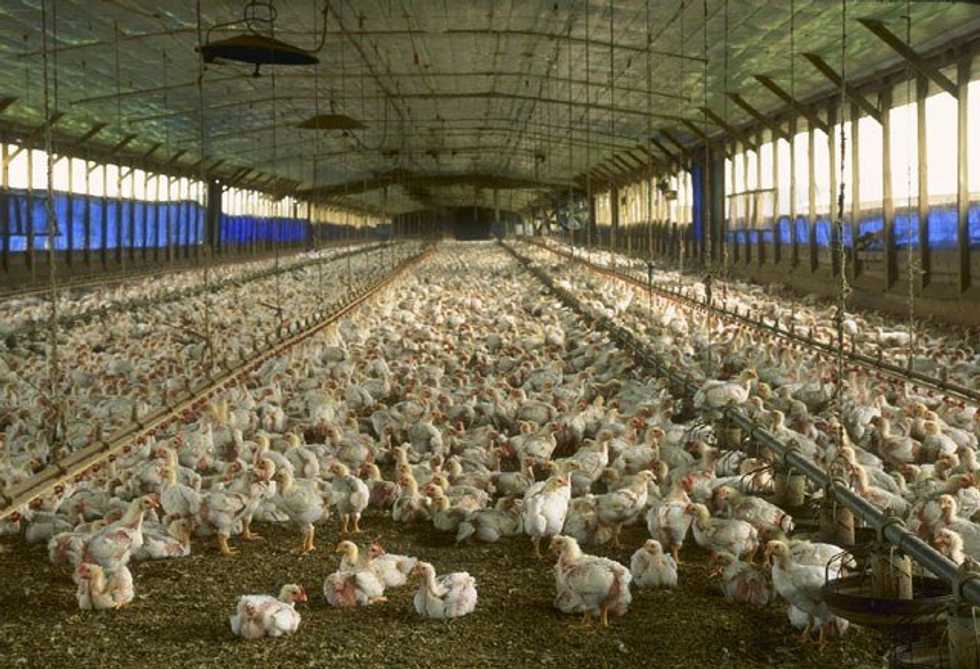
CAFOs, cage-free, natural, inhumane treatment, “Animal Care Certified”, greenhouse gas emissions (GHGE), live scalding, infectious diseases, hormones. You may have heard these terms in the context of factory farming, which is large-scale meat production from animals kept in the minimal conditions required for maximal production and profit. This involves atrocities such as confinement in cages where animals cannot turn around, debeaking poultry, and raising livestock indoors or in feedlots, not pastures. Mari Patis discussed this in her recent Odyssey article “CAFOs: The Issues with Modern Meat.”
This
issue may seem rather inconsequential and difficult for any
individual to solve. However, if we look down at the grilled chicken
on our plates, the burger we just ordered, or the eggs we eat every
morning, we come face to face with a solution we individuals have the
power to implement.
Your food choices make the difference.
Let
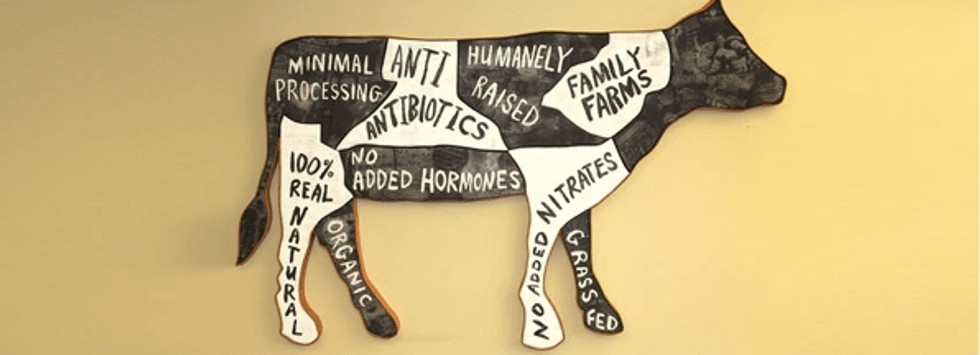
me introduce you to the “conscientious omnivore” (CO) diet, which
reduces
the frequency of meat consumption, limiting it to only meat produced
ethically.
To many people, “reduced meat consumption” essentially means
becoming a vegetarian or vegan. This is too extreme and difficult for
people who view meat as a significant part of their meals. However,
a CO diet is a practical way for consumers to reduce meat consumption
without giving it up completely, and thereby decrease the demand on
factory farms.
Unfortunately,
CO diets are not looked upon favorably from all sides. Social
psychologist Hank Rothgerber has compared vegetarians and COs and
discovered that COs
are more likely to cheat on their diets and not hide their dietary
preferences than are vegetarians.
He argues that because “diet
guidelines are different from CO to CO”, COs do not adhere to their
diets as closely as vegetarians.
That being said, isn't it more effective to mostly adhere to a CO
diet, rather than consider a vegetarian diet but decide against it
because of its extremity?
So,
if a CO diet is less extreme than a vegetarian or vegan diet and
still influential in solving the problem of factory farming, why do
we not meet more COs? Research from Deakin University shows that a
lack of information about reduced meat or mostly plant-based diets is
the largest barrier to changing eating habits.
Also, studies conducted by Rothgerber and University of Lisbon
researchers pointed out that unwillingness
to eliminate or reduce meat consumption is stronger among male
consumers than females,
a phenomena likely linked to masculinity.
However,
such barriers can be overcome. Nutritionist Jennie Macdiarmid et al.
discovered that consumers
can quite easily have nutritionally balanced diets without completely
eliminating meat or dairy products and reducing GHGE of consumed
products by 36 percent.
Vitamin deficiencies are possible with reducing meat consumption, so
Macdiarmid et al. include sample menus in their study. It is possible
to eat less meat, especially factory farmed meat, without having
nutritional deficiencies or being too strict.
Men
who feel more masculine when they eat meat may think less meat equals
less protein, resulting in smaller muscles. CO diets offer sufficient
protein sources and still include meat intake. In other words, you
can be a part of the solution and eat your meat too.
Although
factory farming is a multi-faceted problem that requires numerous
solutions, changing our diets can play a significant role in taming
this beast of a problem. Leaving factory farming to solve itself will
only increase its deleterious impact—GHGE and infectious disease
risks for animals and humans will continue climbing. It will
inevitably hurt us humans.
So,
as consumers who create the demands that drive food producers, let us
use our power responsibly and do our part to solve this issue. It is
time to think critically about how we view, choose, and eat meat.