
The days of New World expansion and roaming across frontier after frontier are gone. There are no new grand civilizations lurking over the next mountain or river and no new continent to explore over the horizon. But as we have stopped our roaming across the seas in search of new worlds, it seems we have also long forgot about a world yet unexplored: the sea itself.
We are just barely in the stages of realization, waking up to the idea that the ocean, what was once mankind's first frontier, is still today the most mysterious and unexplored one. It is our greatest asset, one which we have failed to treat as such with the constant pollution and destruction of its marine life and one we have failed to understand well since we know far more about the moon and Mars than we understand about the depths of our ocean. 95 percent of it is still unexplored and only a fraction of a percent has even been properly mapped.
Yet the future of exploration and innovation may belong just as much to the ocean and submarines as it will to space and rocket ships, and the first signs of this Jules Verne novel have begun to appear. A Japanese construction company named Shimizu has released real plans to build an underwater city with the ability to accommodate over 5000 people in it.
The "Ocean Spiral" project would include a great sphere at the top mainly submerged in the water and would include lobbies that would spiral downward into the ocean's depths. Primarily powered through thermal energy from the sea floor, this eco-friendly project would be a new feat in engineering, one that they hope to have completed by 2030.
The agricultural industry is also getting aquatic, pushing the crop fields out upon the waves. There have been programs now to produce herbs and vegetables using pods submerged several feet underwater. The plants have sufficient sunlight and water that is filtered in from the sea surrounding it and made usable for the plants. Pods or even barges like this could be instrumental in helping meet the growing food demands since we have the whole surface of the ocean to utilize.
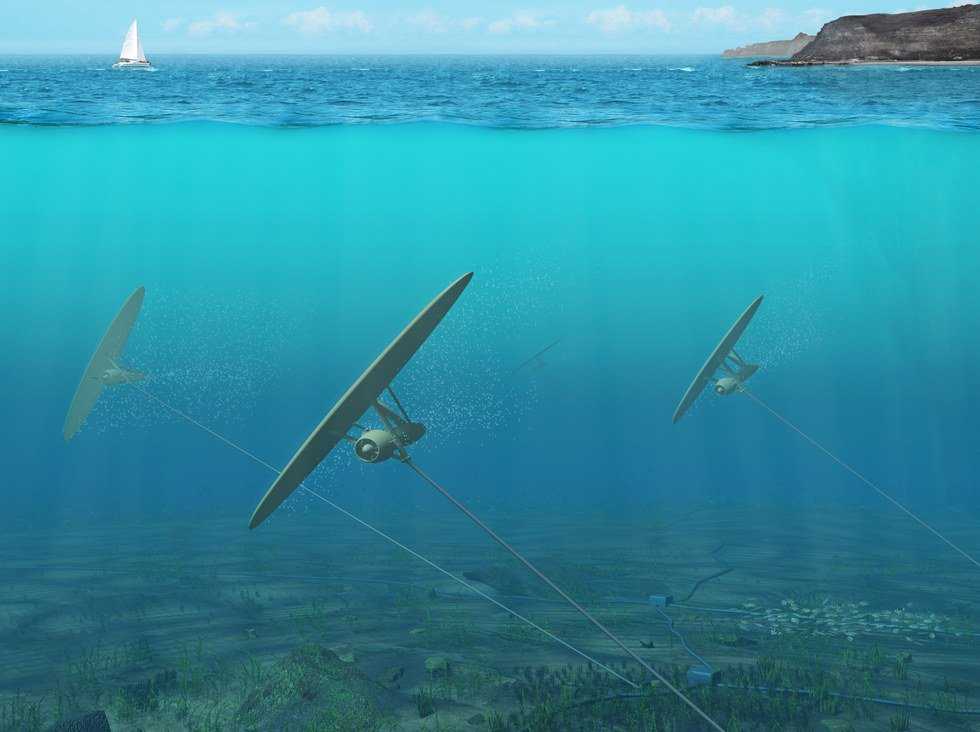
The ocean is also the window to powering the world. Going blue may vastly help efforts to go green. First there is thermal energy from sea vents, but the seawater itself is a wildly untapped source of energy as well. Recent ingenuity has brought about the invention of sea kites: specially mechanized kites that are now being placed underwater with strings attached to turbines. Like a windmill, the currents push the kites causing the turbine to spin and produce huge amounts of energy.
Underwater this process is exponentially more efficient because the kites can move around with the currents and reach incredible velocity since the water it is pushed with is much denser and more powerful than air currents. The tide could power the world; devices like this could produce massive amounts of power relatively cheaply and quickly. Even buoy technology could potentially harness the energy of the ocean's bobbing surface by pulling a turbine in a similar way.
The ocean is the future: the future of food, energy, and potentially our lives as well, and it will be exciting to see what's to come. Such an idea is not without its risks and drawbacks. Colonizing the ocean could be disastrous if we approach it in the same manner we have treated so much of the planet in the past. I can only hope that such projects will help to better the planet working with the ocean rather than taking it apart reef by reef. So it is with optimism that we can perhaps look to the ocean with our future in its waves.
As astronauts once landed on the moon while we watched with awe, ship loads of aquanauts may soon swim upon their own man-made seascapes and triumphantly declare one small stroke for man and one giant dive into the unknown for mankind.