


A few days ago, I was driving home with a friend who had recently turned 18. To my surprise, she told me that prior to picking me up, she had bought a pack of cigarettes. I jokingly asked if she was stockpiling before California enacted a law in June that would move the legal age of buying tobacco products from 18 to 21. She replied that she was actually buying them for a few friends who were regular smokers, as they were still only 17. Cases like this are quite common, so how effective will the new law be in preventing underage smokers?
The habit of smoking often starts at a young age. According to the Surgeon General Report in 2014, 80% of smokers first try tobacco before 18, and 90% before 21. In theory, this law tries to hamper the ability of younger people from getting access to cigarettes and other tobacco products by increasing the age limit.
It’s frighteningly easy to get cigarettes, even as a minor. A 2015 survey by Monitoring the Future showed that 47% of 8th graders and 66.6% of 10th graders believed that cigarettes were easy to obtain. To be fair, these percentages been steadily declining since 1992, the first year the survey started. Many states began to pass legislation for a minimum age for smoking, mostly 17, 18, or 19, during the 1980s and 1990s. Passing a minimum smoking age did seem to have some effect in limiting youth smoking in the past.
If this is the case, how are kids still able to obtain cigarettes so easily? In the 2003 National Survey on Drug Use and Health, 53.3% of 12-17 year olds had purchased their own cigarettes directly from a store, 63.3% of kids had given money to a friend to buy cigarettes for them (like my aforementioned friend), and 30.5% of kids purchased cigarettes indirectly, or from another source, such as a friend or family member. It’s tough to say what raising the age limit on tobacco products will do to these numbers. Over half of the minors surveyed have been able to buy cigarettes from the stores themselves, despite being underage. In a separate study by the CDC in 2006, 48.5% of 9th-12th graders weren’t asked to show any proof of age when purchasing cigarettes. Age restrictions for selling tobacco are often not enforced, undermining efforts like this to reduce smoking by increasing the legal age, and it is difficult to standardize regulations because smoking laws vary from state to state, and even from county to county. However, California has some of the strictest laws in the nation. Comprehensive tobacco control programs in California have been shown to significantly cut down the amount of stores that sold tobacco products to minors, both intentionally and unintentionally. Laws are useless if they are not properly enforced, but California doesn't have a problem with this issue particularly.
Although kids will still be able to have others buy cigarettes for them, the number of incidents may decrease with the new smoking age. Many students turn 18 sometime in their senior year, so there is plenty of access to cigarettes as long as you have a 12th grade friend. The new smoking age complicates this a bit, as now no high school students should be able to legally buy cigarettes. Fake IDs are still an issue, as about 12.5% of high school students own a fake ID, with this increasing to as many as 32.5% of students by the time they reach the second semester of their sophomore year in college. In addition, it is more likely that students who have fake IDs are more likely to participate in illicit activities anyway, such as underage drinking and smoking. Enforcing the new smoking age won’t affect these people at all.
Perhaps the best evidence for how effective this law will be is Hawaii, which is currently the only state that has the tobacco age limit at 21. Hawaii has some of the lowest youth smoking rates in the country, with the second lowest rates of smoking cigarettes, cigars, and overall tobacco use, and the lowest rate in use of smokeless tobacco. Unfortunately, California did not collect extensive data on youth tobacco use so it’s impossible to compare.
It’s difficult to predict the exact effects of raising the smoking age. However, if we want to stop youth smoking, we can’t stop at raising the age limit. One of the most effective ways to tackle youth smoking is by increasing the price of cigarettes through taxes. California has the 17th lowest excise tax rate on cigarettes, which may not seem significant, but 15 of the states that have lower taxes are in conservative states that favor low taxes in general. With such a progressive community, California fully has the power to raise taxes on cigarettes. Indeed, in the packet of bills that was sent to Governor Brown relating to creating stricter smoking regulations, one of these bills would have allowed counties to impose local cigarette taxes in order to help pay for the healthcare cost of those with tobacco-related illnesses. However, the governor vetoed this bill, stating, “Although California has one of the lowest cigarette tax rates in the nation, I am reluctant to approve this measure in view of all the taxes being proposed for the 2016 ballot.” There are multiple studies proving that taxation is an extremely successful deterrent against buying cigarettes, especially for minors, many of whom don’t have a stable source of income.
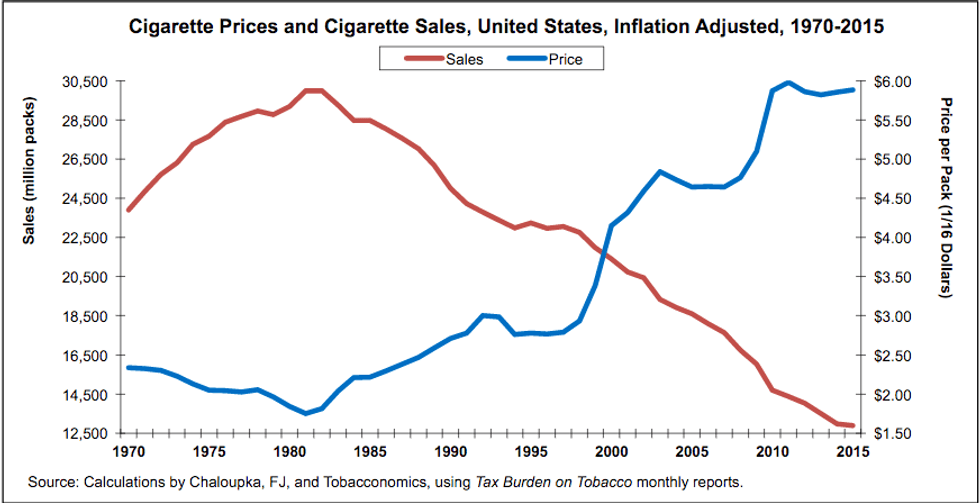
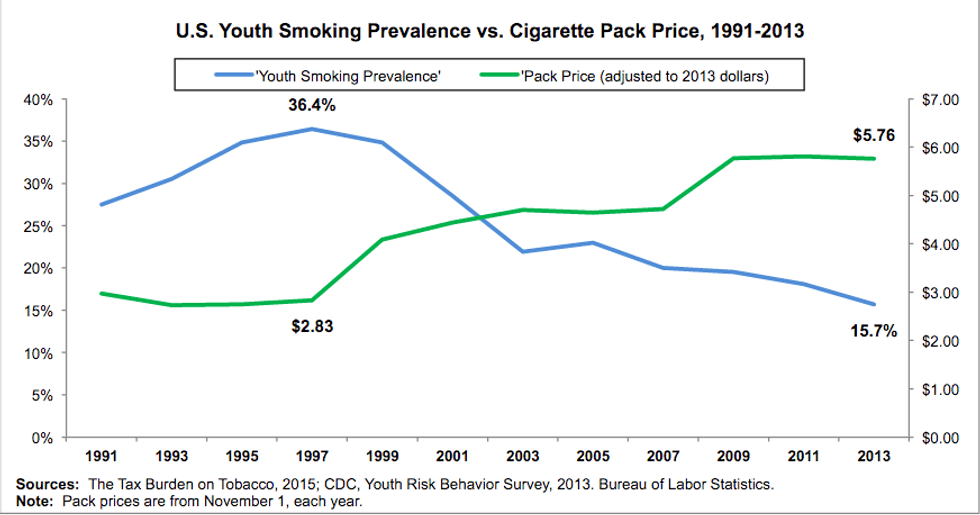
Ultimately, raising the smoking age to 21 is predicted to save many lives. A 2015 study by the Institute of Medicine predicted that there would be 200,000 fewer premature deaths due to smoking for people born between 2000-2019 with the smoking age raised to 21. Smoking is the leading cause of preventable death, and other states should follow suit. However, there are other effective measures to reduce smoking that California has yet to take, such as raising the tax on cigarettes, promoting aggressive ad campaigns on the dangers of smoking, and even promoting physical activities like sports at a young age. If California wants to truly eliminate underage smoking and even smoking in general, raising the smoking age isn’t enough.