PART I: THE SILENT ERA AND GERMANY
The first horror film ever made was actually The House of the Devil, directed by Georges Méliès in 1896. While not a full length film with a running time of two minutes, it was the first captured video that incorporated gothic elements such as ghosts, demons, and old castles. Jumping forward to the first decade of the twentieth century, filmmakers released several experimental films such as Frankenstein (1910), Dante's Inferno (1911), and Der Golem (1915).
1920s Germany birthed several of the fathers of early horror, including F.W. Murnau and Robert Wiene. The latter directed the Daddy of horror: The Cabinet of Dr. Caligari ('20). Cabinet capped off Germany's unique cinemetography and use of distorting filming techniques that would be  used throughout the decade. Carl Boese directed a prequel to Der Golem, which was also called Der Golem ('20) and resonated with Semitic themes. For his directorial debut Murnau made Nosferatu ('22), an unauthorized adaptation of Bram Stoker's Dracula, though that film would haunt him after the release when the late Stoker's family sued and later took him to court.A judge ruled that all copies be destroyed, but, since the movie gods knew this was a masterpiece, a few prints survived and Murnau's film is now considered to be one of the silent era's most influential films that set the standard for the horror films that followed.

PART II: TALKIES!
With movie tickets being only a few few cents, 80 million Americans attended movie theaters weekly. As movies became more and more popular, studios went to great strides to best each other by incorporating innovative and new technologies into their films. The first talkie (The Jazz Singer) came out in 1927, and sound soon became the standard of motion pictures.
1931 was a big year for horror with the births of (authorized) Dracula and Frankenstein on the big screen. Dracula, directed by Tod Browning had Hungarian stage actor Bela Lugosi starring as the title character (Lugosi even requested to be buried in his cape from the film) and Frankenstein (James Whale) starred Boris Karloff. These two films spawned several sequels, reboots, and rip-offs and are today considered beloved classics, forever memorializing Lugosi and Karloff as two of the integral faces of horror.
 The following year, Browning directed Freaks, one of the first body horror films that centered around a trapeze artist's attempt to marry a side-show performer for his inheritance, and the subsequent revenged enacted by his fellow performers. It was a massive box office success that was later censored and banned in several states and cities and reportedly caused a woman to miscarry due to the shocking events in the film that were veeeeeery controversial for 1932.
PART III: B-MOVIES AND CLASSICS
Post WWII audiences were still reeling and on edge for the war, which led to the rise of B-movies, relatively tame and cheap films that were nevertheless carved a new path of horror that relied on suspense. The '50s gave us many schlock films with no substance and laughable monsters, but they also gave us masterpieces such as House of Wax ('53), Them! (53), The Fly ('57), The Blob ('58), and House on Haunted Hill ('59). A subgenre of '50s-'60s horror is every film that Vincent Price appeared in. 
A large British man named Alfred Hitchcock was already enjoying mild success across the pond when he decided to direct the adaptation of Robert Bloch's novel Psycho. Hitchcock didn't give a crap about the heavy CGI that had littered the '50s, preferring to use practical effects and hone in on his characters' psyches. Edit
Another director changed the film by injecting zombies into the mix on one scary night in 1968. Armed with a budget of approximately $114,000, 28-year-old George A. Romero set out to make a film about a group of people hiding in a basement while the dead, who have returned to life outside, really want to cannibalize them.
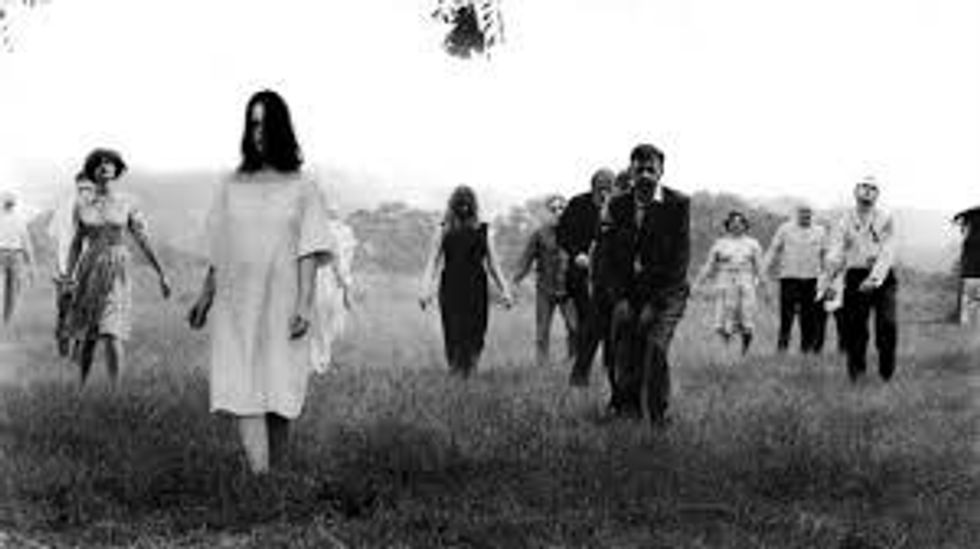 Reader's Digest warned its readers that Night of the Living Dead would inspire cannibalism if watched, but the provocative film went on to become a massive success. Romero directed five sequels between 1978 and 2009, and the first three were remade in the '90s and early '00s. By splicing together psychological terror with a creature feature, Romero's allegory for racial tension is now considered a vital staple to the horror genre.
Boys and ghouls, if I were to mention every important horror film in this period, I'd be here all day. Here are some more films from this period that I love and consider worthy of mention:
The Phantom of the Opera ('25)
Faust ('26)
Island of Lost Souls ('32)
Vampyr ('32)
The Wolf Man ('41)
Cat People ('42)
The Uninvited ('44)
Dead of Night ('45)
The Picture of Dorian Gray ('45)
Invasion of the Body Snatchers ('56)
I Was A Teenage Frankenstein ('57)
I Was A Teenage Werewolf ('57)
Night of the Demon ('57)
Plan 9 From Outer Space ('59) [This one is actually considered one of the worst films ever made. But please still watch it. It's so bad that it's amazing.]
Eyes Without A Face ('60)
The Innocents ('61)
Carnival of Souls ('62)
What Ever Happened To Baby Jane? ('62)
The Haunting ('63)
Onibaba ('64)
Repulsion ('65)
Rosemary's Baby ('68)
Witchfinder General ('68)
Tune in next week for part 2 ('70s-'10s)!