


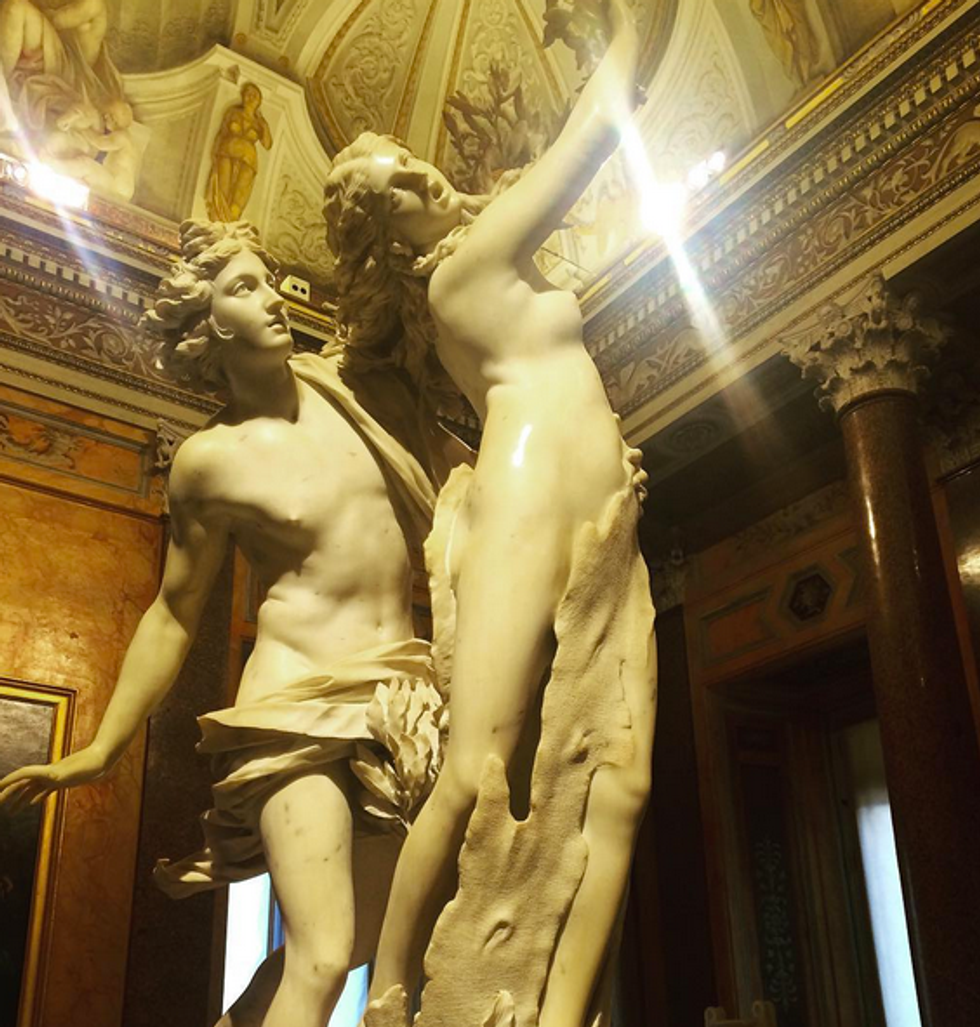
By the time I stepped off the plane in Rome, I was sick of Apollo. Apollo, the sun God, also known as the God of youth, simply did not click with me. I didn’t connect with my God the way I thought I would. The myths I studied, “Apollo and Daphne” and “Apollo and Python” were entertaining, but did not hit me on a personal level. To be quite honest, I found Apollo portrayed in the myths to be immature compared to other gods such as Demeter and Athena. While I appreciated the artwork associated with Apollo, it just did not strike me in any particular way. Yes, the 2D images of sculptures and paintings I observed from my laptop were stunning, but I did not appreciate them on any level but the surface. I was more interested in viewing art that would tell me about the history of Rome, such as “Lupa,” the sculpture of the she-wolf nursing the baby twins and founders of Rome, Romulus and Remus. This was until I viewed the sculpture “Apollo and Daphne” by Bernini in the Borghese Gallery.
“Apollo and Daphne” by Bernini depicts the famous myth about Apollo. After Apollo had defeated the monster Python, he began to tease Cupid about his ability to handle a bow and arrow. Angry, Cupid fashioned two arrows, one with lead which would cause the person struck by it to be repulsed by love, the other with gold which would cause the person struck to fall madly in love. Cupid struck a nymph named Daphne with the lead arrow. Daphne, now desperate to never marry, begged her father to allow her to live a chaste life without marriage. Eventually he agreed. However, Apollo had fallen madly in love with her and needed to have her. He chased her relentlessly, proclaiming his love for her. When Daphne realized she would not be able to escape his grasp, she begged her father to change her form. Daphne was then changed into a laurel tree. Apollo, heartbroken, took leaves from the tree and wears them on his head as a symbol of his love.
The Borghese Gallery, located at Piazzale del Museo Borghese in Rome, is an old Villa surrounded by gardens and greenery. As we walked through the grounds, we could feel a liveliness in the air. As we stepped into the museum, it felt as though we entered a person’s home. It had a marble interior with high ceilings and elaborate arches. Every ornate detail of the museum seemed personal. I almost felt like I was trespassing. As we made our way through the first floor of the museum, I knew I was in for a treat. I marveled at the art around me as it was meticulously placed in order to tell a certain story. Upon entering the room with the work, Isabella, our tour guide who is also an art historian, shared that originally, the work was towards the wall, instead of where it currently stands in the center of the room. She explained that this is because Bernini was a story teller and wanted the story he depicts through his art to be visible.
"Apollo and Daphne,” by Bernini, spoke to me in a way that shocked me considering my aforementioned boredom with Apollo. The structure itself is massive, with intricate details. The sculpture, at first glance depicts Apollo grabbing Daphne as she transforms into the laurel tree. However, as Isabella explained, we can actually see different parts of the myth unfold depending on which side we view the sculpture. Starting at the side, I observe Apollo chasing Daphne with his robe flying behind him as folds of fabric overlap each other. The marble is carved so thin I can almost see through it. From this angle, we view Apollo’s strands of hair, and the bones and taut muscles that spread throughout his body as he runs after Daphne. His face is handsome and youthful, with graceful features, the look of determination in his eyes is obvious as he approaches closer to her. In Daphne we see her long hair gracefully flying behind her as she attempts to escape Apollo’s clutches. Her facial features are soft and elegant, but pleading for help simultaneously. From this angle, we notice that as she reaches up, calling out to her father for help, Bernini has created the soft folds in her marble skin. It looks so lifelike that if one of us were to reach out to touch her, it seems as though she would react. Also at this angle her calf is being engulfed in tree bark, starting her transformation. The bark on the tree is so intricate that it would seem authentic if not made out of pale, ivory colored marble.
As we moved on to the front of the sculpture Isabella treated us to the next part of the myth. In this part of the myth, Daphne’s transformation has continued and Apollo has become aware of what is happening to her. His facial expression has completely changed from this angle, he is now frowning out of confusion. At this angle he has stopped chasing her and is observing what is happening, unsure of what to do as his hand lightly grasps her abdomen triumphantly. We can lightly see the imprints of his fingers into her skin. The tree bark has spread from Daphne’s calf, to the rest of her leg, towards her hips. Her reaching arms are turning into branches as her hands and fingers turn into laurel leaves. These laurel leaves are particularly striking. Our tour guide informed us that as Bernini was carving out the leaves, he used the laurel leaves growing outside his window as a reference to recreate the texture and thinness of the actual leaves. Each laurel leaf, I noticed, was unique from the other. At this angle, I can clearly see Daphne’s terrified facial expression even more.
As we move once again to the next side of the sculpture, we observe the end of the myth. Daphne’s transformation is all but complete. The tree bark continues to engulf her. From this angle, Daphne almost looks at peace as she nears the end of her configuration. The bark has climbed up the entirety of her leg and has moved down her arms and to her shoulders. There is quite an abundance of laurel leaves visible at this angle. Apollo is less visible at this angle, signifying that he is definitely no longer the one in power in this situation. He is nearing defeat and heartbreak. From this angle I noticed that the tree bark, rather than laying on top of her skin, has become Daphne’s skin.
“Apollo and Daphne” is extremely powerful. It blew me away and struck me in way I did not expect. This work of art allows you to literally watch the myth unfold. This aspect is so unique and gave me a perspective on the myth I had not previously had. I was struck with appreciation for the amount of intricate detail Bernini used to make the work realistic and emotional. I sympathize with both Apollo and Daphne in a way I had not before. I could sympathize with her terror just as much as I could sympathize with Apollo’s loss of love. I was truly speechless upon viewing this sculptures. It simply took my breath away, which is shocking, considering prior to entering the Borghese Gallery, I was fed up with Apollo. Seeing the actual sculpture was a completely different experience than observing the images online. When I observed images online, I realized I was seeing through the lens of someone else and not my own eyes. Perhaps viewing the work through person who took the photo’s perspective blurred my ability to have your own, making it hard for me to connect with the work. After having this experience, I have a newfound love for Apollo.















