
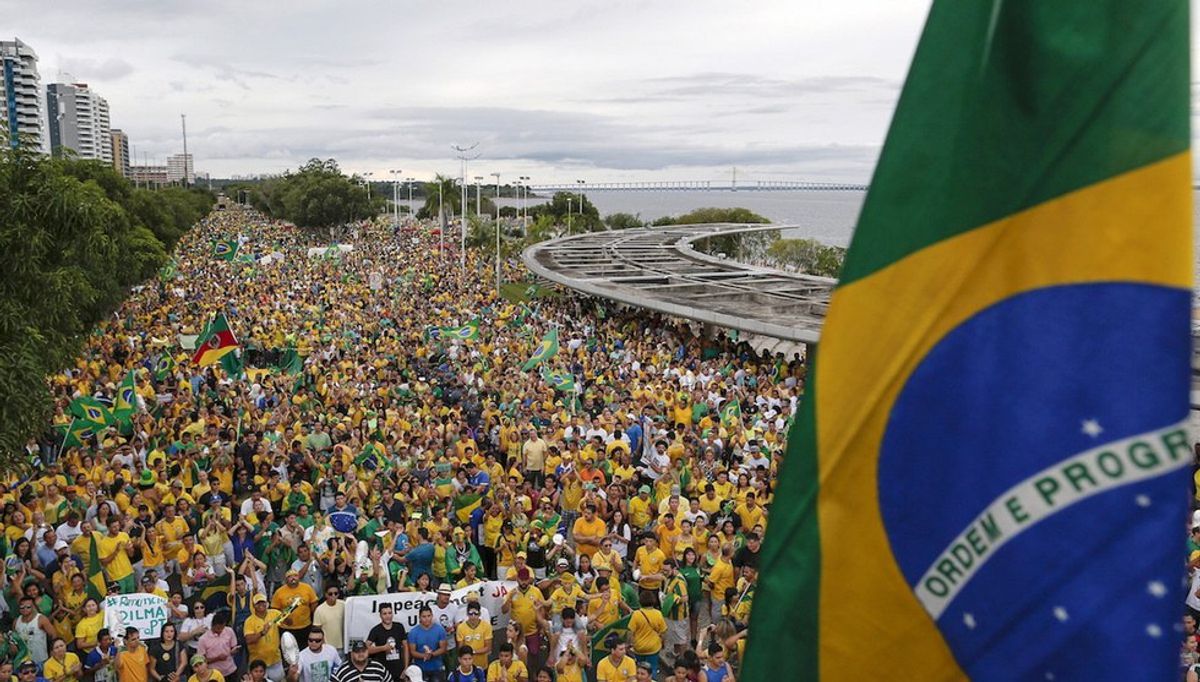
Since March 2014, Brazil - or the “country of the future” as it is known in various political and media circles - has been engulfed in a political corruption scandal of colossal proportions known as the Petrolão. Examining this matter is a 43-year-old federal judge - Sérgio Moro. Despite his soft-spoken and “nerdy” demeanor, Moro has become nothing less than a national crusader against political corruption through his relentlessly aggressive targeting of Brazilian political elites.
The investigation which Moro leads, nicknamed “Operation Car Wash” - Operação Lava Jato - has exposed a scheme at the Brazilian state oil company Petróleo Brasileiro S.A. (Petrobras) that has cost the country some 3 billion dollars. Implicated in the scandal are 352 out of 594 - about 60% - members of Brazil’s Congress including lower house speaker Eduardo Cunha, current vice-president Michel Temer, and some even suspect president Dilma Rousseff. Charges range from embezzlement, bribery, and money-laundering to kidnapping and murder. And although Ms. Rousseff, who has sat on the board of Petrobras, is not implicated directly, she faces accusations of using loans from state banks to plug a budget hole - a violation of the country’s financial responsibility laws.
Arrests of Brazil’s prominent business figures such as Marcelo Odebrecht and Otavio Azevedo aside, the political implications of such a scandal for a country already considered one of the most unequal in the world are simply mind-boggling. With the recent global economic downturn as well as arrest and interrogation of Brazil’s former president Lula - a man of working class origins who came to power on the promise to elevate the country out of poverty - one might venture to conclude that things are not all that great in Brazil. Yet what this scandal signifies in reality is a positive development - a ray of hope in an otherwise corrupt society known for it’s “Brazilian way” or jeitinho brasileiro. While the concept is synonymous with finding a creative solution to problems when facing a scarcity of resources, more often than not it manifests itself as a way of circumventing rules and conventions by means of bribery or nepotism.
As such, current political turmoil demonstrates a broad change in the way Brazilians want to be governed. The economic miracle of the past decade, having lifted 40 million out of poverty and into a middle-class living standard, has acted as a catalyst for a shift in the nation’s mentality. No longer are the people willing to accept corruption and lack of transparency as a way of life. No longer are the people willing to subsidize the extravagance of high-flying politicians and well-connected business leaders. The Brazilian public is in search of fairness and access to resources for all. Furthermore, the independent judicial institutions Brazil has built since its transition to democratic governance in 1985 are proving themselves as willing and very much capable of reigning in the excesses of the executive.
Critics may claim this to be an attempt at a “coup,” yet it is clear that Latin American leftist leaders’ definition of the term is strangely out of touch with reality. Venezuela’s socialist leader Evo Morales, for example, believes that both the courts and the legislature must be under the directive of the executive and any attempt at a system of checks and balances is a coup. Similarly, Argentina’s former president Cristina Kirchner, when faced with a criminal investigation into the 1994 Buenos Aires bombing as well as a more recent murder of the special prosecutor involved in the case, condemned the matter as a “judicial coup.”
Thus, what Brazil desperately needs now is to not lose steam. The investigation must go on unhampered and at full speed. Given the depth of the scandal, Brazil’s public must urgently demand a constitutional amendment that would allow for an early general election. Military juntas being a thing of the past and no looming threat, president Rousseff, who no longers governs in any meaningful sense of that term, should step down or face impeachment proceedings leading to an early presidential election. Such a radical re-arrangement of Brazil’s political landscape is not only necessary and proper but will also serve as an impetus toward much needed economic and political reform as well as toward the preservation of truly democratic governance on a regional level.
















