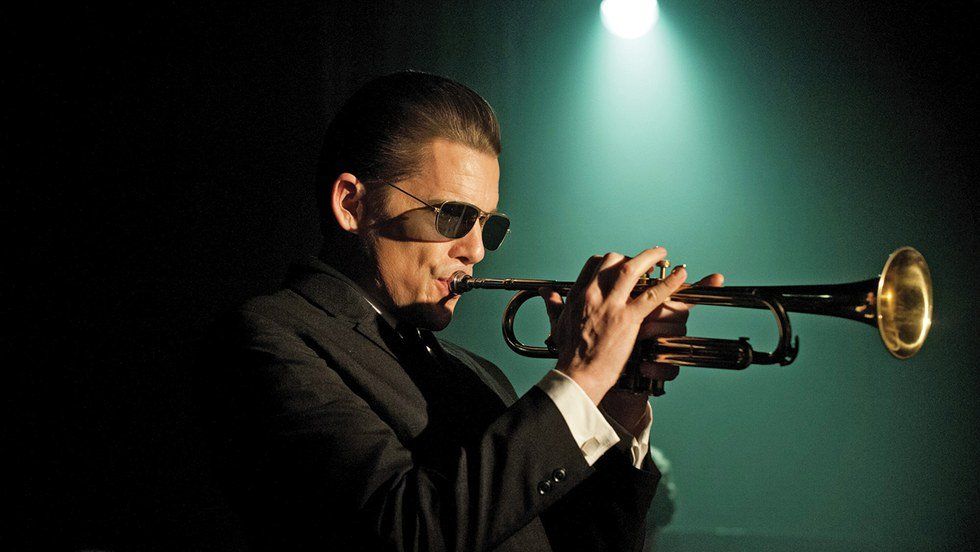
"I don't want a career," Chet Baker says to his manager, Dick, in the riveting penultimate scene in a New York club dressing room. "I want to play the trumpet."
In "Born to Be Blue," written and directed by Robert Budreau, Ethan Hawke plays Chet Baker, a famous Jazz Trumpete, most prevalent in the 1950s and 60s, battling with heroine addiction. When he gets mugged outside of a bowling alley from his heroin dealers, resulting in getting his front teeth knocked out, Chet has to learn to play with false teeth in addition to staying clean.
The first act — specifically the explanation of Chet's life prior to what happens in the film--is very unconventional. We first see him right at his lowest: laying down in a jail cell in Italy. Chet is bailed out by a Hollywood director and the next thing we know the film has turned to black-and-white and we see Chet performing at a club very similar to the one we see at the end (don't worry, there are no spoilers in this review). What ensues is an extended cologne commercial: smoke, jazz, cubism camera shots, and Miles Davis. Okay. Maybe Miles Davis isn't usually a regular in cologne commercials.
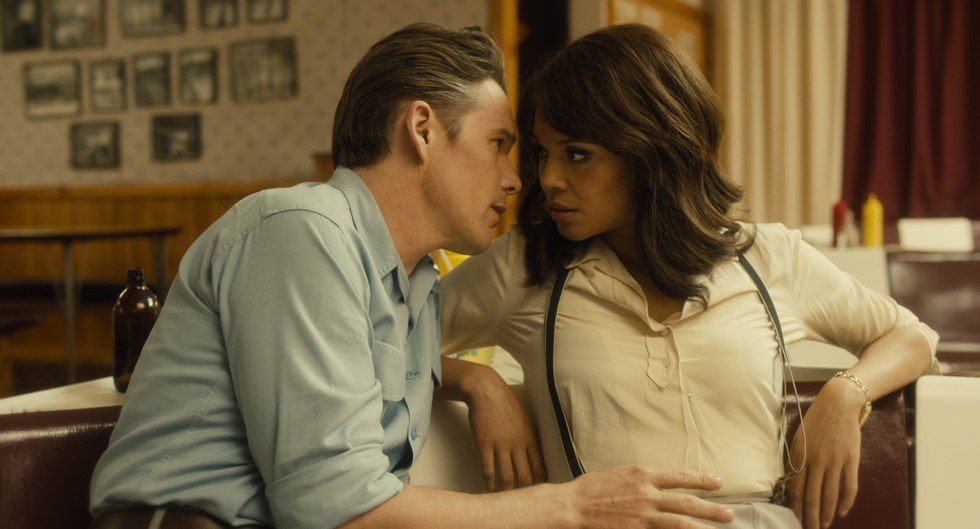
Chet brings a girl back to his room, and she gets him to try heroin for the first time. Not a minute later, his wife Elaine comes in, played by Carmen Ejogo. Jane kicks the girl out, argues with Chet, and they start to discuss improvising.
Wait. What?
The director yells cut, we go back to color, and later than I would like to admit, I realize this was all Chet playing himself in a biopic, and Ejogo does not play Elaine but Jane, an actress. The idea that Chet can play himself, a character so blatantly worthy of antihero status, and go along the job, even ask the actress out that plays his ex-wife (with success), is very eerie, especially with the determined calmness of Hawke and his boyish, ethereal tone of voice he portrays Chet with. Throughout the film, but especially in the aftermath of Chet's injury, we are brought back to Chet's past, which he doesn't look back on with relief but regret. He still craves that world, even with the strings that come with it.
Chet is accompanied for a great amount of screen time, to a fault, even, by Jane, his love interest. What could have easily been written off as the pretty, supportive love interest becomes a fascinating character in Jane, someone who understands the complexities and sympathies of Chet even better than the audience does (which I'll get to later). She can talk about priorities one minute and Chekhov the next, but she also does not come off as the extemporaneous, free spirit that "saves" Chet. Elaine is her own person until the very end, and is an additional riveting part of the story.
The real spectacle here is Chet Baker, but especially Ethan Hawke. Many people say "the best acting doesn't look like acting." I respectfully disagree. I believe the best acting looks like someone is acting, but it's always consistent to the character and always at 110 percent. Hawke gives us that unrealistic percentage and then some, playing the soft-spoken Baker with a tender surface but a hard shell underneath. His performances, a healthy part of the film, are very convincing as well, especially by someone who hasn't played trumpet before.
"Born to Be Blue" is, above all else, however, a study of the artist and what he needs to succeed. Chet constantly claims (at separate times) he needs two things to succeed: heroin and Jane. Being that he's succeeded with these in the past, the claim isn't dismissed as a lunatic junkie archetype but instead with sympathy and even some truth. "It's always been you," his manager says, and even the audience has to question that.
A few reservations with this. Though the film was a good tool to show the past, Chet's motivations are rather quiet and seem to scale up toward the end than be expressed at the beginning. He often becomes reminiscent of a quiet child, constantly unhappy but you're never sure why. This would have been good, in the first half in particular, to see a little less of Jane and a little more of the professionals in his life, people who simultaneously want the best for him and not like his decisions. As well, speaking of the first half, the visit at Chet's parents' bucolic house is a poor change of pace following his announcement, and though it does pay off eventually from a steady buildup in the whole second act, a less contrived plot device should have been encouraged.
Regardless, "Born to Be Blue" still soars due to fantastic performances from Hawke and Ejogo, an unconventional screenplay, and the proposition of complex themes.