

Right now, I'm thinking out loud about several things. For one, I am still internally screaming about the fact that Ed Sheeran won a Grammy. This can't be reality, can it? Surely enough, this happened:
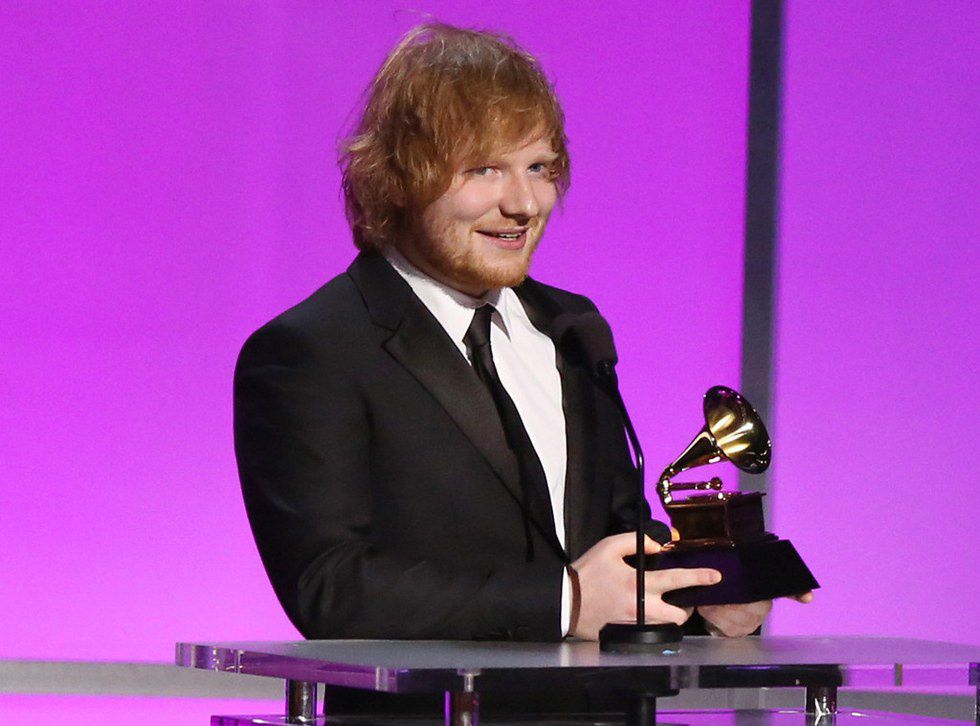
It was a beautiful moment for us "Sheerios," a nickname given to Ed Sheeran fans. However, the Sheerios aren't the only fandom who's desperately been waiting to see their artist shine. As you can tell by the title, this is not an article about Ed Sheeran.
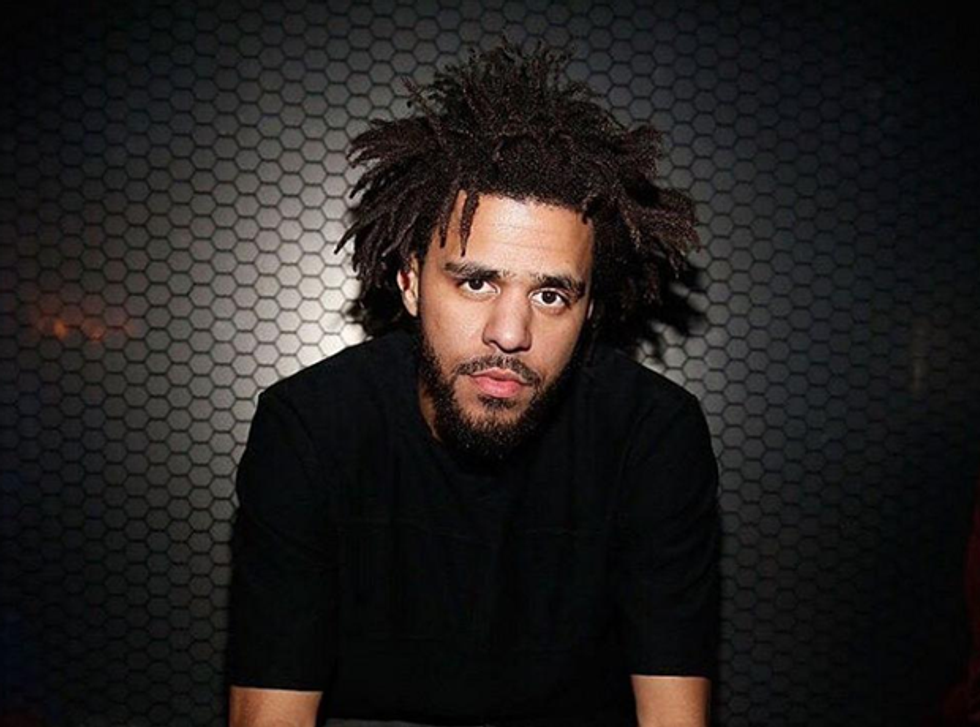
While I do believe that his vocals are like a scented candle (because they warm you up inside), there's another artist who's deserving of a Grammy: Jermaine L. Cole. That night, us born sinners were reminded that it's still a cole world for Jermaine, who has been very vocal about his distaste for the Grammys before:
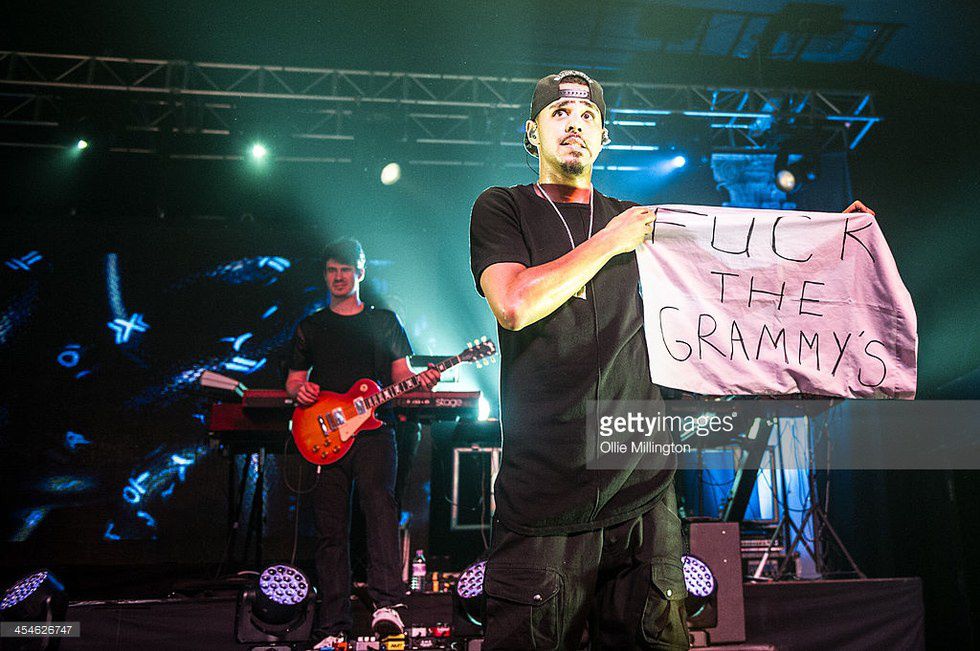
Perhaps this image something to do with his lack recognition? Maybe so. But, Cole's candid nature likely results from repressed anger on account of deaf ears.
Cole has something important to say, yet he continuously falls to the wayside as Kendrick Lamar and Drake get a lot of the shine. Kendrick Lamar and Drake have become tokenized in their respective genres, but it's not just the men. Nicki Minaj is also subject to this. Her vulgarity is very entertaining, but I feel that she has become a token woman - meaning that it's hard for other women rappers to get where she's at without having to take Nicki down in order to do it.
But, I digress. I want to talk about J. Cole, the underrated rapper. While I was watching the Grammys, I couldn't help but wonder, "Where's Jermaine?" (That's one for the "Born Sinner" fans).
Year after year and album after album, Cole works toward a seemingly unachievable goal: respect. While he received some respect for "2014 Forest Hills Drive," it's still disappointing to see another year go by where his talents are dwarfed by those of the token artists.
"2014 Forest Hills Drive" was a pivotal album for Cole as an artist, but it was not recognized the way that Kendrick Lamar's "To Pimp A Butterfly" was recognized. After all, you didn't see both Kendrick and Cole take that Grammy stage; it was just one of them.
In relation to my statements about tokenism, Kendrick stands tall as our conscious guy; Drake is our delegate for the integration of white world and black world (since he appeals to either side); Nicki Minaj is our woman. Meanwhile, people like J. Cole are fighting for a place in the rap industry.
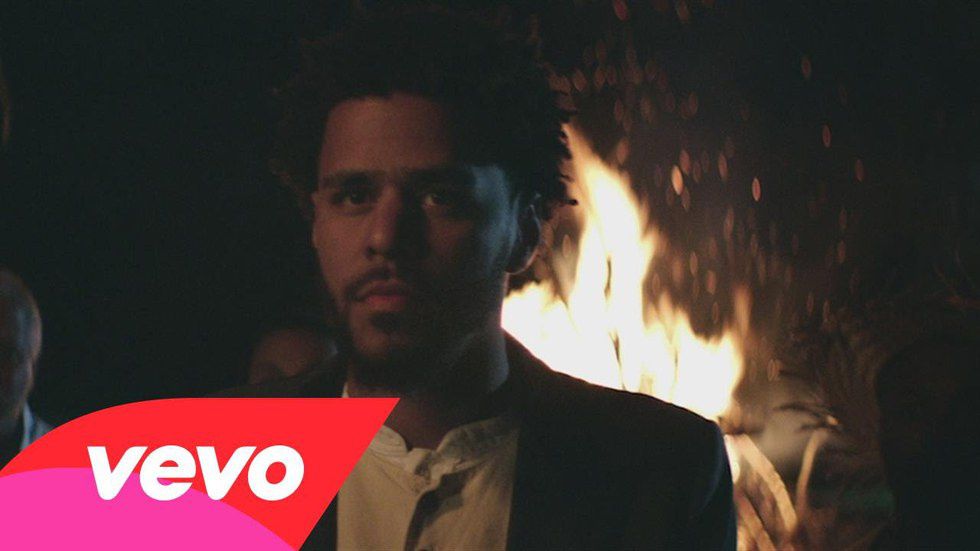
I'm a die-hard Cole fan (if you couldn't already tell). As an admirer of Cole's artistry, I've noticed that Cole has evolved with time. Starting with "Born Sinner," he began to craft songs with mass appeal that still kept him rooted as a conscious black artist. Even so, he goes relatively unheard. Take "2014 Forest Hills Drive," for instance.
On "2014 Forest Hills Drive," songs like "G.O.M.D" and "Fire Squad" were as catchy as they were crucial. "G.O.M.D." was an open letter to people who won't leave Cole alone, but it was also a black man's lament about some important questions. "Why every rich black n**** gotta be famous / why every broke black n**** gotta be brainless?" Cole asked.
As he was speaking colloquially about people bothering him, he was too speaking consciously about a plight he sees in his community.
Then, in "Fire Squad," Cole talks about the Grammys - holding that "white people have snatched the sound," and that, last year, he would "probably go to the awards, dap her down; / watch "Iggy win the Grammy as [he tried] to crack a smile." Although Cole says he's "just playing," he followed that statement by noting that "all good jokes" contain some truth.
Once again, Cole is speaking consciously about a plight he sees. Now, have white people snatched the sound? That's a great debate. Without regard to the truth or falsity of that claim, though, J. Cole is embracing his own personal truth. This is "Fire Squad's" conscious appeal. "Fire Squad's" mass appeal is its production, pace, and delivery.
So, again, I am iterating that J. Cole makes music that keeps one physically and mentally conscious. Furthermore, he does not limit himself to just talking about issues pertaining to African Americans. He also talks about issues pertaining to young men in general.
In "Wet Dreamz," fans were informed that even a die-hard activist is still a human being with human desires and emotions. Honestly, "it ain't nothing like that first time" you heard "Wet Dreamz" and couldn't help but smirk, giggle, and turn your stereo all the way up (unless, of course, kids were around).
J. Cole's main talent is his unpredictability. "Born Sinner" was amazing because it spoke volumes about liberation. Then, almost out of nowhere, Cole went and dropped "2014 Forest Hills Drive," an album that taught me about myself in ways that I wasn't ready for. In spite of all this, Cole is still not as recognized as other conscious (Kendrick) and catchy (Drake) artists.
To me, it's because African American artists become subjected to tokenism, which is defined as "the policy or practice" of desegregation. At the surface, tokenism promotes inclusion because it gives certain, token, individuals of minority groups a place next to people of the majority group.
However, tokenism limits versatility because the idea is that people are a token - meaning only one. This might show my age, but I'm going to use "The Hunger Games" to explain this. There can only be one victor, or artist, from each district, or category of music.
This creates a conundrum for artists like Cole: does he take down his fellow artist for his own personal gain or does he just sit back, relax, and enjoy the show that's starring Kendrick and only Kendrick?
I admired Kendrick Lamar's political stance at the Grammys. I enjoyed seeing a rock band led by a black woman (proving that black girls literally rock). But, I couldn't help but feel that something, or someone, was missing. Kendrick Lamar and Alabama Shakes were about the extent of black performances at the Grammys.
Miguel was limited to just an introduction while Tyrese and John Legend were lumped into a group of multiracial performers who were likely asked to perform in order to fill diversity quotas.
I applaud the Grammys for their attempt at inclusion, but, comparatively speaking, there were more white performances than performances by people of color - specifically black people (for the sake of this article). This is why African Americans need shows like the BET Awards and BET Hip Hop Awards.
Stacy Dash might think that these shows promote "reverse segregation," or something to that extent, but the black awards shows are imperative because they allow African Americans to stop searching for someone who resembles us in complexion.
When watching the BET Awards, we don't ever have to worry about how many black performers will take the stage because that's already been taken care of.
What Dash missed in her condemnation was the fact that programs like the BET Awards sprouted from the lack of inclusion. The end goal, really, is to have an award show that's diverse in actuality instead of being diverse in theory (like the Grammys was). True inclusion would be a variety of talented artists across all races who might have different perspectives on similar topics.
Why is it that Carrie Underwood, Sam Hunt, and Taylor Swift can belt some form of a love song while the only explicitly conscious performance by a black artist was by Kendrick Lamar - not Kendrick Lamar and J. Cole? Although Cole and Kendrick are rapping about the same plight, they have different approaches on what they take to be truth.
In all actuality, music in itself transcends race. I'm just waiting on the Grammys to show that. After watching Kendrick's performance, I thought in the back of my mind about the non-conscious rappers who were not up there. Kendrick's message is very important and deserves that platform, but - in the grand scheme of things - it has some problems
There were three main issues I saw: (i) some of us are not big K-dot fans (like me). (ii) Some of us are not conscious (not like me). (iii) There are two sides to the human psyche. As I stated before, even a die-hard activist has human emotions and desires. Dr. King, anyone?
My conclusion is that the Grammys has to do better. Until they do, I will gladly take Stacy Dash's lost invite to the BET Awards in the hopes of meeting an amazing, humorous, conscious artist who goes by the name J. Cole.

















