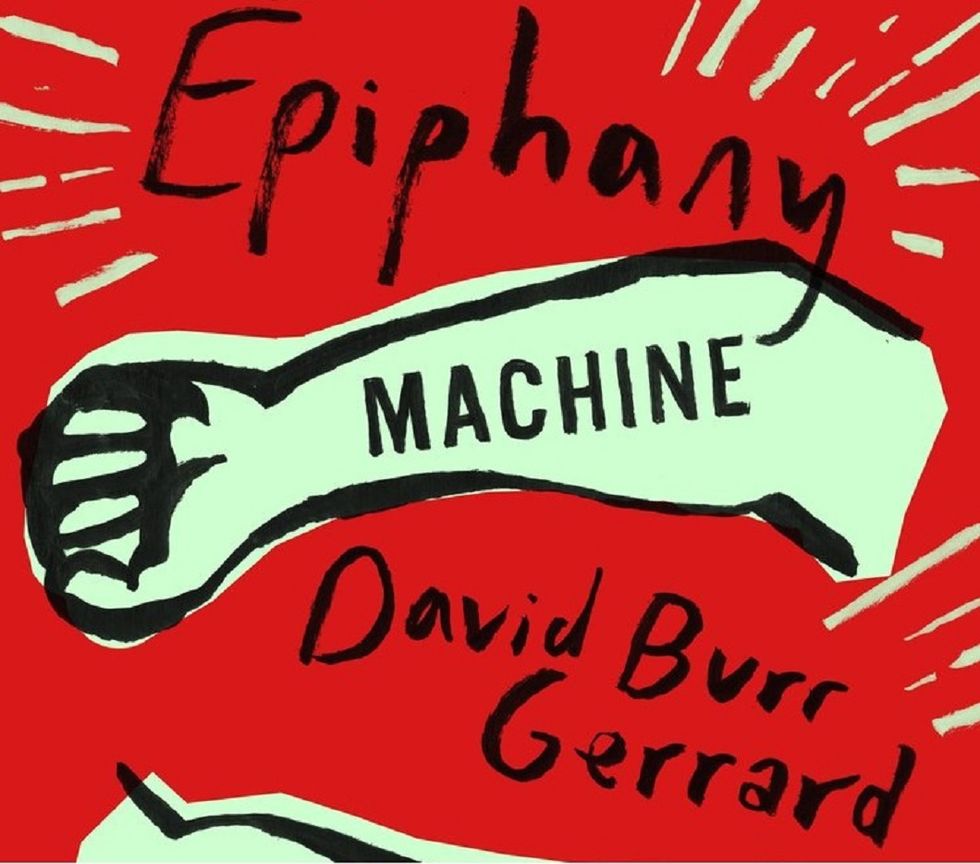
There may be spoilers here depending on how pure you like to keep your mind before jumping into a novel. That said, the following two paragraphs are completely spoiler-free.
"The Epiphany Machine" is an absolute must-read for pretty much everyone. This is the first book I've read that I would recommend to people I hate just as much as to people I love. I'd also say it's just as well suited to PhD-holders as to high school students. Fans of Kafka, William S. Burroughs, and James Joyce may find it especially interesting due to a number of allusions and tonal similarity, while fans of J. G. Ballard will likely enjoy use of current culture in the novel. Due to a rather dominant soul-searching aspect of "The Epiphany Machine" I would highly recommend it to recent graduates (of high school or college or whatever else) and incoming freshmen. Throughout the book, I found myself simultaneously pondering both the causes and effects of fortune cookies, horoscopes, recommended YouTube videos, and news outlets.
Not to falsely accuse anyone of witchcraft, but David Burr Gerrard might be a language wizard. He keeps his words and sentences short and sweet and then shocks the reader with beautiful metaphors and sudden bursts of imagery and intricate language punctuated by vulgarity. I didn't realize quite how tightly woven his themes are until somewhere around the last quarter of the book. The short chapters keep you longing for more and the very realistic characters keep you wondering what to believe. There's a sentence or two where his style didn't quite work for me, but this is only his second novel. I'm ready and waiting for a third!
The slogan of the epiphany machine (and literally the first line of the book) is "Everyone knows the truth about you, now you can know it, too." Of course, this immediately prompts the reader to question themselves. If there were a machine that tattooed a phrase on your forearm with great insight into your soul (or brain or typical behavior -- let's not get too technical) for you and everyone else to see, what would it say? This is followed by a list of things to consider before getting an epiphany tattoo, and by that point Gerrard has effectively put the reader in a position of wanting to get one (by continuing to read).
For the most part, you follow the main character, Venter Lowood, on mostly mundane adventures through mostly contemporary New York. His psychological struggles are the most exciting. He is faced with his family's history with the machine, the strangely charismatic man who owns it, it's reputation of cult behavior, the questionable significance of it's insights, and the consequences that fall on those with certain tattoos. Now throw in a mysterious author writing about the machine, a shadowy Russian American businessman, relationship problems, and a terror attack. You might find the reality line a little blurred. Did I mention the novel is also written in a mix of first-person, testimonials, and in-novel excerpts (such as chapters from the unknown author's book)? It's good!
I believe that if the epiphany machine tattooed "The Epiphany Machine" it might just read "cult classic" (in a cool tattoo font, of course). I am thrilled that I was able to read this book through Penguin's First to Read program (which you too could join if you Google those words). Really though, whoever you are, you should probably read this book.