


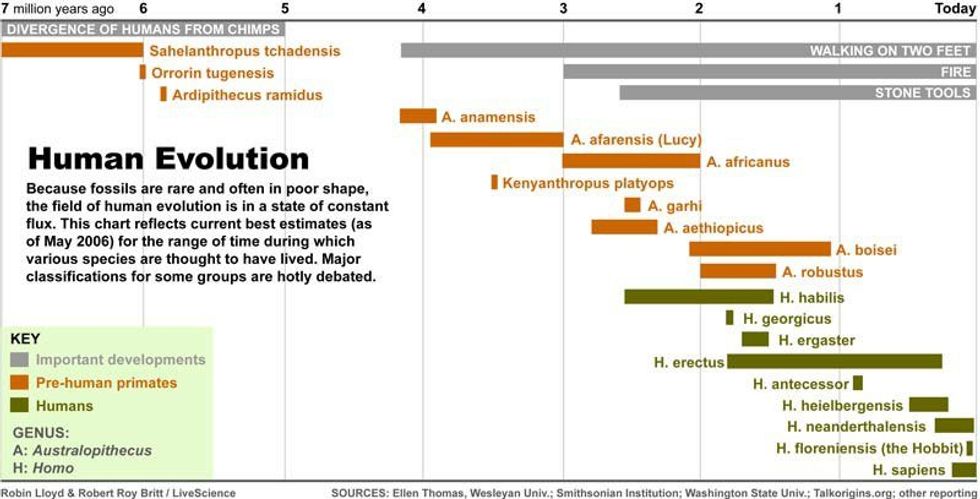
A recent study of thigh bones left in a museum for several years suggests that a species of human hasn’t been extinct for as long as scientists thought... at all.
A femur supposedly belonging to the Homo species of human has been studied recently, causing some questions about the timeline of human ancestry.
The thigh bones suggest that the earliest species of human, simple designated as Homo, may have not died off until 14,000 years ago, giving them life until the end of the last Ice Age.
The bones were found in China in a cave known as the Red Deer Cave. After being discovered, they were placed into storage, and then into a museum. Until recently, they remained unstudied; but when Darren Curnow and Ji Xueping studied the femur, they found that Homo may not have died off as early as was thought.
The bone is, overall, tiny- long and thin rather than short and squat, with build up in areas where there would have been strain. The ‘hip flexor,’ where the muscle would have been attached to bone, is almost completely backwards. The hip flexor is the only part of the bone, too, that is larger than normal.
There is some concern about the ability of the single bone to represent the Homo species’ as a whole. There may be a mutation or a genetic deformity in one that is misleading to the timeline. Some scientists are suggesting inbreeding would have resulted in this bone formation; the above description of the bone also lead scientists to believe that that particular human would have been smaller than normal, strengthening this possibility.
If the thigh is part of the original Homo species, though, it would be evidence towards pre-modern humans existing at the same time as more modern humans in East Asia. This discovery would mean that these humans outlasted the Neanderthals and the Denisovans, (Europe/West Asia, and Siberia respectively).
A skull found in the same area had been studied before the thigh bone, but the skull seems to be much more developed- in terms of the human evolution- than the thigh bone. With both of these, some scientists are suggesting another species of human previously undiscovered. This, they say, is possible especially in this tropical Southwest area. The pleasant climate would have drawn many people, as well as some geographical movement (like the Tibetan Plateau) that would have moved many different types of people.















