
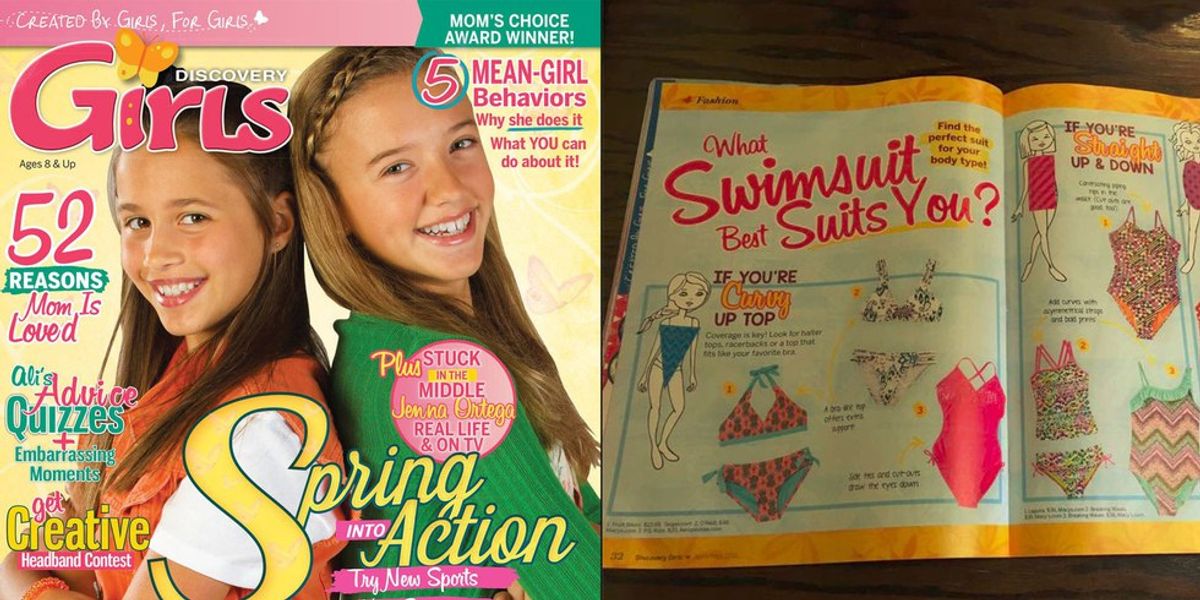
Most of us have probably seen an article floating around on Facebook or Twitter about a spread in Discovery Girls, a magazine published "by girls, for girls" that includes an illustrated "how-to" guide for girls for picking out the "right" kind of swimsuit for their bodies (here's one of the articles if you haven't seen it: http://goo.gl/v9zqIO). On the one hand, I've taken these quizzes in magazines and online (as I'm sure many have) but on the other hand, I have access to a great support network of friends who understand what body shaming has done to our culture.
Body shaming has become increasingly prevalent in our western culture. It's not a new concept and, in fact, has been present in the discourse for a while within periodicals, pop-culture, and fashion trends. Furthermore, although this article focuses on cisgender females, it's also important to recognize that body shaming affects cisgender males and non-binary folks as well.
By setting rules for those that don't need them (like the spread in Discovery Girls), we are actually doing the patriarchy's work. We're telling girls to wear high-waisted bikini bottoms if they've got a tummy, we're telling boys to dress like men, and we're telling trans folks to pick one. You have control over your own body but you have no control over any other body.
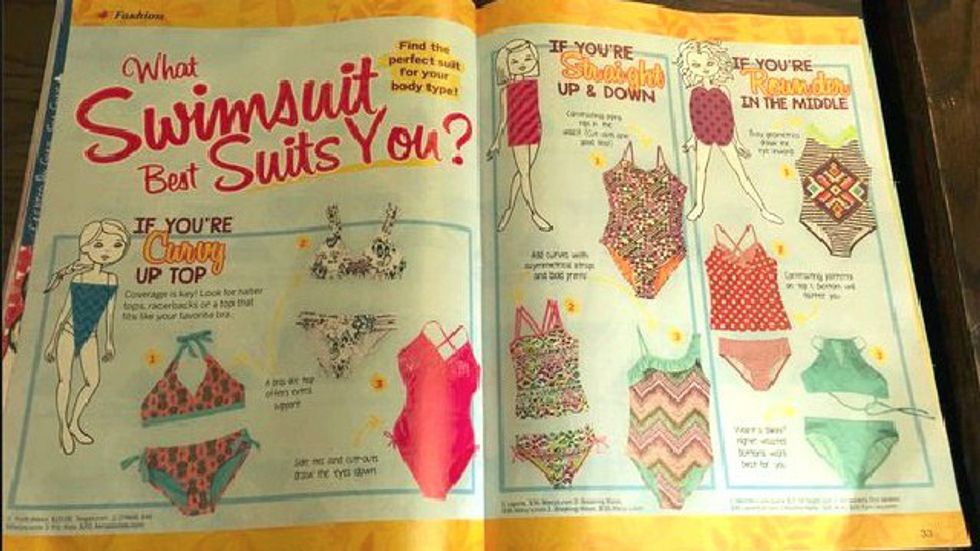
A photograph of the Discovery Girls spread.
Now, when a young girl reads an article like this, she sees herself in the illustrations and begins to see herself not as how she presents herself, but as who she thinks the rest of the world sees. And when a young girl reads an article like this, the suggestions become instructions and she looks at the other illustrations and then other girls before asking why she can't look like them.
When a young girl has examined herself, looked at others, compared and contrasted the two, and then asked herself why she isn't like the rest, something dangerous happens. The girl's world shrinks a little and she begins to feel a little too big, a little too busty, and/or a little too small. Body image isn't just about wishing to be thin. It's about how someone sees every part of themselves: how a nose looks compared to their eyes, how skirts stick to or swish around their thighs, and how collars look around their necks.
Finally, after living with this slowly shrinking or expanding world, they feel too out-of-tune with their own skin. A girl who was once eight is now thirteen and in rehab for an eating disorder her parents knew nothing about. She listens to other girls talk about their binge diets, their apple-a-day diets, their godly and godawful diets. Pieces of hair come out in her brush, but that's been happening for weeks.
Now, she sees a new magazine and a tagline that reads "How I lost 30 pounds in 30 days." The girl begins to read.

















