
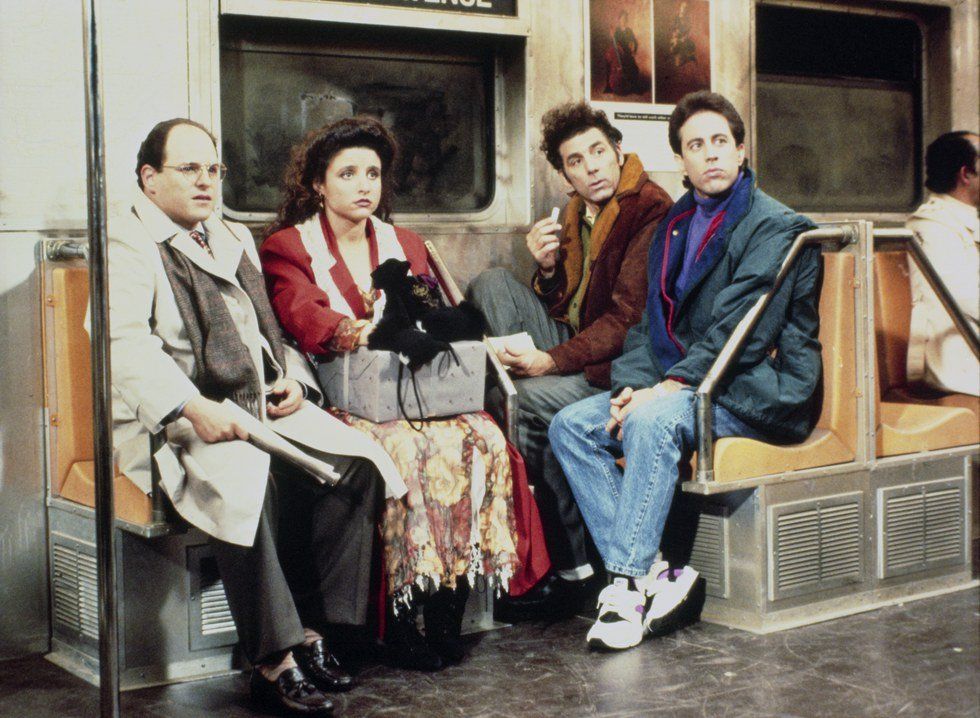
Seinfeld was an NBC sitcom that ran from 1989 until 1998 for a total of 180 episodes. Created by stand up comics Larry David and Jerry Seinfeld, the show revolved around a fictionalized version of Mr. Seinfeld as a semi-famous comedian living in New York and the "adventures" (typically involving fallouts from daily minutiae or social obligations gone wrong) he has with his best friend George Costanza, his neighbor Cosmo Kramer, and his ex-girlfriend Elaine Benes.
Considering it was one of the most popular sitcoms of all time and was a cultural watershed, transforming television forever — Arrested Development, Louie, and The Office don't exist without Seinfeld — one would assume that it was simply a more fine-tuned version of other sitcoms at the time. After all, all of my friends who don't enjoy Seinfeld cite the same reasons: it's dated, a multi-camera show with a laugh track. Not to mention, it went off the rails after Larry David left at the end of the seventh season, turning from witty and dry-humored and into a much goofier and absurdist (and less funny) vision.
But the great majority of Seinfeld is so much more subversive than its casual detractors realize. Before going any further, I should mention that it's my favorite show of all time and have seen every episode at least five times, so there's admittedly a bit of a taste factor involved. (And I was raised by my father, a neurotic New Yorker with a sense of humor not dissimilar to Larry David's. That's another problem cited among my friends who don't like the show.)
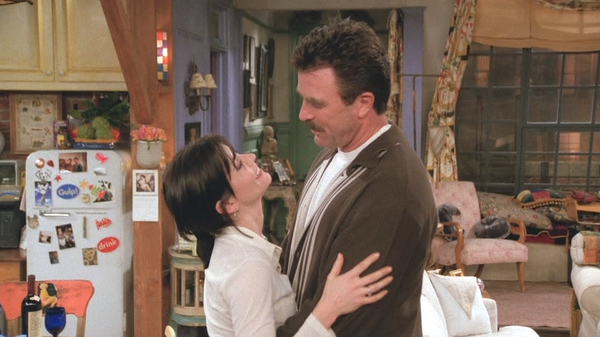
However, the reason why it's such a good show extends beyond the fact every episode is ingeniously crafted so that all the seemingly random subplots tie up neatly by the end of every 22-minute episode, as well as the fact it's hilarious, (which can be just a matter of taste, like I said). But, unlike other sitcoms at the time (I'm looking at you, Friends) and a lot today (e.g., Modern Family, How I Met Your Mother, The Big Bang Theory), Seinfeld had intentionally no hugging or learning. There is no optimism. No generosity of spirit. No compassion. It's a show that represents the gaping void of American culture, the sitcom equivalent of a nightmarish Herzogian gaze.
But if the show had no heart, how could anyone derive any enjoyment from the show or feel any sympathy toward these characters? Sure, the other shows I've mentioned are popular and nominally have a heart, with scenes of families and friends learning to overcome their differences and live in harmony. But they're not revolutionary like Seinfeld, and it's because Seinfeld does indeed have a heart, it's just not as tacked-on as the other shows have it.
It's very difficult to even explain how Jerry, George, Elaine, and Kramer can be likable. Jerry is an anal, self-obsessed comedian who is snarky and condescending. George is a bitter loser, a selfish narcissist who often destroys whatever relationship he has — romantic, social, or business — by the end of any episode. Elaine is manipulative and pompous, often ruining her relationships by overly agonizing on minor flaws or faux pas. Kramer is easygoing but oblivious and stupid, often destroying other people's relationships through an accidental comment. You could easily retitle the show Four Psychopaths, and you'd have the same outcome.
So how could it have a heart and still have likable characters? Seinfeld has to be one of the bleakest shows ever made, comedic or not. But the show uses the same key that worked for The Colbert Report that made his egomaniacal character watchable: they are all trying to do the right thing while lacking any natural capacity to do so. Except for the last couple of seasons, when they turned into true monsters, the characters are unbelievably not trying to intentionally hurt people. In arguably the darkest moment of the show, George's fiance, Susan, dies from licking envelopes that were picked out by him (only because he's such a cheap bastard). His reaction to the news of her death is not of utter sadness but of relief. He's not happy she died but that he doesn't have to deal with the awkwardness of breaking up with her.
In a lesser, more heartless show, George would have rejoiced privately with his friends or, even worse, intentionally found a way to kill her. His actions still make George utterly despicable and not someone you'd want to hang out with, but he's pathetic enough to enjoy watching him through the shield of fictional television. Along with hundreds of other examples, all of the characters in Seinfeld don't want to actively hurt people, however their own narcissism, selfishness, manipulation, and idiocy blind them to any conceivable act of charity.
There's a fable of the scorpion and the frog. The scorpion wants to go to the other side of the lake, but he doesn't want to drown. He asks the frog to ride on his back. The frog retorts that the scorpion will kill him with his tail. The scorpion promises that he won't because that would be detrimental to both of them. The frog agrees to give the scorpion a ride. Halfway through the trip, the scorpion strikes the frog's back. As they both drown to the bottom of the lake, the frog asks why the scorpion would kill them both. The scorpion replied, "Sorry, it's my nature."
On Seinfeld, all four characters are scorpions.