
Let’s face it, it’s ingrained in us. Blaming one another is basically second nature. Sure, you don’t mean to do it, we never mean to do it, but it still happens. You see, not all of us constantly blame other people for the things that happen around them, because of them or otherwise. But many of us do and, with the way the rest of our society is structured, it comes off as no big deal.
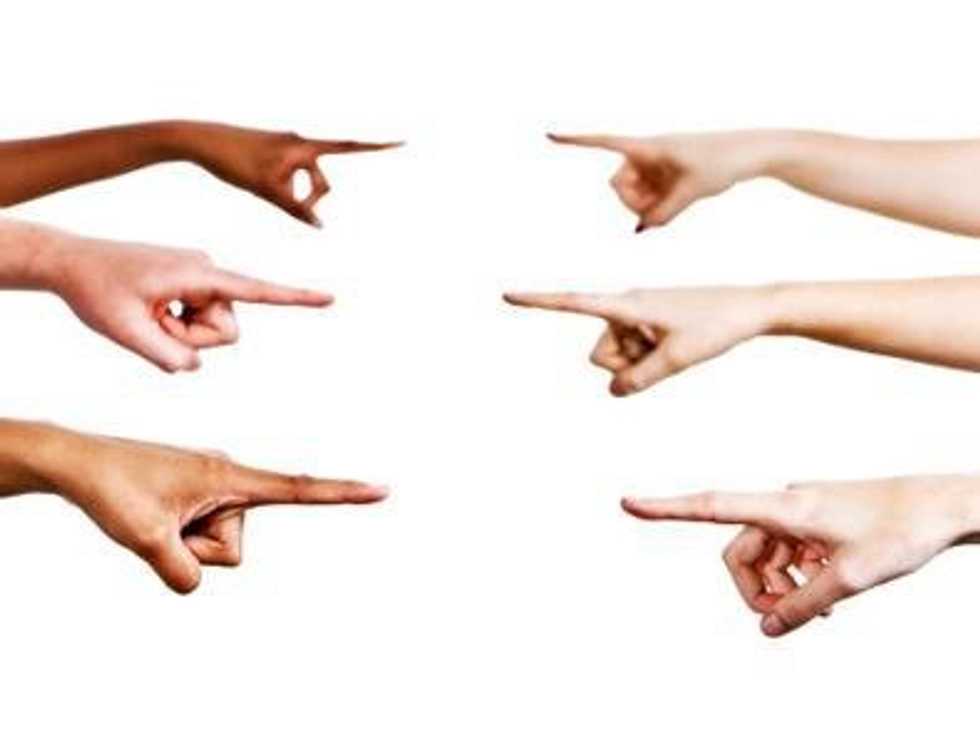
Think about it. When we were kids, and we fought with one of our siblings about something that ended in a fight, maybe a shove or mean words that end up catching the attention of a parent, how would we always answer? “They started it!” with tiny grubby fingers pointing at one another. Or what about when you ate the last snack cake or bag of chips even though you knew you shouldn’t have? And your parent demands to know if you ate it. Your reply, more than likely, was “Wasn’t me…” which effectively pushes the blame onto someone else, when it was really you. I’m sure we’ve all gotten the “I wouldn’t be angry if you just said it was you” talk and we’ve all rolled our eyes or ignored it just the same.
What about when we were in school and we played a prank on one of our classmates? Tugging the chair out from under someone, harmless fun right? We always had a friend who was behind the act with us. And when we got called out for embarrassing and mildly harming our classmates, what was our first defense? “It was their idea,” while pointing at our friend or gesturing into their direction.
High school seems to be where the blame game gets so real it’s frightening. In friendships where drama arises, we tend to remember every negative thing that could have related to or lead up to our own actions. Say your friend mistakenly shared a detail you had asked to remain private. A few weeks later, the same situation happens only vice versa, with you sharing the detail that they wanted private. They confront you. Your answer? “You did the same thing a week ago.” There it is. Blame shift. If you hadn’t done it in the first place, I wouldn’t have accidentally done it now. What about using blame to get what you want? A friend uses your homework answers (don’t pretend this isn’t real we all know it is) and you need answers for a different homework assignment. Maybe they’re nervous you’ll get caught and get in trouble, or you’re known for not copying notes without being obvious, so they say no. “I let you use mine.” Blaming their prior demands to meet your own because, hey, it’s gotta be fair, right?
This is all pretty trivial. What’s it really hurting? So what, you learned the hard way not to pull a chair out from under someone, or blame it on a friend. You learned the hard way that you shouldn’t spill the beans when someone asked you not to. Why does any of this matter? Remember how teachers always told us not to use the internet to write our essays because then, during a test or something of the variety, we won’t be able to effectively finish? It’s the same thing. If we can’t take the blame for the little, trivial details in life how can we be expected to take the fall when it’s something important?
You’re at your job and you misplace an important document, maybe put it in the wrong folder which makes it harder to find or convinces your supervisor that it’s completely gone and irreplaceable. There’s no clear indicator that it was you, but you didn’t realize that you put it in the wrong folder. No biggie, right? You panic. You’re new and you can’t lose this job, or you’re not sure what to say in the first place. So, since no one saw you do it and no one can really determine that it was you, what’s your answer? “No, I haven’t seen that document” or “No I don’t know what document you’re talking about.” Something so simple, saying “yeah sorry I put it here instead of where it goes” which would be greeted with a simple “just don’t do it again” or, “ask if you need help” is made even more complicated because you’re use to blame shifting.
It’s not really hurting anyone in the end. Blame shifting only gives you a bad name, right? Wrong. It seems that being unable to take the fall for your own error starts to take a toll. Friends start to lack trust in you, or just disappear all together. It’s harder for you to understand what you’re doing wrong because, in your mind, you’re not doing anything wrong. All this time you’ve been doing nothing wrong because everyone else was really the cause, since you’ve made yourself believe so for many years. Sometimes we don’t even realize we started doing so in the first place. Sometimes it is just something that has happened so many times around us that it’s become a part of who we are.
In finally taking the fall for your actions, understanding that sometimes the consequences just aren’t as bad as you thought, tends to lead to a happier, healthier lifestyle. Things become more light, much easier and by far more worthwhile. Are the consequences really that harsh that you have to lie your way out?