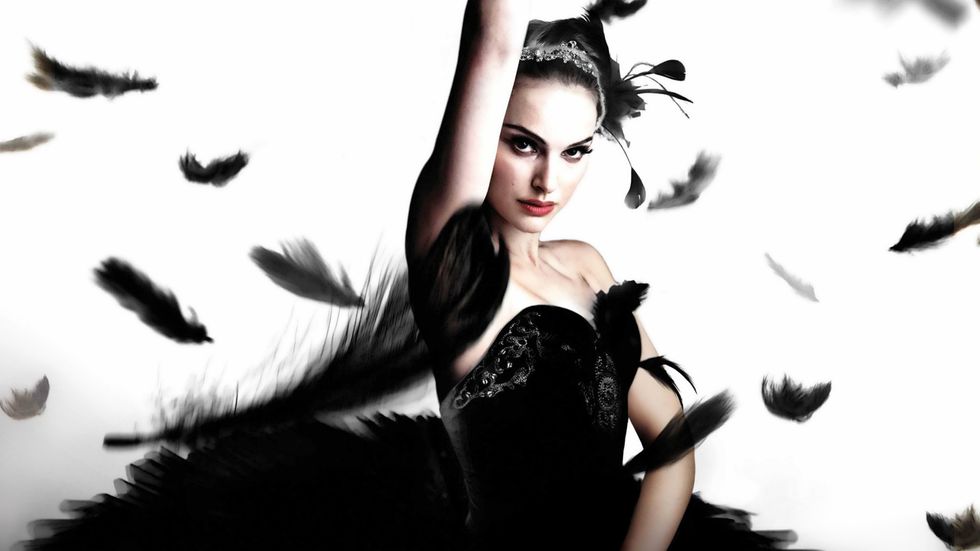
In the film Black Swan (2010), we discover that it is indeed possible to achieve perfection...but at what cost? Director Darren Aronofsky attempts to answer this question through unconventional methods of arousing fear in the audience that renders Black Swan an innovative and unique psychological thriller. These methods include utilizing and even manipulating the classic elements of film such as cinematography, sound, and plot in order to convey an important theme that runs throughout the film--that the strive for perfection has dangerous effects on the mind which can ultimately lead to self-destruction.
Black Swan is centered around Nina Sayers (portrayed by Natalie Portman), a gifted ballerina whose desire to achieve perfection as Swan Queen in the ballet Swan Lake threatens to destroy her overall sanity and eventually leads to her downfall. Additionally, Portman's on-screen mother (played by Barbara Hershey) struggles with her own delusions as she attempts to live vicariously through her daughter in order to compensate for her own failed ballerina career. Ironically, the plot of the film mirrors the basic storyline of the classic ballet it revolves around—each character in Aronofsky's film Black Swan (2010) is a manifestation of a role in Tchaikovsky's ballet Swan Lake (1876). Aronofsky also toys with the idea that the innocent, fragile Nina (who clearly embodies qualities associated with the White Swan) is called to portray the dark, provocative Black Swan who ruthlessly devours the White Swan from within and thus requires the ballerina playing the Swan Queen to master both roles. As Nina struggles to perfect this dual-natured role, elements of the Black Swan begin to physically and mentally consume her from within, causing Portman's character to rebel against her former self and slowly lose her mind to terrifying hallucinations.
The visual elements of the film effectively combine to convince the audience that Natalie Portman's character is slowly losing her grip on reality. Throughout the film, the camera angles seem to focus on Nina's point of view and match her movement in dizzying close ups so that the viewers feel like they are moving with Portman at all times--including riding (shakily) on the subway, walking (bobbing) on the street, or dancing (spinning) in the studio. As Portman's character increasingly loses control over her thoughts and actions, so too does cinematographer Matthew Libatique over his scenes and sequences. Additionally, the editing by Andrew Weisblum reflects Portman's gradual descent into madness through the use of pace and transitions as tools for revealing connections between fantasy and reality and then skillfully blurring the line between the two. Just as the film's editing and overall pace becomes faster and dizzier as Nina loses her sense of reality, the score of the film (by Clint Mansell) gradually alters to become more ominous, frightening, and intense. This darker and louder score is accompanied by faint noises of flapping bird wings that adjust in speed to mimic Portman's anxieties, fears, and frustrations as she begins to slowly lose her senses.
Nina is absolutely consumed by the desire to achieve perfection as the Swan Queen until it eventually drives her mad. Her illusions become powerful enough to propel her into a world of jealousy, chaos, and confusion that ultimately leads to the most destructive actions. This theme bears resemblance to a variety of other common situations in athletics and academics where many young people push themselves beyond their physical and mental capacities, occasionally to the brink of psychological breakdown. The film thus serves as a clear warning to those who feel compelled to achieve any impractical sense of perfection because such attempts might lead, as with Portman's character, to a most dangerous mental state.
Black Swan is brilliant in employing the classic elements of film in a unique way in order to convey a powerful yet potent message. In doing so, Aronofsky's film attains the crucial balance between entertainment value, artistic merit, and thematic purpose. Evidently, Aronofsky seems to learn from the mistakes of his own characters by allowing the classic elements of film a measure of creative freedom instead of attempting to achieve a traditional sense of perfection within each aspect of Black Swan.