Last week, the tragic deaths of two Black people at the hands of white police officers brought the issue of disproportionate police brutality against Blacks to a national media spotlight. Alton Sterling, a 37-year-old Black man, was shot multiple times in the back and chest by two police officers when selling CD’s outside of a supermarket. A day later, Philando Castile was shot through his car window even after he lawfully reported his concealed weapon; his girlfriend recorded his final moments on video, calmly and respectfully following Officer Jeronimo Yanez’s orders while her daughter cried in the backseat.
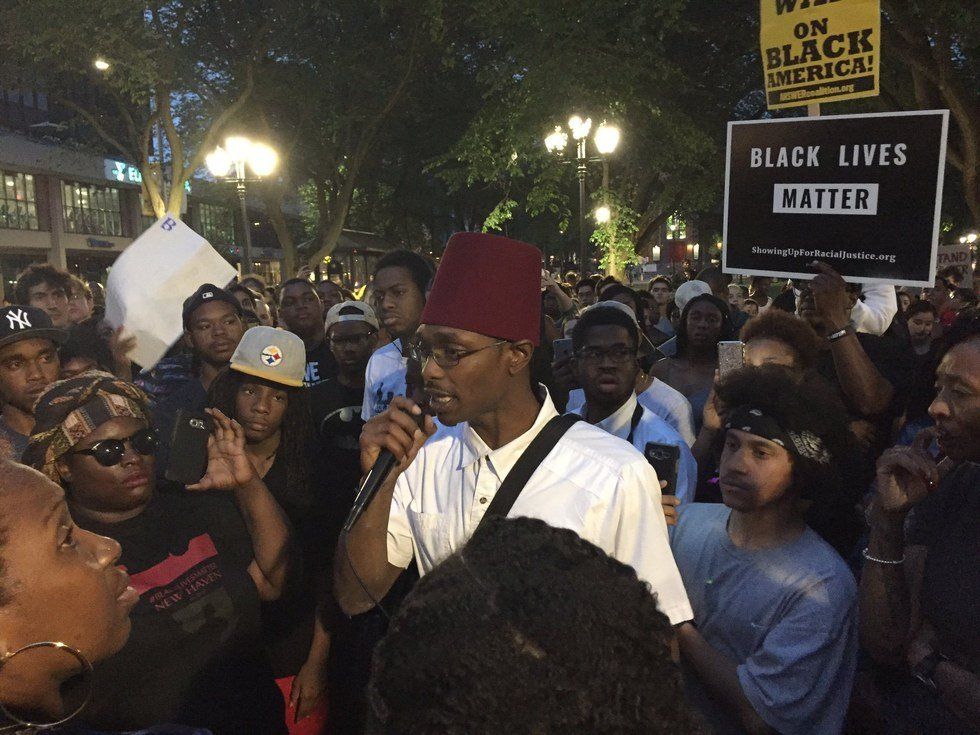
Vigils and rallies, generally organized under the umbrella movement Black Lives Matter, were held in cities across the U.S. in memory of black victims of police brutality. While some people have been sympathetic toward the cause of eradicating police brutality towards black people, others are more skeptical; one of the most prominent objections to the BLM movement, as some critics express, is that it fails to address black-on-black crime. Such sentiments date back to a few years ago - “Nationally, nearly half of all murder victims are black,” wrote conservative commentator Juan Williams after Trayvon Martin was killed in 2012, “And the overwhelming majority of those Black people are killed by other Black people. Where is the march for them?” After Ferguson, former NYC mayor Rudy Giuliani told CNN that perhaps President Obama should focus on “also should have spent 15 minutes on training the [Black] community to stop killing each other.” () Today, they are still being perpetuated by commentators and critics when addressing the Black Lives Matter movement.
1. Crime is largely intraracial for all racial groups in the United States
For a start, it shouldn’t come off as particularly surprising that across all racial groups, in the vast majority of cases, criminals and victims belong to the same race; in other words, crime is largely intraracial for all racial groups in the United States. Critics of the BLM movement like to cite that Black-on-Black murders are responsible for 93% of all Black victims of murder – but they fail to acknowledge that white-on-white murders account for 84% of all white victims of murder – also a vast majority. Since people in general tend to live and work within racially-segregated communities and associate with members of the same race, it shouldn’t be surprising that the crime is largely intraracial, and that black victims of murder are most likely murdered by other black people, just like statistics of every other racial group.
The very construct of “Black-on-Black” crimes is also fairly problematic, especially since it is being utilized to ascribe violent criminality to blackness, rather than the particular socioeconomic and cultural conditions some blacks face today. In fact, Black youths aren’t even committing that many crimes, and while proportionately more Black kids are being referred to law enforcement or arrested than their white peers, they are also judged more harshly and punished more severely compared to white children.
2. Combating Black-on-Black crimes and BLM are not mutually exclusive
Just because BLM is stressing the importance of protecting black people, does not mean it doesn’t care about the lives of everyone else; instead, it advocates for equality amidst a status of quo of racial prejudice. Similarly, just because BLM is focused on targeting police brutality against Black people, does not mean other crimes committed against Black people – often perpetrated by other Black people – are not significant. In other words, BLM addresses, very specifically, the problematic treatment of Black people by police officers, amidst a multitude of serious issues that Black communities face today.
The existence of Black-on-Black crimes does not refute the existence of institutionalized racism in the American police force. Statistically, Blacks are disproportionately killed by law enforcement personnel – in many circumstances, doing perfectly harmless things, such as selling CD’s, wearing a hoodie in the rain, or declaring their concealed weapon. Denying the existence of the excessive criminalization of Blackness by the American police is simply speaking against factual evidence, while dictating for Black communities what their activism should center on demonstrates a patronizing irresponsibility.
3. African Americans have been combating Black-on-Black crimes for decades
Contrary to what Williams and Giuliani may believe, Black communities have been actively protesting Black-on-Black crimes for a long time. In Chicago – a city with a significant African American community and relatively high crime rates, grassroots efforts have sprung from locals – especially Black women – to prevent Black people from committing crimes in the neighborhood. For example, Tamar Manasseh formed Mother Against Senseless Killings to patrol the neighborhood after a murder in South Stewart, and for the next five weeks no shots were fired in that block thanks to her patrol. Every week, Lunden Gregory and other Woodlawn residents protest the excessive use of guns and weapons in her neighborhood, and the historically Black fraternity Alpha Phi Alpha “reclaimed” Weiss park from notorious gangs … and these are just Chicago alone. Such grassroot activism is abundant in Black communities, yet rarely appears in media.
Ta-Nehisi Coates responds to Williams’ claim that Black people don’t care about Black-on-Black crime by presenting a long list of demonstrations against Black-on-Black violence organized by the African American community. Congressmen, police officers, activists and ordinary residents gathered across the country to protest. It is patronizing and baseless to claim that Black people are not paying attention to Black-on-Black crimes, or that the Black Lives Matter movement is somehow an indicator that black people are “playing the race card”. Rather, there has been continuous strife within the Black community to dispel Black-on-Black violence.
4. Black-on-Black crimes can be traced to many of the social issues that BLM is now fighting
As mentioned before, there are huge issues implicit within the “Black-on-Black” crime narrative – the use of this narrative to undermine the Black Lives Matter movement for justice is an manifestation of how our societal perceptions of Blackness is still centered on Black criminality. Instead, few manage to articulate numerous underlying socioeconomic issues pertaining to a high crime rate within the Black community – cycles of poverty, inadequate educational resources, racism and discrimination in the workplace, incarceration and – yes – police brutality, all of which have clearly done more harm than good. To a large extent, Black Lives Matter, through advocating for just treatment of African Americans, is also fighting the racist institutions that have placed African Americans at a disadvantage from the day they were born. By all means, a community does not forfeit fair and just treatment simply because it has crime.