
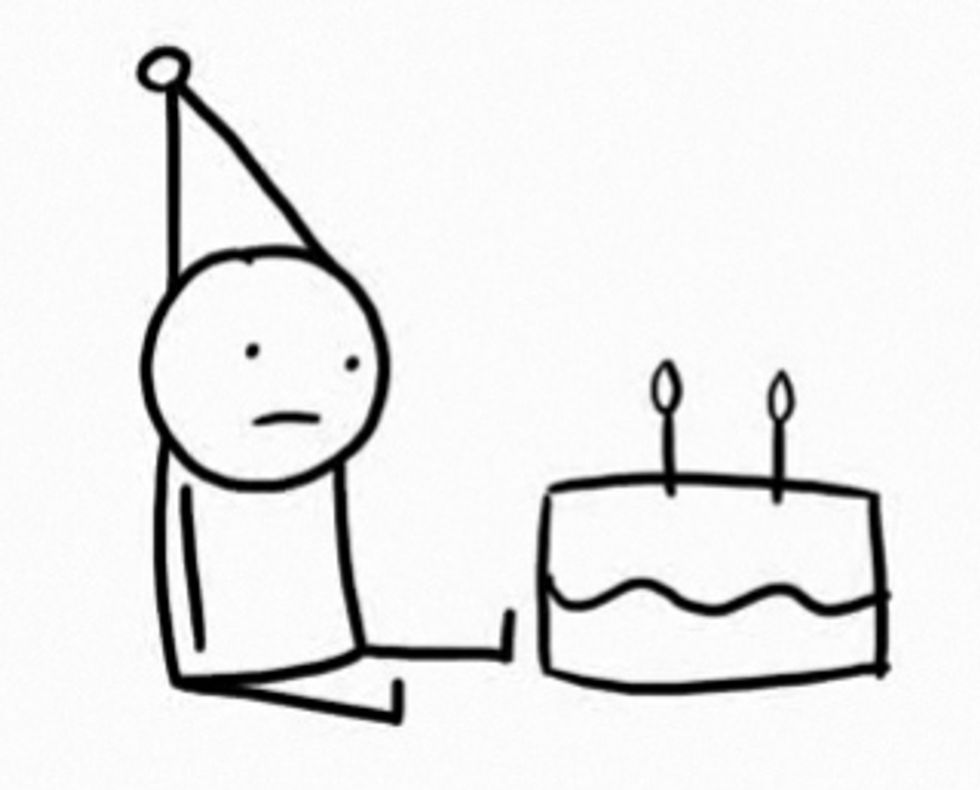
I turned 20 the other day, which means I still can’t legally drink. That said, this birthday feels sort of pointless, more so than most (except for 19, the most meaningless birthday of all). But in reality, aren’t all birthdays equally meaningless?
Celebrating birthdays doesn’t make much sense to me, but it’s a cultural phenomenon. Everyone celebrates their birthday, my question is: “Why?” There’s no real reason for it, birthdays aren’t special; they are as meaningless as every other day that passes us by on the way. I could probably take this 20 different directions, but for your sake and for mine I will restrict myself to the concept of time and dates.
Let’s think about birth dates. According to About.com, any given person (besides those born on Feb. 29) shares the same birthdate with one in every 365 people of any given population. Translate that over to the 7 billion-person-population of Earth and it turns out that you share your birthday with over 19 million people. So, on Sep. 4., over 19 million people other than myself were born. Not so special, right?
Let’s go further. What is a day anyway? More specifically, what is a date. Because many people like to say, “I was born today” or “today was the day I was born” when, in all actuality, you were born on an entirely different day with the same date. Time is not a circle, it’s a line. So my saying “I was born 20 years ago today” wouldn't really make any sense. I was born 20 years ago on a day that has nothing to do with today other than the calendar date prescribed by man to both days. In other words, I was simply born 20 years earlier on a linear timeline. And we can actually disregard the date altogether. This is because dates aren’t really a thing outside of human society. Having a four on a certain day doesn’t make it the same as another day with a 4 on it other than the superficial and figurative meaning given to the four by humans.
For an example of this artificial meaning: non-human animals have no idea what the date is. They don’t have a concept for time other than “this is when I wake up, this is when I eat, this is when I sleep.” Of course, for most (if not all) animals, it’s vastly more involved than that. There are migratory patterns, the recognition of seasons, many animals hibernate, some are nocturnal -- there are innumerable, instinctual measurements for time in the animal kingdom. But there is no calendar. That was us. We gave the days dates -- we said “you’ll be 4 and you’ll like it!” And we did it pretty recently (as far as human history is concerned).
The first recorded calendars came from the bronze age (3300-1200 BC). If we think about human history, we’ve been a species for some 200,000 years. So, we decided after a couple hundred thousand years of existence we were going to give our days numbers. Now let’s consider the fact that time and the Earth have existed for billions and billions of years (time itself [as in, the universe] is approximately 13.8 billion years old, and the Earth is approximately 4.5 billion years old). As it stands, we’ve had calendars for a good 5,000 years. So, we chose to start keeping dates and measuring time once we passed the 99.999999999 percentage point of the universe's existence. In other words: we have currently measured and kept dated about .0000000004 percent of all time that has existed.
That’s assuming that all time is on the same line, which it isn’t. But I'll stay inside our solar system for argument’s sake. Consider this: one year on Earth (the amount of time it takes for our planet to make a single revolution around the sun) is 365.25 Earth days. A year on Saturn (the time it takes to revolve around the sun) is 10,847.9 Earth days, or 29.7 Earth years. So, on Saturn, I’m not even a year old (according to the human definition for “year”). That’s not even the planet with the longest year (the longest is Neptune at 164.8 Earth years per revolution around the sun).
More information can be found at Universe Today.

















