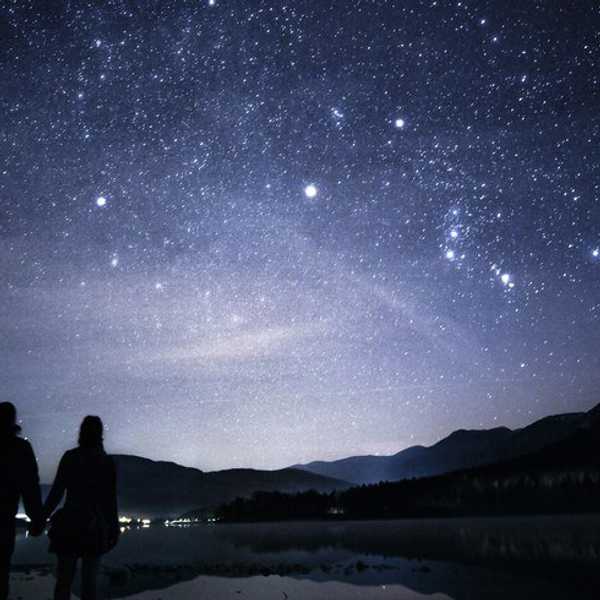
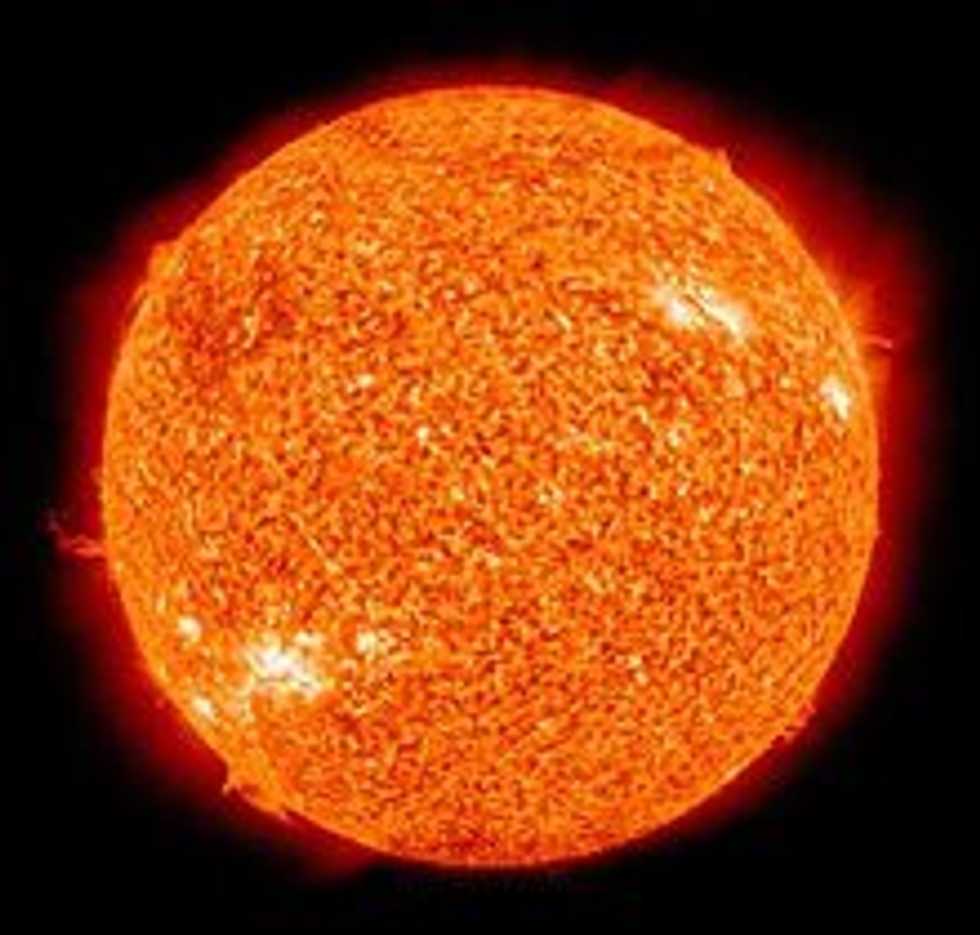
We all know that when we look outside after sunset, we see countless little lights dotting the sky. Every dot, for the most part, is a star. That's what most people think of when they think of the word "star," a tiny light in the night sky, however, each of those stars is like our sun -- a huge sphere emitting light and heat. If there are an unfathomable number of stars out there, the question begs, how did they all get there?
Not only is that a fantastic question for us to ask as humans, but it has an answer that is more attainable than you may first imagine. Let us remember that we are extremely close to a star - our sun. As close as we are, it is fairly simple to study the sun's composition and behavior, especially with modern observation methods. By far, the most prominent method in the study of any astronomical object is spectroscopy, which in this case is the study of matter that emits electromagnetic radiation. Our sun, along with the stars you see at night, emit electromagnetic radiation in the form of visible light, which is why we can see them. Let's consider how astronomers can use spectroscopy to answer a few questions about stars.
Most simply, spectroscopy can tell us what color a star is. Seems silly, doesn't it? I mean, you'd think that we can physically see what color each star is. We don't need some fancy machine to tell us that. Honestly, the color itself isn't what is most important; it has to do with wavelengths of light. You may or may not know that light has properties similar to that of a wave. Therefore, each individual wave of light can have a wavelength that is longer or shorter than others. Longer wavelength light has less energy than shorter wavelength light. As well, shorter wavelengths of light produce more blue-colored light, while longer wavelengths of light produce more red-colored light. So, if we can receive the light from a star and measure its energy, we can determine the wavelength of the light that we are receiving. If we look at how much light we see at each wavelength, it gives us an idea of what color that star might be.
Believe it or not, from this information, we can easily determine temperature. Since we've established that the amount of energy in light varies based on wavelength, we can also determine how much energy this star is giving off. A star gives off energy in the form of both heat and light. So if a star gives off blue light, which has a short wavelength and high energy, it must be hotter than a red star. Makes sense, right? And honestly, it's not too complicated. All we've looked at is a slightly more technical way to detect the color of a star, and that has gotten us energy and temperature already.
At this point, the only thing you might care to know any more about is what stars are actually made of. Well, you're in luck, because spectroscopy can tell us that, too. We know, based on studying our sun, that stars are emitting light because there are molecules in the star's atmosphere that are superheated, thus causing them to give off that excess energy in the form of light. Consider that through physical experiments that we can conduct under controlled environments on Earth, we know that a given molecule will emit certain wavelengths of light, and absorb others. Based on the wavelengths emitted and absorbed by a star, then, we can determine what molecules exist in that star. Pretty cool, huh? And it turns out that most stars are made of a majority of hydrogen gas, a decent amount of helium gas, and a really small amount of larger elements. We would expect this, as hydrogen is the simplest and most abundant element in our universe.
OK, so now we've established that stars are huge balls of really hot gas -- and that's about it. What astronomers did with this information next is formulate a way that such a ball of gas could naturally form. Basically, here's what they've got.
Nebulas
Nebulas are expansive clouds of relatively cool hydrogen gas that exist in space. We can see evidence of these existing in our universe, since the gas is usually warm enough as to emit small amounts of radiation.
Gravity
Sometimes, these nebulas are in a state of equilibrium, in which they will remain until another force acts on them. If any force - whether it be from a distant star forming, or collision of objects nearby that sends a shockwave to the nebula - causes the gas to condense at all, then its gravity will likely cause it to continue to collapse on itself. This gravitational energy causes the gas to heat up and emit some radiation.
Fusion
After a long period of time during which the gas will collapse, the gas becomes dense enough that it causes molecules to violently interact with one another. At the center of what is now the star, hydrogen atoms have enough energy that when they collide, they combine into helium atoms. This process is called fusion, and produces high amounts of energy. The energy emitted through fusion is what allows stars to consistently emit light and heat.
Though very much simplified, this is truly the process by which the stars in our night sky got there. It's also how our sun was born. At face value, this can be taken very lightly. Sitting down for a moment and giving time to this idea, that every star we see started as I've described - that they've each developed over millions, even billions of years -- can yield some fantastic perspective from our end. Taking just a moment to look up into the night sky can leave you in awe of the magnitude of what lies before you. Stars cascade into your eyes as if tiny lights hang against a black backdrop. And as you stand there, you can let your mind trick you into giving little thought to those "lights" scattered all across the sky. If you remind yourself where that light is coming from, and what stars truly are, looking to the sky becomes a beautiful reminder of how small we are, and how vast and wondrous this universe is.