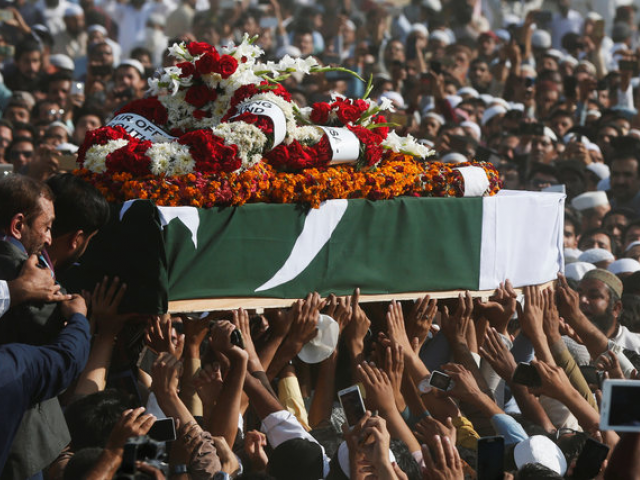
On December 7, en route to Islamabad, Pakistan, highly influential and beloved nasheed singer Junaid Jamshed and his wife Nahya died in a fiery, horrific plane crash. His body was identified through facial x-rays, and his funeral was held the following week. Despite having never met him, I (like most desi Muslims) was terribly saddened to hear news of his death, because he was and still is an inspirational pillar of strength for every generation of Muslims around the world. Junaid Jamshed showed us that anyone can turn their whole life around.
The Beginning

Jamshed's metamorphic journey began in 1987 when he was recruited as a singer into the rock band Vital Signs, signing his first record deal at the ripe age of 23. With his heartthrob looks and husky vocals, it was no wonder the lead singer and his band quickly spiraled into fame. Vital Signs's breakthrough shot through the world's musical glass ceiling with their release of the catchy patriotic pop song, "Dil Dil Pakistan," which became the unofficial anthem of the nation — catching the attention of other nations who then acknowledged Pakistan as a culturally rich developing country.
When Vital Signs disbanded in 1995, Jamshed successfully launched his solo career and then experienced his first significant moment of truth in October 1997.
Jamshed had a reunion with one of his friends who had become religious, sporting a full-length beard and wearing loose, white shalwar khameez — standing in stark contrast to Jamshed's clean shaven face and western clothes. Curious about the change in his friend, the singer warily agreed to go on three days jamaat (religious retreat) out of concern for his friend. There he felt a deep spiritual tug in his heart, and the emptiness and discontent that was gnawing his mind those years were soothed by the good company, religious practices and self-reflection of what the purpose of his life was.
The Struggle

The simple lifestyle Junaid Jamshed experienced in jamaat inspired him to rekindle his faith. He began to regularly pray the five prayers at his local mosque and avoid media attention, which caused his newest album to flop due to lack of publicity. Jamshed's friends oversaw his struggle to maintain a lifestyle caught between both worlds, but it was becoming increasingly impossible to sustain his faith without acknowledging the elephant in the room: that music is haram (impermissible) in Islam.
Eventually, he would have to choose what to prioritize as the purpose of his life: religion or music?
At jamaat, Jamshed's friend told him:
"Junaid... [we] don't ask why you don't [pray], we only encourage you and after that we [can] only pray that Allah (SWT) give you understanding."
Jamshed remained torn between his two opposing lifestyles. His pop singer life had a tough setback after 9/11 when his American tour flopped due to heightened tension in the West. Many attempted to guide him back to reign as king in the Pakistani music industry. Even Prime Minister Nawaz Sharif himself requested Jamshed to return to music, personally calling him to sing the national hit "Dil Dil Pakistan" at a train launch in Pindhi. At first, Jamshed refused but then relented, saying he would regard it as his final performance.
Then, between 2003 and 2004, Jamshed officially and publicly gave up music once and for all. Around that time, he also opened a fashion design company which has since become a full-fledged business. He faced heavy backlash from his friends and the media but bore it all with grace. Jamshed did not regret his decision, and his business flourished, his first wife (who married him in 1990) supported and participated in his lifestyle change and he gained new popularity from advocating a religious, Islamic lifestyle as something accessible and desirable.
For the youth, it was incredibly intriguing that a famous, rich pop star would ditch his industry to dedicate his life to religion, and the understanding of Jamshed's experience encouraged others to strengthen their faith as well.
For the music industry, Jamshed was a trail blazer when it came to nasheeds —producing many Islamic songs sans music, which helped to spread deen. The nasheeds included singles like "Mera Dil Badal Dai," a singing-only remake of "Dil Dil Pakistan" and the "Muhammad (SAW) Ka Roza" album.
The End
Junaid Jamshed held steadfast to his faith and prospered when others thought he'd fail. Since then and still today, he is recognized as one of the "World's Most Influential Muslims" by The Muslim 500 magazine. His clothing business has also blossomed successfully. However, the rest of the western world has little to no idea who Jamshed is — to the point where publications like The Express Tribune mistakenly identified him as a "televangelist" despite the fact Jamshed never preached for funds on TV nor did he ever dupe his audience for money. He supported himself and his family through his clothing business and did not attempt to make a profit off of any of his religious pursuits, including his wildly popular nasheeds.
Junaid Jamshed has left behind a legacy of setting the stage for halal (permissible) nasheeds as a religiously acceptable alternative to music. This stable foundation has prompted other nasheed singers like Zain Bhika to continue this legacy.
When mourning for Junaid Jamshed, let us honor him for what he truly was: a beloved family man, a successful entrepreneur, an influential Muslim philanthropist and forever an uplifting singer, rising to the heavens above.
May he rest in peace.