
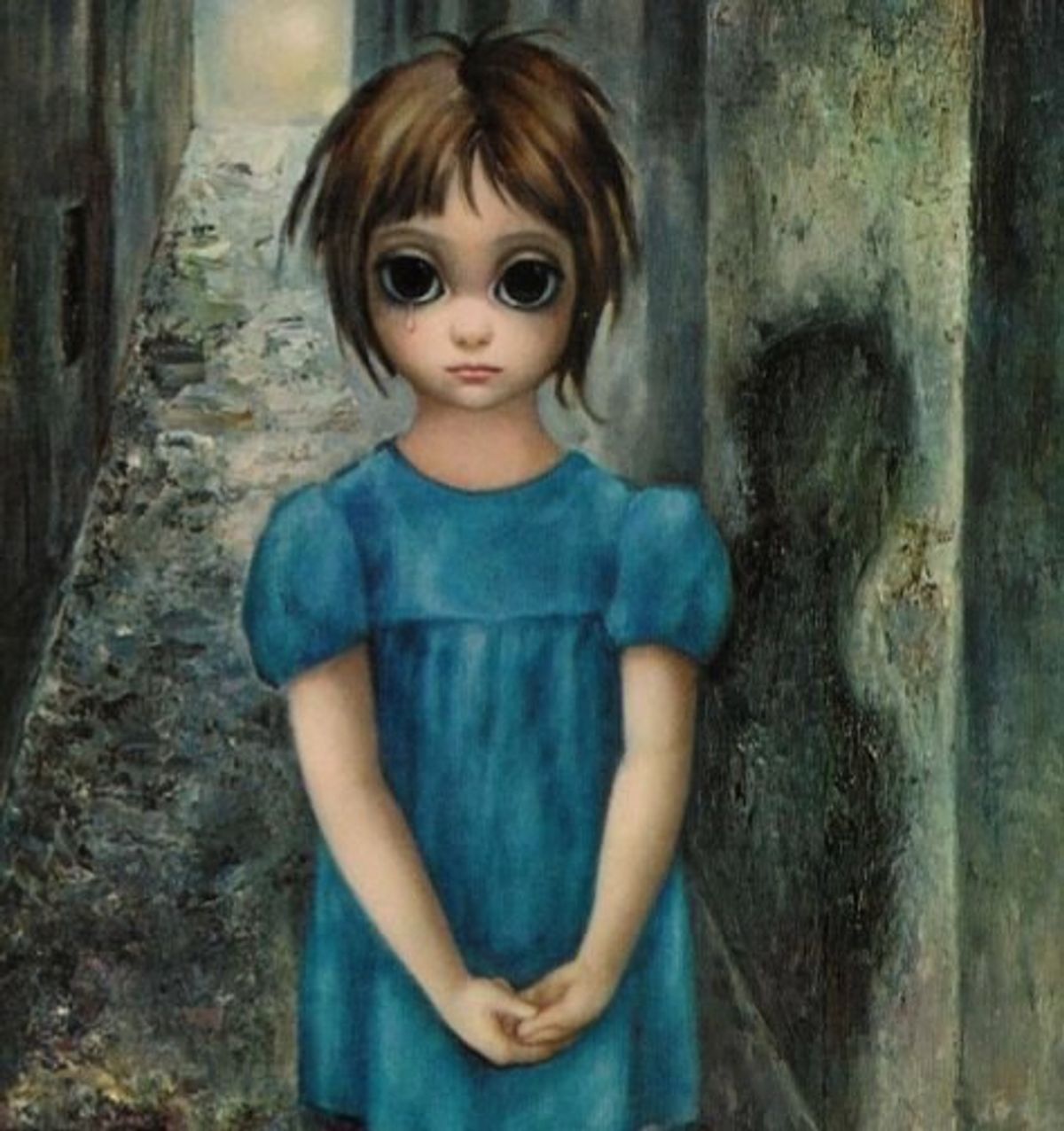
The artist of this painting was Margaret Keane. She was in an abusive relationship with her ex-husband, Walter Keane, who was a con artist. He told her not to tell anyone that she was the artist of the paintings with children who had big eyes. He even threatened to kill her if she did. Out of fear and anger, she locked herself away in her studio to create.
Margaret Keane had painted hundreds of pieces, but never received credit for them because Walter would say he was the “Keane” behind her work. No one thought twice about who was the artist because she would sign her paintings with her married name — his last name, and the thought that women could produce such art was ludicrous.
This went on for years until she had the guts to confront the situation. First, she divorced her con artist of a husband. Second, she took him to court for defamation. During the trial, they were both asked to paint a child with big eyes. Margaret Keane miraculously won the trial, gained about $3 million, and the recognition she rightfully deserved.
I wanted to tell her story for a couple of reasons. First, Margaret Keane is one of my favorite artists, because her paintings speak volumes. Second, her story has a universal lesson in it, making it relevant to everyone who could not and cannot rightfully express himself or herself. Lastly, I believe art holds remarkable messages within its frame.
All of her paintings have one thing in common. Each character she illustrates has enormous eyes. When looking at her art you cannot help but get lost in them. You begin to think about the reason behind those enormous eyes or what the purpose of them being proportionally inaccurate means. These enormous eyes look as though they searching for something no one else can see. It is as though the eyes themselves are asking the viewer a question.
When Margaret Keane was asked about the reason behind the big eyes, she replied, “Gradually it dawned on me that I was painting my own inner emotions. Those children were asking: 'Why are we here? What is life all about? Why is there sadness and injustice?' All those deep questions. Those children were sad because they didn't have the answers. They were searching.” We all ask these foolish questions that have no answers to them. We continue in a repeated cycle of not knowing. Each generation cultivates these types of questions. Each generation ponders about them. Each generation, naïve to a point, leaves these questions unanswered believing the generation after will have the answer to them. However, they do not. These questions we have about life and our existence will continue to haunt humanity, just like the way the enormous eyes will haunt our memories.
Art is created by the imagination. The beauty of it is that art expresses vital ideas or thoughts. Art is a language. It is a language that many of us can understand despite the fact we come from different walks of life. Art is universal. Two different people can view the same painting, and develop different emotions for the piece. However, the next two people who view the same painting may have the same emotion as those before them. A person’s race, culture, and education do not matter when it comes to understanding art. The language art speaks is from emotions. Viewing a piece of art, one is viewing a person’s life and their struggles. Art is all about visualizing your thoughts, which allow you to get a clearer understanding of who you are as an individual. It incorporates mind, body, and spirit as one commodity. Art connects us in unlikely ways through the emotions that were felt as the artist put paint to canvas.
If you want to know more about Margaret Keane’s amazing story, then watch Tim Burton’s film "Big Eyes" with Amy Adams.

















