
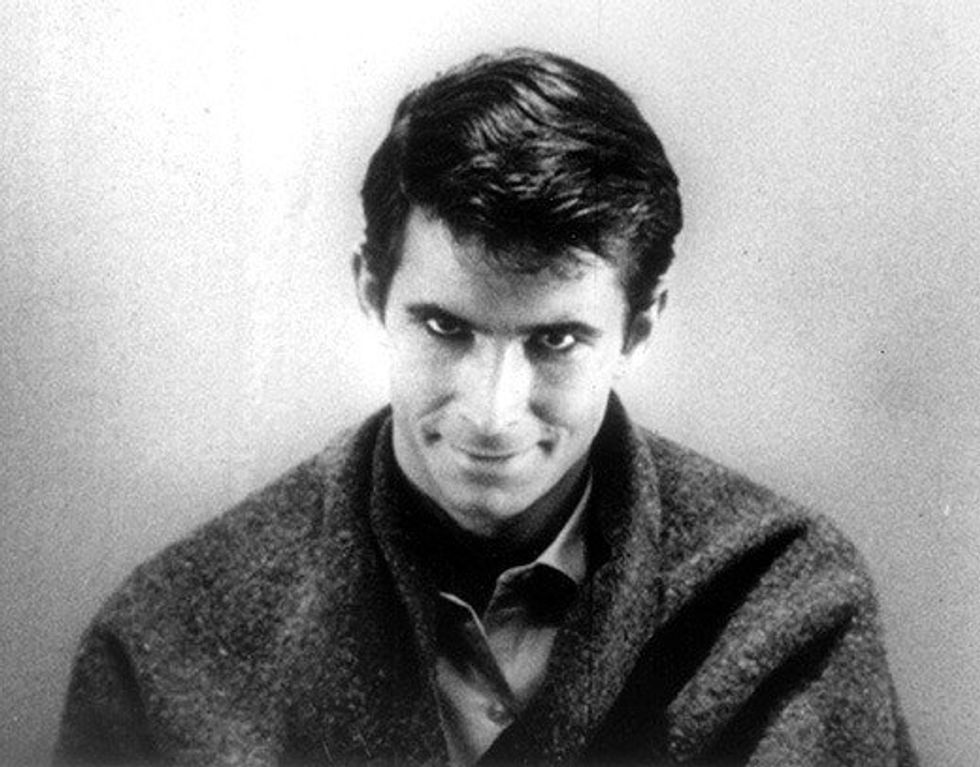
A young man sits wrapped in a blanket in a straight backed chair with the edges of the dark fabric pulled loosely over his whole anterior side. His brow is furrowed in delusional thoughts, his gaze cast listlessly out into space. His right hand is exposed from under the blanket, crossed onto his left thigh, mirroring his right foot crossed over his left. Around him are blank, white walls and matching floors, with a single barred window back behind his left shoulder. This is Norman Bates (played by Anthony Perkins), the serial killer immortalized by Alfred Hitchcock’s landmark 1960 film, Psycho, in the final scene of the work. The scene lasts only about 64 seconds, but is easily one of the most jarring and memorable moments of the entire film. Second perhaps only to the shower scene, and lets the viewer into the head of a possibly schizophrenic and certainly insane killer. The manipulation of camera distance in relation to Bates, when in conjunction with the direction of his gaze, work in orchestrated harmony to get the viewers exactly where Hitchcock wanted them to be in terms of symbolic space, and still works to raise the hair on even contemporary viewers’ necks.
When the scene begins, the camera is sufficiently far away from Bates as to allow his entire body, from the bottom of his shoes to the top of his head, to be in frame. His body is approximately 5/6 the height of the camera shot, and he is situated to the left of center shot, in the second quintant from the left if the shot were divided into five equal quintants. The window encompasses almost the entirety of the fifth quintant from the left, being used only to break up the white floor and walls, giving the scene a better representation of a holding room. As soon as the mother’s voice begins speaking, the camera slowly pans left, bringing Bates closer and closer to the center of the shot, and eliminating the window from view. With the removal of the window from the shot, nothing but Bates, his blanket and his chair are in view, backed by blank whiteness on all sides. It’s not a stretch to be able to see this room morph (symbolically, of course) from a simple holding cell in a police station to an isolation chamber in an insane asylum, and therefore symbolically transforming his blanket into a strait jacket, which is further evidenced by the crossing of his right hand onto the opposite side of his body. The shot continues to close the distance between the viewer and Bates, further bottle-necking the focus of the shot from Bates being isolated in front of a blank background to the bust of Bates as he breaks out into a malevolent smile.
The purpose of these morphing shots is to place the viewer in different symbolic relations to Bates: Firstly, during the opening shot of the scene, the viewer is in a position of power over Bates, seeing him defeated and captured in the holding room where he is literally situated in the story. After that, the viewer is transported to a position of even higher power once the window is removed from the scene, seeing Bates as a subdued psychopath wrapped in a strait jacket, possibly embodying the space of either an asylum handler or psychiatrist. The utter importance of the final shot is revealed through this line of thought, and the final power shift is not one in favor of the viewer. Once all is removed from the shot other than Bates’ shoulders, neck and head, the viewer no longer has any sort of power over Bates; instead, Bates violently jerks the viewer down below the symbolic space of himself, and the viewer only has a few seconds to realize that they now embody the space of one of his victims, staring directly into the smiling mug of their own murderer, before a skull flashes over the face of Bates as the shot fades out into the end scene. Without this manipulation of space, Hitchcock couldn’t have thrust the viewers into such roles as he had, and the eyes of Bates work hand in hand with the aforementioned shot manipulation to reel the viewer into the exact position in which Hitchcock wanted him or her to be.
In the first section of the scene, where Bates still embodies his literal space, his eyes are cast down and to the left of the viewer. (Note: Due to the confusing nature of the duality of the mind of Norman Bates, I will refer to the mother persona using female pronouns. The physical body of Bates will continue to be referred to using male pronouns.) This is a typical sign of embarrassment or defeat, making sense in that he is a prisoner and, according to his delusion, the mother persona’s son is surely to be found guilty of multiple murders. The mother continues to speak of how she couldn’t let the police think she murdered anyone, how Norman was always bad, essentially justifying her reasoning to let Norman take the fall for the murders she had committed. His eyes move for the first time once the camera has stopped zooming into his face. He looks up and over the viewer, moving in an arc from above the left shoulder of the viewer, directly over their head, reaching the space above the right shoulder of the viewer, and then back again, to fall down onto a fly crawling on his hand. The eyes’ movement develops more slowly than the zoom of the camera does, but it still follows the same three symbolic spaces that the aforementioned camera distance did, so this second metamorphosis of the eyes’ movement is a representation of the eye movements of a paranoid mad man, searching for people watching him. Finally, looking up from the fly on his hand as he cracks a smile, Bates makes eye contact with the viewer for the only time in the film, and by doing this, creates a different sort of intimacy with the viewer, putting that viewer much closer to Bates and establishing the reversal of the symbolic power dynamic between the two. Without eye contact, the scene wouldn’t have pulled the viewer in nearly as much, most likely eliciting a much less severe response, but when these eye movements are seen in conjunction with the manipulation of the camera distance, they paint an eerie picture of a man out of his mind.
Hitchcock’s Psycho truly excelled in its utilization of cinematic technique and on-screen acting to manipulate the viewer into falling into symbolic roles, and never was this seen better than in the final scene. While they may do so at different rates, both the camera distance in relation to Bates and his gaze work to take the viewer through a series of three symbolic relationships with the killer, the first of which is a captor/captured relationship, followed by an overseer/patient dynamic after that, and finishes with a victim/killer dichotomy as the scene fades out. This subtle and intricate facet of the film, to me, solidifies Hitchcock as one of the great directors, and also Psycho as one of the great films, in cinematic history.