"NOT THE BEES! NOT THE BEES! AAAAAAH!"
- Nicolas Cage's character in "The Wicker Man"
I am not going to lie — bees kind of scare me due to a few experiences of being stung as a kid. But do you want to know something scarier than bees? No bees. After all, the crop value of bee pollination is about $15 billion, and about 33% of our diet benefits from bee pollination.
That is only one significant reason why beekeepers' reports of unusually high rates of honeybee death in 2006 scared quite a few people. Some said that the situation was a case of Colony Collapse Disorder (CCD), which occurs when most of a colony's worker bees abandon their queen and hive.
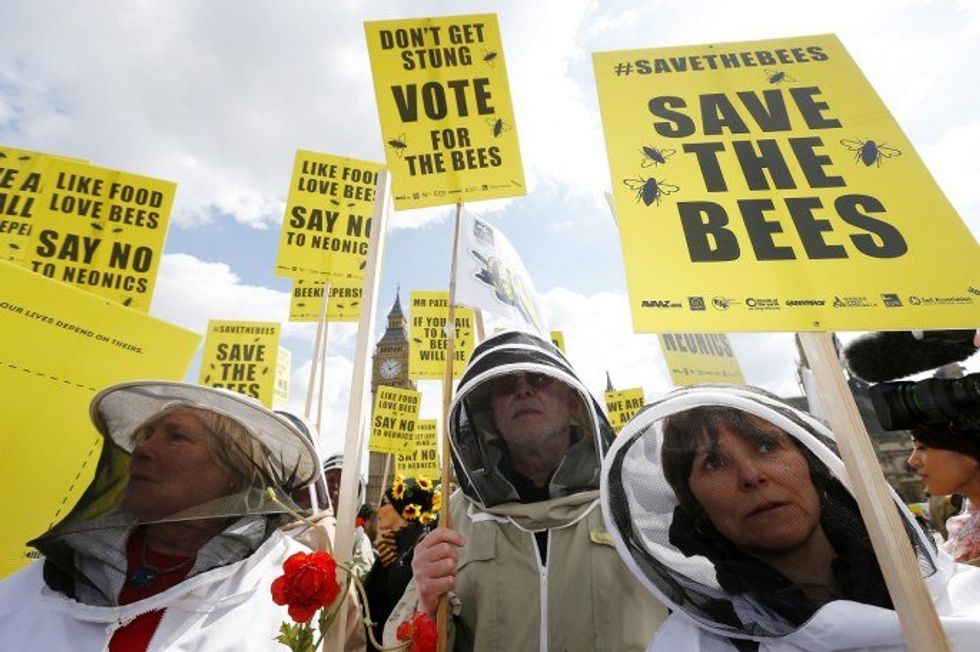
As a result, environmental activist groups all across the nation mobilized to inform the public and combat the apparent "bee-pocalypse" crisis. They have rallied (and still are rallying) against a class of pesticides called neonicotinoids, or "neonics" for short, which they blame for the bee death outbreak. For example, I recently received an email from the League of Conservation Voters entitled "Stop the Bee-pocalypse! Take action now to protect our nation's bees," which said the following:
In recent years, bees have been dying at a record pace in a phenomenon scientists are calling “colony collapse disorder.” The situation is so bad that people have started to dub it the “Bee-pocalypse.” To be clear — this is not a natural occurrence. Scientists believe a deadly class of pesticides known as neonicotinoids are playing a huge role. That’s why we’re targeting the German chemical giant Bayer (yes, the same company you get your aspirin from) — one of the largest producers of neonicotinoids in the world.
One of the strongest pieces of evidence that neonics can have dangerous effects on bees is a 2012 review of the existing research by the Xerces Society. In it, the researchers describe various studies in scientific literature which show the harmful effects neonics can have on bees. However, even in this report, they declare, "There is no direct link demonstrated between neonicotinoids and the honey bee syndrome known as Colony Collapse Disorder (CCD)." This is listed as a "clearly documented fact."
The negative effects neonics have on bees, as described in the Xerces report, may not appear in the field. A 2013 report commissioned by the government of the United Kingdom reviewed almost 40 scientific studies on the subject. The researchers found that, while neonics can be highly toxic to bees in high doses, the honeybees are not exposed to significantly harmful doses under normal circumstances.
In 2014, a study was published by Stewart et al. which surveyed 560 samples across multiple states. They found the same result — neonics in crops were at too low of dosages to harm 95% of the bees in the study. Another study, published by Eston et al. in 2013, found that exposing bees directly to field-realistic dosages of neonics did not cause any adverse effects on brood production.
Researchers are still discovering the true cause of CCD. But it is unlikely that there is a single primary cause. Rather, as described in a 2012 USDA report, CCD is the result of interaction between many factors including pesticides, parasites, genetics, nutrition and diseases caused by certain viruses and bacteria.
So, despite the misplaced enthusiasm and sense of urgency of the activists, it turns out that neonics are not the bad guy here and we probably should not "target" producers of them. Also, it ought to be mentioned that bee death rates are back to normal, even though the lifespan of queens is apparently lower than usual — and researchers are still hard at work finding solutions to new problems as they arise.
For more information on this subject, check out some of the following resources:
Forbes: "Science Collapse Disorder" and "Bee Deaths Reversal" (I highly recommend the second one, since it flipped my position on the issue)
The Scientist: "New Suspect in Bee Colony Collapse"
Entomology Today: "Neonicotinoids Barely Found in Pollen of Seed-treated Plants"
Producer: "Ontario field study finds no link between seed treatments, bee deaths"