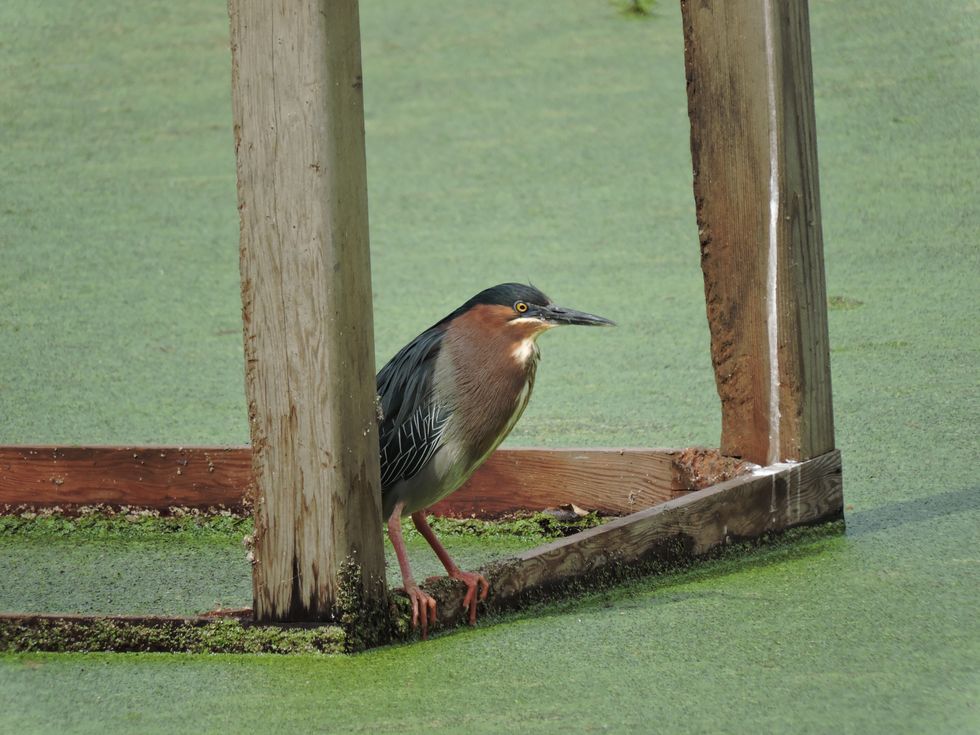
When you think about birding, you might think about people in hiking boots, green or khaki outdoorsy clothes, vests or coats with lots of pockets, huge binoculars (and possibly a camera) slung around the neck, and a small telescope and tripod propped on a shoulder. Not to mention pencils, notebooks, and goodness knows how many field guides. "How can I ever get into birding?" you might ask yourself, since there's so much gear to deal with.
But I'll let you in on a little secret.
You don't actually need any special equipment to start birding. (If you're a birder, awesome! Then you already know this, and probably everything else I'm about to say.)
All you need are a set of functional eyes and/or ears. Whether you're walking to class, or taking your dog around the block, or hiking with your family, birds can be found anywhere—and a surprising number of them can be seen with the naked eye. Even if you don't always see a lot of birds, you're likely to hear them chattering away. Just stay alert!
Of course, you may need help in identifying the birds you see. A nice field guide can be helpful, and if you become serious about birding, I would recommend getting one. However, when you're just getting started, there are plenty of free resources available, such as the Merlin Bird ID app, WhatBird, and All About Birds.
Binoculars are very useful, and if you happen to have a pair lying around your house, great! If not, just focus on identifying the birds you can see up close, and the ones singing in the bushes that you couldn't see anyways. In your backyard, on campus, out the window at work, even at rest stops along the freeway—you can find birds wherever you are.
And guess what? There's not even a huge time commitment for birding. Yes, it is possible to spend hours or days wandering around parks and refuges looking for birds, I'll admit that. Yet by simply training yourself to be more aware of what's out there, you can bird whenever you're outside or near a window.
If, then, you engage in casual birding as you go about your daily routine, there's no need for muted earth tones in your clothing (unless you already like wearing that), and certainly no need for hiking boots (except, you know, if you're hiking or something). Unless you really feel a need to take pictures, don't bother with a camera, and as for a scope, that's a nice bonus, but probably awkward to haul around. I don't even use a spotting scope.
Lists and notebooks and spreadsheets, oh my! Don't let yourself get bogged down worrying about how detailed your lists need to be. I do recommend keeping a life list, because it's fun to track how many species you've seen, but it can be very simple. You can have a little notebook/journal, a note on your phone, or a spreadsheet on your computer, whatever works best for you. At a bare minimum, I would include each species of bird you've seen, along with date and location of your first sighting. You could include more taxonomical info and other random notes about the bird, but that's totally up to you.
If you ever decide to delve more deeply into the birding world, you may decide to invest in some fancier toys and spend more time researching birdy things, but that's not necessary to enjoy the bountiful avifauna around you. Just get out there and bird!