


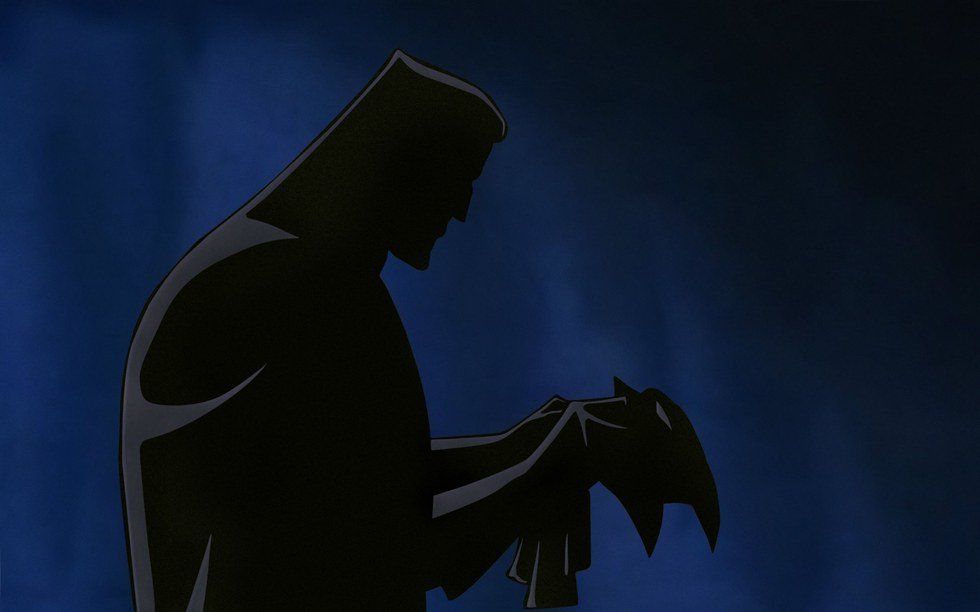
When I was growing up, I was infatuated by the heroics of Batman and Robin. I remember watching them as they glided about Gotham City, taking down the bad guys and saving the day. I read the comics, I saw the shows, and I watched the movies, and even then, Mask of the Phantasm stood out in my head. And I am convinced that even without my bat-laden childhood, I would enjoy this movie.
Phantasm is drawn from and shares many features with the popular 90’s TV show Batman: The Animated Series, but it is not restrained by guidelines the way the show is. Some of the sequences, particularly at the beginning and the end of the movie, are quite violent, and may be a surprise to see from a Batman cartoon. But what the audience must know going into Phantasm is that it is not a typical superhero cartoon. Phantasm takes a much darker look at Bruce Wayne (voiced by Kevin Conroy from the animated series) and the creation of Batman. A look only seen before through Tim Burton’s Batman films. Even the storyline is more adult-oriented.
In Phantasm, the audience experiences Batman in a new way; it’s a love story that follows Bruce Wayne’s relationship with Andrea Beaumont. The two met during a time of doubt and depression in Bruce’s life. He is attempting to create the symbol of fear and vengeance that is Batman and keep the vow he made to avenge his parents. But Andrea steps in his way. In one of the film’s most powerful and memorable scenes, Bruce is standing at his parent’s grave, explaining that he can’t risk his life fighting crime if there is someone waiting for him to come home. Drenched by the rain, he mumbles “I didn’t count on being happy.” In Phantasm, the audience sees Batman at his most human.
Bruce and Andrea share a happy life together. As they travel to the Gotham City’s World Fair, it seems as if their futures (and the city’s) will be bright. But soon after accepting Bruce’s hand in marriage, Andrea flees the country with her father, who has gotten himself tied into a bad business deal with the mob. Bruce is devastated. And it was at this moment he becomes Batman.
Years later, mob members begin getting killed off by a ghostly cape-wearing figure called “The Phantasm,” and Batman is blamed. Now, he not only has to capture the villain to clear his name, he must fend off the police who are now after him, and stop the Joker (voiced by Mark Hamill, who was also the Joker in the TV show) from terrorizing the city. But somehow, these extremely different dilemmas successfully manage to come together in an entertaining way.
The film’s storyline revolves around flashbacks. The placement of these flashbacks is an interesting and yet uncommon concept in superhero movies that I felt added a nice touch to the film. The love story and the Dark Knight’s beginning are interwoven during the film’s present time in which Batman has already been established as both a hero and vigilante. And this technique gives Batman an extra serving of the audience’s sympathy I believe would not have been given if the story had been in chronological order.
Phantasm also looks good on the big screen. It is beautifully drawn, very much like the animated series, and is as visually stimulating as it is emotionally. Mask of the Phantasm is certainly worth watching, Batman fan or not. And its powerful and successful ability to engage its audience makes the film evolve from a cartoon to a motion picture.
















