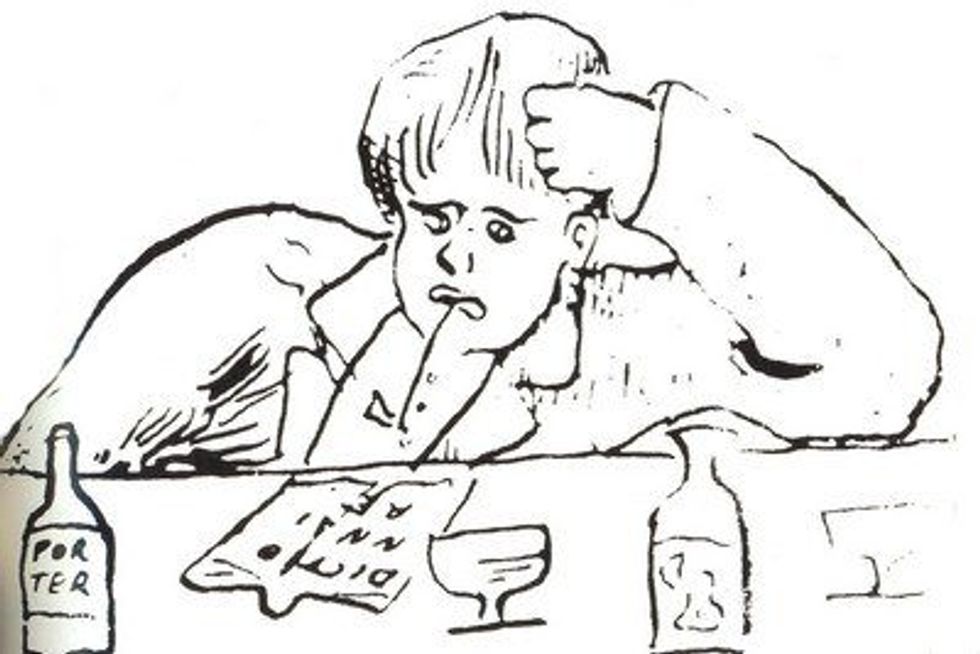
Arthur Rimbaud was a French poet active during the late 1800s. He has gone down in history not only as a young libertine, pursuing freedom and adventure, but also as the founder of the French symbolist movement and one of the first poets to utilize free verse. Artists and writers from Allen Ginsberg to Patti Smith and Jim Morrison cite him as one of their biggest inspirations. Since I discovered him through a mention in a biography of William S. Burroughs, another author, I’ve come to admire his gallant lifestyle and the story through which he became the influential figure he is today.
Rimbaud was born in 1854 in Charleville-Mézières, France, to an ardent Catholic family. His father was an army officer, and spent nearly all of his time abroad. His mother was awful, characterized by early biographers as withdrawn, stubborn and taciturn. Rimbaud privately referred to her as the “mouth of darkness.” In 1862, Madame Rimbaud moved to family to Orleans, fearing that the poor population of their current home would have a bad influence on her children. Here, Arthur and his brother began going to an established school, rather than receiving their lessons at home. He showed signs of rebellion even at this early age, writing a 700 word essay arguing against having to learn Latin in school, but was a well-behaved child, winning academic and religious awards at school.
By age 15, Arthur was beginning to show the signs of maturing as a poet. One of his first poems he presented to his rhetoric teacher, "Ophélie," went on to be included in most of his post-mortem anthologies. However, something changed in the previously mild-mannered young man. In 1870, his school was converted to a military hospital, so Arthur snuck onto a train to Paris. Upon arrival, he was arrested for fare evasion. His mentor, Georges Izambard, bailed him out and, after allowing a brief stay in Paris, sent him back home. Ten days later, Rimbaud ran away again. He began to grow his hair long, speak rudely, write obscene poetry, steal books from the local shop, and consume large amounts of alcohol all in the pursuit of “long, intimidating, immense and rational derangement of all the senses” (Rimbaud), which he believed to be essential to the creation of the poet’s persona.
Arthur wrote to several poets, but heard back only from Paul Verlaine, who would go on to be an important symbolist poet. Verlaine invited Rimbaud to come live with him in Paris. Here, the two poets began a short but heated affair, fueled by absinthe and hashish. The Parisian literary circles were shocked by Rimbaud’s behavior. He began to churn out great volumes of work during this time. In 1872, Verlaine and Rimbaud moved to London, where Rimbaud could be found working in the reading room of the British museum because pens, paper, and lighting were all free. During their time in London, the two poet’s relationship became increasingly bitter. Verlaine returned to Paris, but soon regretted his decision and asked Rimbaud to meet him at a hotel in Brussels. Here, in a drunken rage, Verlaine shot at Rimbaud twice with a pistol, wounding him in the wrist. Rimbaud had his wound attended to and did not initially place charges. However, while Verlaine and his mother were walking Rimbaud to the train station, Arthur was alarmed by Verlaine’s erratic behavior. He ran to a police officer and begged him to arrest Verlaine. Verlaine went on to spend two years in prison after an investigation into his attempted murder and past relationship with Rimbaud. The two met for the last time in 1875, in Stuttgart, Germany.
Arthur went on to live the life of an adventurer, first enlisting in the Dutch Colonial Army to obtain free passage to Indonesia, where he deserted. He soon managed to return to France without being discovered and shot for his desertion. Rimbaud then travelled to Cyprus, Greece, where he worked in a stone quarry. In Cyprus, he caught typhoid and returned to France. Upon his recovery, Arthur moved to Aden, Yemen, as an employee of the Bardey Agency. Within a year he left that job to become a merchant of coffee and firearms. In 1891, Rimbaud returned again to France due to a pain in his right knee. After an incorrect first diagnosis followed by an amputation, he was diagnosed with bone cancer. He was dead within the year.
The bulk of Rimbaud’s work was completely unknown until Verlaine published an 1895 anthology in honor of his dead ex-lover. His poetic philosophy can be summed up in this quote, from a letter to his teacher, Izambard:
“I'm now making myself as scummy as I can. Why? I want to be a poet, and I'm working at turning myself into a seer. You won't understand any of this, and I'm almost incapable of explaining it to you. The idea is to reach the unknown by the derangement of all the senses. It involves enormous suffering, but one must be strong and be a born poet. It's really not my fault.” (Rimbaud)
This style went on to inspire Lucian Carr’s “New Vision,” a set of statements regarding art and poetry that were central to the establishment of the Beat Generation. Dozens of other famous writers, poets, artists, and musicians mark Rimbaud as one of their influences. Many a writer and college student today has heard of “write drunk, edit sober” as a fix for when they’re experiencing a bad case of writer’s block. To me, Rimbaud is an example of living a torrid, beautiful youth while still managing to establish a decent life for oneself later on. If you’ve stuck with me through this whole article, I hope you too are inspired to do the same.