Perhaps the most uniting and yet universally divisive aspect of the human condition inside a fragmented world is suffering. Everyone suffers in some way, but there remain certain instances of suffering which should be intolerable to Christians. These are those born out of injustice and prejudice. After “the fall,” the harmony and unity humans were created to live in became corrupted. Rather than living in equal relationship with each other and being free for one another, humanity turned towards the individual. This shift caused people to strive to prove their own humanity and superiority by dehumanizing others in a hierarchal society. This moment was the birth of injustice. Viewing “Tortured Christ” and exploring the theological assertions it makes allows us to make claims about who God is and who we are. This is a Christ who is not against anyone, but who was and who remains, wholly against injustice; a Christ who was crucified not only by individual sin, but by the state and powers of the world. If God is a just God, the cross must make an accusation against the iniquities of society.
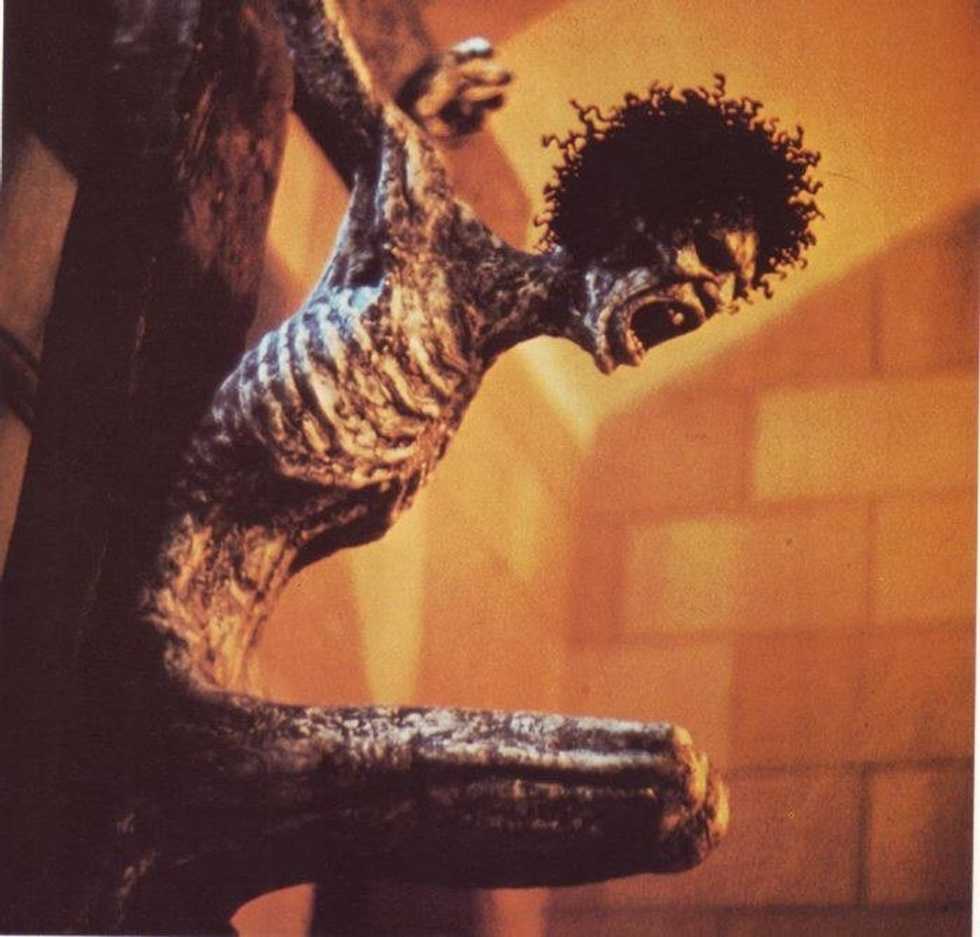
Even at first glance, Guido Rocha’s “Tortured Christ” (pictured above) is a unique depiction of Christ’s suffering during the crucifixion. Here, unlike more traditional depictions of the crucifixion which might show a bleeding and wounded Christ with his head hanging low (example), Rocha has sculpted an emaciated Christ pushing himself off of the cross to look down at his tormentors. This Christ is sunk down, his bony knees protruding from the cross with accusation. His arms are long and straining to push his body outward. His agony is clearly shown, but his mouth, open in a wild yell, also suggests the righteous anger he feels towards his persecutors and the corruption of the church and the state which are crucifying him. Rather than looking ethereal or transcendently peaceful, this image of Christ is a snapshot of the dark reality of the crucifixion through Rocha’s artistic lens. Because this artwork is not dogma, but is clearly theological, it is essential to understand what theological questions this piece is speaking to. To do so requires recognition of the origin of these questions in contextual theology. That is, it is necessary to understand the artist behind the lens in order to grasp the deeper theological meaning of this model of Christ.
In Walter Altmann’s essay, “Is There Hope in the Midst of Suffering? Images of Christ in Latin America”, Altmann defines what suffering is in a theological context. He asserts that suffering itself is meaningless apart from the meaning that may be bestowed upon it. He goes on to argue that there are two types of suffering: unnatural suffering that is outside of God’s will and which is the result of injustice, and suffering which is deliberately endured in order to demolish the unjust suffering and is thereby within God’s will. This distinction is the premise for a school of theology known as Liberation Theology. Liberation Theology in Latin America grew out of the deficit left by the two primary pictures of Christ. One of these is of a dead Jesus who is broken and powerless; the other is of a celestial monarch who clearly correlates holiness with wealth and power. Liberation Theology presents a picture of Jesus as someone who identifies with the poor and needy but rejects rather than endures oppression in a powerful way.
Liberation Theology gives light to “Tortured Christ.” Guido Rocha’s portrayal of Christ is deeply rooted in his Brazilian heritage. His depicts Christ as dark-skinned with the dark, curly hair of a Brazilian to emphasize who Christ represents to him: the people. This striking portrayal of a hurting, but powerful and indignant Jesus speaks to Rocha’s own suffering under the corrupt governments of Latin America. He shows a Christ that is not passively accepting his fate, but is actively choosing to sustain it while vigorously pushing against the injustice. Rocha’s Jesus is suffering, but is not defeated.
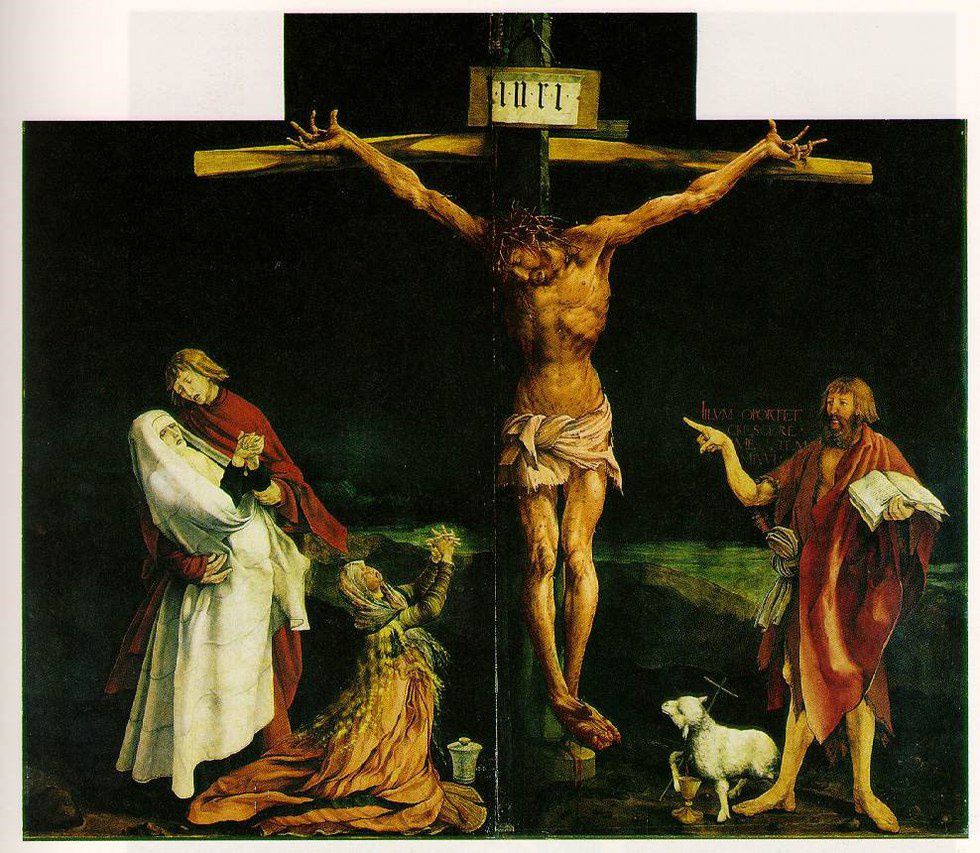
Matthias Grünewald painted the Isenheim Altarpiece (pictured below) in 1515 long before Rocha began exploring Liberation Theology. This piece shows a Christ who is a giant relative to the bystanders pictured in the foreground. But more importantly, this piece shows a Christ who is suffering deeply, not only the anguish of crucifixion, but of skin sores like those of a leper. This altarpiece was created for the Monastery of St. Anthony which served as a hospital and a refuge for lepers and victims of the plague and other skin diseases. The people who would worship at this altar endured more than just physical malady – these were outcasts of society, people who were ostracized because of their condition. By showing a Christ who bore similar marks, Grünewald was relaying to the viewers that Christ identified with both their health conditions and their status in society. Because of hypostasis and the two natures of Jesus being fully intertwined, everything Jesus the person endured during his life, God also touched. Saint Bonaventure describes this by introducing the concept of submersion as means of understanding Christ’s suffering and redemptive works. That which Jesus assumes, he saves.
As Christ became fully immersed in the aphotic waters of human suffering, humanity was redeemed and death lost its hold on humanity. Saint Bonaventure wrote in “The Tree of Life”, “He who is God blessed above all things is totally submerged in the waters of suffering from the sole of the foot to the top of the head, in order that he might draw you out from these sufferings”. The event Rocha is depicting in “Tortured Christ” and which Grünewald shows in the Isenheim Altarpiece is a moment of liberation. Jesus’ cross illuminates the journey through suffering. His resurrection serves as a sign of reconciliation and repair of the brokenness.
Rocha’s “Tortured Christ” is a visual commentary on social injustice and the suffering which ensues. His God is one who does not abide by the mistreatment of other people and who willfully endures suffering in order to bring about an end to the injustice. Frederick Douglas writes “To be the friend of the one, is of necessity to be the enemy of the other. I love the pure, peaceable, and impartial Christianity of Christ: I therefore hate the corrupt, slaveholding, women-whipping, cradle-plundering, partial and hypocritical Christianity of this land.” Because God is a God who loves justice and equality, he must be the enemy of discrimination, of persecution and of the inequality of the status quo. Injustice anywhere is a violation of the solidarity pact that is assumed by being a member of the human race and should be treated with all the disdain it deserves.
Injustice is not confined to ancient times, or Latin America or European monasteries, but is something that touches every part of our daily lives. Injustice exists in the persistence of racism and social segregation. It exists in the margin of difference between what a man is paid and what a woman is paid. It is responsible for the mistreatment of children and the abuse of the elderly. Injustice takes advantage of its neighbor and condemns those in its care to a life of hardship and misery. Injustice plays a role in all suffering. Even so, returning to the wise words of Walter Altmann, this can by no means signify that we will accept passively the reality of meaningless suffering. On the contrary, the existence of suffering of this kind is a permanent call to overcome the causes of suffering and, when this is not possible, to express a compassionate solidarity with those who have to bear suffering.”