


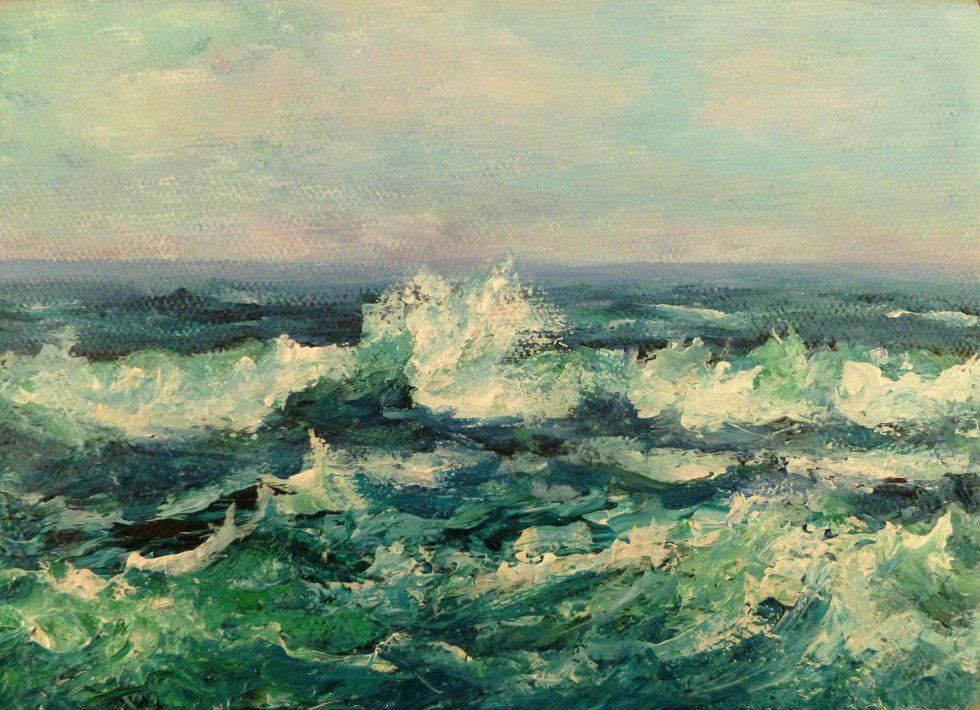
“Ars gratia artis!” “L’art pour l’art!” Art for art’s sake!
There’s something so deliciously rebellious about that phrase. In the nineteenth century, this cry erupted from a group of artists who defied the notion that art must serve a didactic or moral purpose. Why must art have an agenda, they asked. Their response was that art can—in fact must—exist without a preconceived purpose. In other words, a work of art was not a tool by which the artist made some argument or point. Rather, the work of art was an end in and of itself. Call a rose by whatever name you want, but don’t dare demand of it a purpose. Its artistic beauty is justified merely by its existence, and it needs no reason for being.
However empty or idle the phrase may seem when we really ponder it, I think it is attractive at first glance because it is bold and unapologetic. Young people especially, I imagine, like the sound of it, for they grow weary of trying to justify their choices to parents and professors and future employers. How wonderful would it be to say that your choices don’t need a reason, that they don’t need justification? To say that they exist for their own sake, they are good in and of themselves, and no one has a right to question their purpose or value—it seems like a breath of fresh air.
Perhaps, too, those who spend time either creating art or appreciating it—I’m speaking to the painters, writers, museum-fanatics, and avid readers—feel a bit defensive about spending so much time on things that do not have a practical purpose. In a culture where we are encouraged to show something for our work and make a case for why the work was worth the time and money, a pursuit of impractical activity seems silly and stupid. You spend three years studying tribal rituals and religious culture in Zambia, you come back to the states and apply for a job in a marketing firm, and when the hiring manager asks you to explain why those three years were a good decision, you feel a bit impotent.
The answer, of course, is that it was enriching. It was something interesting, something that fulfilled you personally, and when you set out on that journey, you weren’t thinking about how it could help your career. But in this moment, sitting before a table of suits who are all asking you to explain yourself, the phrase, “art for art's sake" seems a bit glib and threadbare.
We must ask ourselves whether the great amount of time we spend making art and appreciating it is worth anything? It rarely serves any practical purpose. Is it worth our time and energy and money? What is gained, after all?
I look to two old guys for my answer: C.S. Lewis and Rev. Frederick Buechner. In his essay, “The Weight of Glory,” Lewis addresses “the view that human culture is an inexcusable frivolity.” “I reject at once,” he writes, “an idea which lingers in the mind of some modern people that cultural activities are in their own right spiritual and meritorious.” So much for art for art’s sake. Though Lewis is writing from a Christian position, he does not argue that art created by a Christian must serve a Christian purpose. “By leading [a] life to the glory of God I do not, of course, mean any attempt to make our intellectual inquiries work out to edifying conclusions.” That is, if you are a Christian painter, you must not feel compelled to paint only scenes from the Bible. If you are a shoe-maker, there’s no compulsion to put a cross instead of a swoosh on your running shoes. This is to miss the point entirely.
What Lewis means is “the pursuit of knowledge and beauty, in a sense, for their own sake, but in a sense which does not exclude their being for God’s sake. … We can, therefore, pursue knowledge as such, and beauty as such, in the sure confidence that by so doing we are either advancing to the vision of God ourselves or indirectly helping others to do so.” The claim is this: For a Christian, art need not be “Christianized” in order to be justified. If your painting of a child making a sandcastle or my novel about two brothers fighting together in WWII somehow helps us (the artists) or our appreciators (the viewers/readers) see God, then the work is wondrous in God’s sight. Why? I turn to Frederick Buechner for the answer.
For the Westminster Town Hall Forum on May 18, 1988, Buechner gave a talk on art and religion. It was a thirty-minute speech that seemed half-lecture, half-sermon, and it is one of the most illuminating and thought-provoking things I’ve ever heard. I encourage you to seek it out (It’s easy to find on iTunes Podcasts). He argues that literature, art, music, and the other “sisters of the arts” all seem to be asking, at the very least, that we stop, look, and listen. "Art makes noticers of us--attention-payers of us."
A painting by Rembrandt asks you to stop and truly notice the face of an old woman—a face that might give you no pause if you saw it on the bus or in the grocery store but which, because it is framed and hung against a blank white wall, demands that you see it more intensely than you may have ever seen a face before. He draws your attention to the wrinkles, the skin tone, the eyes wise with a lifetime of experience. A symphony by Beethoven asks you to “keep time,” as the musical phrase goes—to listen to the difference in woodwind, string, and piano. A play by Shakespeare with its strange, sometimes maddening syntax, asks you to hear the pathetic cries of the grieved and the triumphant resilience of the human spirit in the face of hardship.
These artists teach us to hear, they teach us to see. Books make us realize the incredible hurricane of thoughts that stir behind every pair of eyes. Paintings help us see the details of every different face, and they make us appreciate the sheer variety of forms not only within the human species but within the natural world and even the creations of humankind. Music teaches our ears to appreciate various sounds, and in a strange way, especially for those who learn to read notes and play an instrument, music teaches us about time. It teaches us to keep up with it, to appreciate it, to remember where we’ve been, where we’re going, and to notice refrains.
Buechner’s argument is that faith in God asks just what Rembrandt and Beethoven and Shakespeare ask—that is, to stop, look, and listen. Stop and notice the people around you in their glorious diversity and complexity. Listen to their stories, to the emotion behind their voice. Look into their eyes and see not just a supporting actor or “extra” in the movie that is “Your Life,” but rather see immortal beings, capable of greatness. Even if they never write great books, cure rampant diseases, or become powerful politicians, the people around you have it within their power to draw from the lips of the Most High, “Well done, my good and faithful servant.” Even the most seemingly insignificant person has the potential to find God, love him, serve him faithfully, and to ultimately draw a beaming smile of acceptance and love from that face that is like the Sun to look upon. This is a great power your fellow humans possess, and if you can see people like that—the way I imagine Jesus saw people when he was walking the earth—then you will begin to love people the way Jesus did.
Art teaches us to see our fellow men and women. By seeing them, we are better able to love them. And then, of course, the more we love them, the better we are able to see them. Art doesn’t need to be “Christian,” in fact it need not serve a practical purpose at all. But if it helps to train our eyes and ears and minds in the lifelong pursuit of vision, and if that increasingly clear vision helps us to see God and to see other people, then time spent with art is, in Buechner’s phrasing, “time richly spent; even, in the truest sense of the word, holy time.”

















