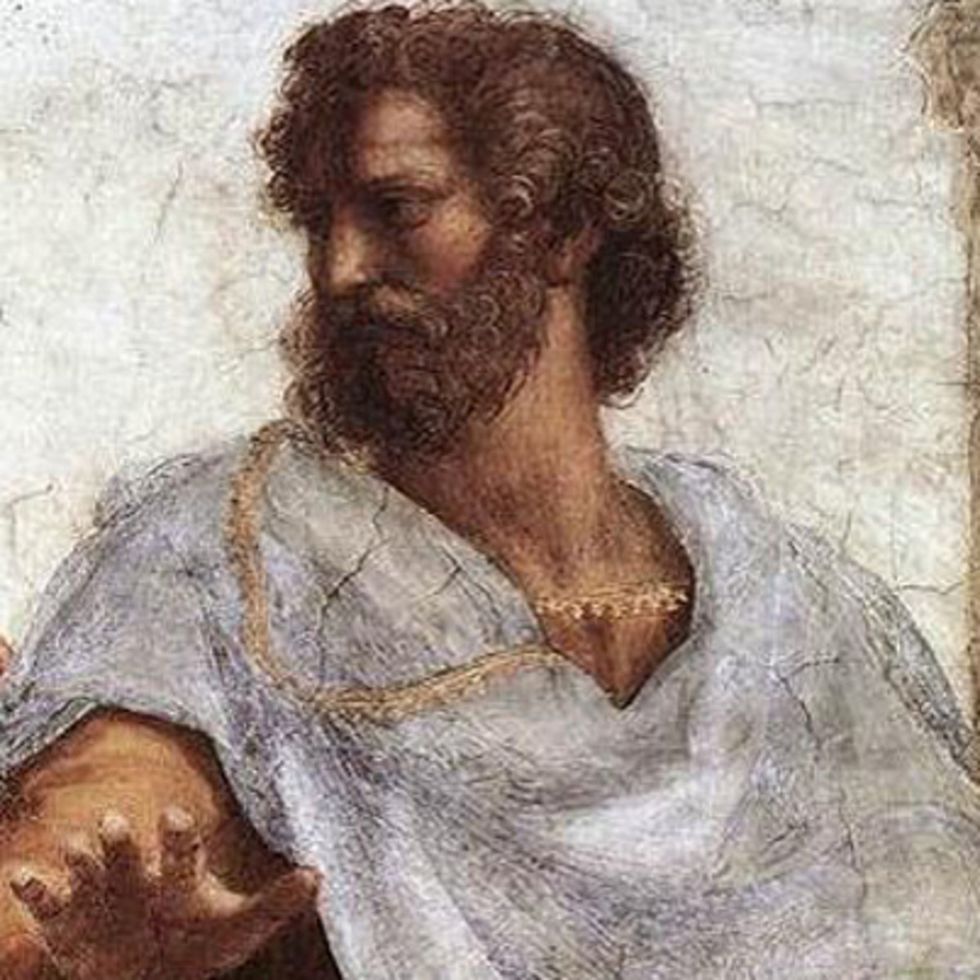
For years, I have been fascinated by the distinct and yet intrinsic rivalry between Aristotle and Plato. Indeed, the differences between them both in giving explanations for how we understand reality and from what context must we aim to understand it could in effect provide some kind of “civil war of philosophical inquiry”. From whose premise does more sound logic identify with? I leave such a question for each of my classmates to consider. But for the sake of this post, I will discourse on some of the intrinsic differences between Aristotle and Plato and then briefly discuss some of the similarities and differences between Aristotle and the Presocratics.
For purposes of simplification, Plato’s entire concept of nature could be seen as an inside/out approach while Aristotle’s theory could be deemed more as an outside/in approach, specifically with regards to how we understand the Forms.
For Plato, our understanding of reality comes from shadowy representations that do not represent the things in and of themselves. In other words, when we look at an object, we look at it merely as an artistic representation of that object, and our views of reality are shaped primarily by these representations and imitations only. This kind of view can be likened to Plato’s usage of the Cave Allegory to describe humanity being like prisoners bound to a wall staring at shadows of objects, which would then be our reality. In essence, the Forms take on physical forms in the physical world that imitate the original Forms, but don’t properly embody them. Plato asserts that the Forms in and of themselves are separate from the “beings” to which they posit their defining characteristics.
Aristotle, by contrast, rejected this idea by positing that the physical objects are forms in and of themselves and should be understood in the context of their functions. In other words, beings and human beings can be considered as primary examples of the original forms. These “examples” are different to one another, as he would note, and our understanding of nature comes from recognizing the differences of each individual thing. Directly contrasting Plato, Aristotle posits that the separation between the Forms and beings is virtually non-existent. Sensible objects that have developed through a changing process are rightly considered to be the “forms” in and of themselves, in-separate to one another.
Plato, like Socrates, concerned himself with the things that are common to all things. Such inquiries can be posed in the form of questions such as: What makes actions just? What makes things beautiful? What makes things good? In essence, Plato wanted to understand what in fact are the transcendent realities that are common to all things but he didn’t put primary focus on the “things” themselves that are influenced by the transcendent realities. Further analyzed, Plato seems to have conjectured that there exists a reality of “being” that dwells outside of the world of “becoming” and yet has influence on it.
Aristotle, being a biologist in his own right, made his main concern the understanding of entities in nature in the contexts of their forms. In other words, a human being and an animal would both be considered cardinal examples of their respective forms. Its functions and what they accomplish in respect to their forms are proofs of this. For Aristotle, the context of nature should be understood in what things “grow into”, not where they are “growing from”. For example, for a bed to become a bed, it requires form. This form, in the context of all other things is considered to be nature. For Aristotle, refuting Plato, there exists no state of being outside of the world of “becoming”. Things in reality could properly be identified as forms in and of themselves.
Now that we have highlighted some of the intrinsic differences between Aristotle and Plato, let us take a quick look at some of the similarities and differences that define the relationship between Aristotle and the Presocratics.
With regards to the Presocratics, many of them considered reality to be recognized at the irreducibly microscopic level, and these specific elements are what is common to all things. In other words, when taking all “beings” down to their microscopic levels, we find an irreducible element, which is common to all things. This explains why a thinker like Democritus would posit that there are essentially no differences between the human being and the insect at the atomic level. For Democritus, everything in reality was comprised of atoms that assembled in different ways to create sensible objects and would then detract and assemble again to give the appearance of “different objects”. However, at the atomic level, everything is essentially the same. For Thales, as another example, “water” was the essence of all things at the micro-level. Anaximenes, as yet another example, posited that “air” was the essence of all things. The common idea amongst all the Presocratics was their emphasis on the “arche” or first principle of matter by which everything else in reality is birthed from.
Aristotle by contrast rejected this notion by positing that the basic element to nature is in fact forms as opposed to matter. Unlike the Presocratics, Aristotle didn’t believe in the notion that at the micro-level, all things are essentially comprised of the same basic materials. “Beings” and “objects”, he would incur, are separate and distinct to one another in form. These forms are the result of a changing process, and Aristotle thought it best that primary emphasis be placed on the “finalized product” of this changing process. The functions of each “thing” define its “species”, distinguishing it from other “things”. The “principle of the changing process” is an internal force, in which form is imposed on certain things to turn them into other things (ex. Wood being imposed by form to make a bed).
However, for all the critique, Aristotle’s theory of Causes could be determined to have similarities with the Presocratics’ diverse theories on causation. Specifically, Aristotle posited that in order to know a “thing”, we would have to answer 4 critical questions of causes: What is it made out of? What are its defining characteristics? Who made it? What is it for? It is only when we are able to answer these questions, according to Aristotle, that we can be determined to truly possess knowledge of a thing. Material, efficient and formal causations seem to be the dynamic features of Aristotle’s theory. What is interesting about this is that he has implied that his notion of these various forms of causation were inherited directly from the Presocratics.
These intrinsic questions of causation can be traced directly back to the Presocratics, who themselves were already grappling over the aspects of material and efficient causes for reality. For example, Anaxagoras and Xenophenes posited the concept that “mind is moving all things”, putting emphasis on efficient causation. Materialists like Thales and Anaximenes, in their respective competing theories about “water” or “air” being the first principle to reality, set the foundation for Aristotle’s notion on material causation. It is also interesting to note that Aristotle’s notion of “Forms”, although not taken from the Presocratics, was influenced by Plato’s theory of “forms”, though their perspectives on the “forms” differed greatly.
Instead of isolating the questions of inquiry, Aristotle grouped all questions of causations into a litmus test for knowledge, adding one more question of causation (final causation) to draw focus on the functions of “things”, which he would posit is one of the most important aspects of a “thing”. If one cannot determine an object’s function, would it stand to reason that we know it at all?
So what can we conclude from all this? It is pretty clear that Aristotle was both heavily influenced and heavily critical of Plato and the earlier Preoscratics in their own individual theories. However, their influence on Aristotle attributed greatly to how he constructed his own understanding of how reality should be understood in terms of material, efficient, formal and final causation. He may have used his position to dispense with the idea that all things broken down are the same on the micro-level and with Plato’s theory that all things are merely imitations of the actual Forms, but it can’t go without saying that each and every primitive theory, as is evident in his writings, was pertinent to how he developed his own understanding of reality, which in my opinion proves to be the more superior world-view.
Joseph Vazquez III